TIFF Impact Day: Learning, Leadership, and Mission in Action

TIFF held Impact Day on Tuesday, November 4, 2026, bringing our team together for a series of inspiring conversations with leaders across sectors — from technology and education to philanthropy and conservation. The day underscored TIFF’s commitment to learning from organizations driving meaningful change, deepening our understanding of the impact they aim to achieve, and exploring how we can translate those insights into our own work and communities. Here are some of the highlights from each of the day’s speakers.

Matt Gillin, Relay Network
Matt discussed his journey as an entrepreneur, from his family’s influence to founding two successful companies. He emphasized the importance of believing in your mission, staying agile, and harnessing artificial intelligence (AI) to amplify — not replace — human potential. Matt described AI as a platform shift unlike any we’ve seen before and reminded us that while the greatest risk may be not deploying AI fast enough, it’s ultimately human creativity and curiosity that move organizations forward.

Kerry Woodward, Philadelphia Financial Scholars
Kerry spoke about expanding access to personal finance education for Philadelphia students by equipping educators and bringing practical, classroom-ready resources to schools. She also highlighted the PFS Summer Experienceship, which provides students with real-world exposure, skill-building, and mentorship across local organizations, helping them grow financial confidence and envision pathways into future careers.

Keith Palmer, Travis Manion Foundation
Keith shared powerful lessons on leadership and teamwork drawn from his service in the Marine Corps and his work supporting veterans and families of the fallen and mentoring young people. He reminded us that effective leadership starts with “mission first, people always” — an understanding that you can’t accomplish the mission without investing in your people. Anchored in the Foundation’s guiding principle, “If Not Me, Then Who…,” Keith spoke about the importance of mentorship, community engagement, and collaboration as the true drivers of meaningful leadership and impact.

Oliver Bass, Natural Lands Trust
Oliver shared reflections from his 28-year career at Natural Lands Trust, highlighting how the organization’s endowment provides the financial stability needed to pursue mission-critical work — from protecting open spaces and managing development pressures to restoring wildlife habitats. He spoke about how the nature of conservation challenges has evolved, even as the organization’s purpose remains constant, and emphasized that strong financial partnerships make it possible to achieve long-term environmental impact.

A Commitment to Promoting Exchange

Impact Day is born out of one of TIFF’s most fundamental beliefs: that continual learning and open exchange strengthen how we serve our clients. By embracing broad perspectives, we challenge ourselves to think more creatively and to deepen our impact on the communities and missions we support. We’re grateful to each of the speakers for their insightful stories and contributions.

The materials are being provided for informational purposes only and constitute neither an offer to sell nor a solicitation of an offer to buy securities. These materials also do not constitute an offer or advertisement of TIFF’s investment advisory services or investment, legal or tax advice. Opinions expressed herein are those of TIFF and are not a recommendation to buy or sell any securities.

These materials may contain forward-looking statements relating to future events. In some cases, you can identify forward-looking statements by terminology such as “may,” “will,” “should,” “expect,” “plan,” “intend,” “anticipate,” “believe,” “estimate,” “predict,” “potential,” or “continue,” the negative of such terms or other comparable terminology. Although TIFF believes the expectations reflected in the forward-looking statements are reasonable, future results cannot be guaranteed.
Real-World Lessons in Nonprofit AI Adoption

Artificial Intelligence is transforming how nonprofits operate, communicate, and deliver services.

According to The State of AI in Nonprofits 2025 report by Tech Soup and Tapp Network, “85% of nonprofits have a high interest in tools like Generative AI and Predictive Analysis.” Adoption, however, is uneven. While many leaders see its potential, many organizations lack the staffing, funding, or policies necessary for thoughtful AI adoption.

Consider these realities, from The State of AI in Nonprofits 2025 report:

  • 76% of nonprofits do not have an AI strategy
  • 42% of nonprofits have one to two staff learning to use AI
  • 43% of nonprofits rely on one staff member to make IT and AI decisions
  • 80% of organizations do not have an AI-acceptable use policy

If this sounds familiar, you are not alone.

Join us on Wednesday, November 19 from 12:00 – 12:40 PM EST for the webinar, How to Adopt AI in Your Nonprofit with Real-World Lessons. Anne Duggan, Managing Director, Client CIO Group at TIFF will be joined by Ebonie Johnson Cooper, Faculty Director, Nonprofit Executive Education & Training, The Do Good Institute at the University of Maryland, Remy Reya, Director of AI & Thought Leadership of Compass Pro Bono, and Beverly Ross, Program Director, Compass Pro Bono. Drawing on the real experience of Compass Pro Bono’s own AI journey, you will learn what worked, what didn’t, and key insights to apply to your organization. With an emphasis on change management, this webinar will appeal to early adopters and skeptics alike.

This session will help you:

  • Identify where AI can have the greatest impact in your operations
  • Ask the right strategic questions to guide your team
  • Build a roadmap that empowers your staff

Register today to take a proactive and responsible approach to integrating AI into your organization.

The materials are being provided for informational purposes only and constitute neither an offer to sell nor a solicitation of an offer to buy securities. These materials also do not constitute an offer or advertisement of TIFF’s investment advisory services or investment, legal or tax advice. Opinions expressed herein are those of TIFF and are not a recommendation to buy or sell any securities.

These materials may contain forward-looking statements relating to future events. In some cases, you can identify forward-looking statements by terminology such as “may,” “will,” “should,” “expect,” “plan,” “intend,” “anticipate,” “believe,” “estimate,” “predict,” “potential,” or “continue,” the negative of such terms or other comparable terminology. Although TIFF believes the expectations reflected in the forward-looking statements are reasonable, future results cannot be guaranteed.
Client Management
Ashley Tate
Client Services Associate

Ashley Tate joined TIFF in 2025 as an Associate in the Client Service team.

Prior to working at TIFF, Ashley began her career with Tate & Kirlin as an Account Representative managing delinquent accounts. She then transitioned to a Financial Planning Associate with Northwestern Mutual, where she focused on financial planning modeling and trading, building a foundation in client advisory and compliance. She then served as the Director of Operations for Lewis Financial, overseeing client relationship management of High Net Worth individuals and organizations, with a focus on improving team efficiency and restructuring processes.

Ashley earned her BA in International Affairs, magna cum laude, from The George Washington University.

More Team Members
Alexander Barenboim
Client CIO Group Analyst
Amy Paterson
Associate Director, Marketing and Communications
Angela Yu
Associate Director, Client Service
Anne Duggan, CAIA
Managing Director, Client CIO Group
Work With Us
If you are interested in working with us, please check out our current openings.
FY25 Performance Drivers: Insights from the Biggest University Endowments

October is when the biggest university endowments − those with over $1B − share their annual investment results. From these early reports, we can glean what performance drivers we will see, ahead of the full NACUBO-Commonfund Study of Endowments, which comes out in February 2026.

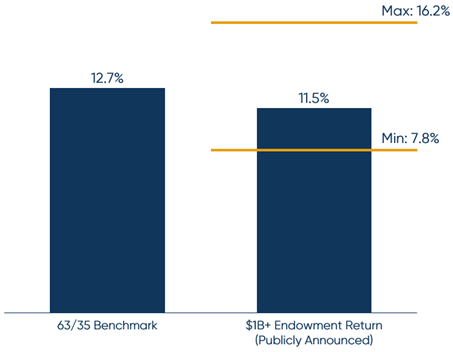
The average return of $1B+ university and college endowments that publicly announce is 11.5% vs. 12.7% for the 65% MSCI ACWI / 35% Bloomberg Agg. This represents the second consecutive year of double-digit gains, following an 11.2% average 1-year performance for all institutions in FY24, per the NACUBO-Commonfund Study of Endowments. However, the trends of what drove performance have shifted in FY25.

FY25 Endowment Returns


FY25 Endowment Returns
Source: Endowment returns as reported by Pensions & Investments, as of October 29, 2025. Represents 40 university and college endowments. 65% MSCI All Country World Index, 35% Bloomberg US Aggregate Bond Index.

What is driving the returns?

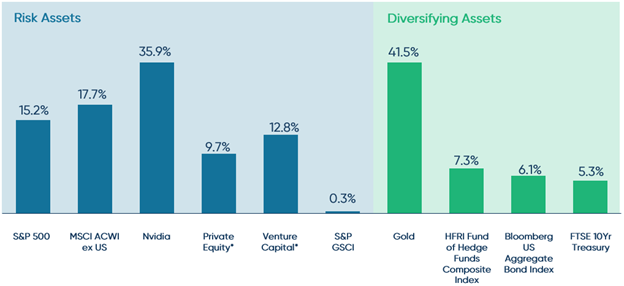
  1. A return to long-term trends: top-performing endowments have large private equity allocations. Certain sub-asset classes like growth or pre-IPO private equity outperformed. Broadly, the return spread between the allocations appears to be narrowing with private equity and venture posting high single digit/low double digit returns vs. 15.2% for the S&P 500, a spread of only 300-500bp.
  2. Strong absolute returns in an unusual year where both equities and bonds contributed positive returns. Both risk and diversifying assets performed well, highlighting broad macro and economic concerns despite strong equity returns.
  3. AI continues to drive equity markets. Portfolios with exposure to AI-related themes like Nvidia outperformed.
  4. Return of international performance. FY25 made the case for international diversification in equities, with MSCI ACWI ex US (17.7%) outperforming the S&P 500 (15.2%).
  5. Broad performance in diversifying assets, including gold. Investors looked for and received performance in a swath of uncorrelated asset classes, including gold, hedge funds and traditional fixed income.

Finally, the Endowment Tax is coming. Multiple private universities commented on the forthcoming increase in tax rate in their FY25 annual reports and endowment return press releases. The increase in the Endowment Tax rates goes into effect for taxable years beginning after December 31, 2025. For institutions with a fiscal year end of June 30, this means the new tax rate would apply starting July 1, 2026.

FY25 Asset Class Returns

FY25 Asset Class Returns
*As reported State Street Investment Management. Source: State Street.

How did individual endowments do?

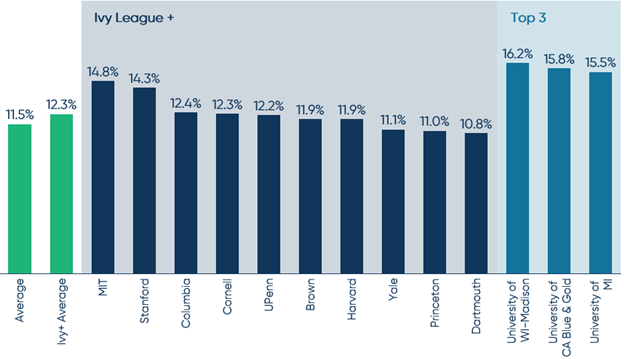
When looking at individual returns, the Ivy League and other renowned private endowments returned slightly above the total group. The top three returns came from public universities, with University of Wisconsin-Madison the highest FY25 performer with 16.2%.

FY25 Returns Publicly Announced

FY25 Returns Publicly Announced
Source: Pensions & Investments.

Case study: private allocation of top performers

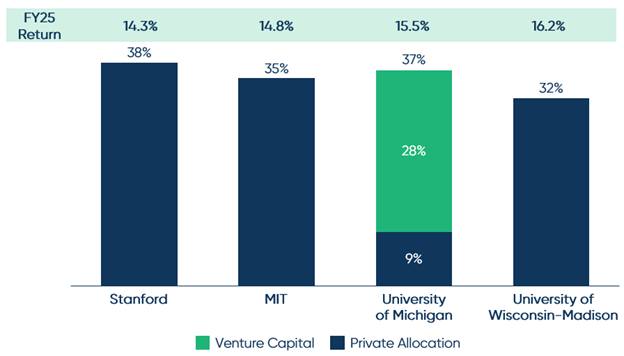
Looking at top performers’ asset allocation, it’s clear that the two-year trend of large private allocations being a detractor has come to a conclusion. Among the top performers that publicly release their asset allocation, each had approximately one-third or greater invested in private equity. A standout example on the strength in late-stage venture/growth is University of Michigan, which returned 15.5%. University of Michigan states that 28% of its portfolio is in venture capital with an additional 9% in private equity.

FY25 Top Returners Private Allocation

FY25 Top Returners Private Allocation
Source: University of Michigan FY 2025 Financial Statement; MIT Report of the Treasurer FY2025; Standford Management Company website, pulled 10/8/25; University of Wisconsin Foundation website, pulled 10/22/25.

The materials are being provided for informational purposes only and constitute neither an offer to sell nor a solicitation of an offer to buy securities. These materials also do not constitute an offer or advertisement of TIFF’s investment advisory services or investment, legal or tax advice. Opinions expressed herein are those of TIFF and are not a recommendation to buy or sell any securities.

These materials may contain forward-looking statements relating to future events. In some cases, you can identify forward-looking statements by terminology such as “may,” “will,” “should,” “expect,” “plan,” “intend,” “anticipate,” “believe,” “estimate,” “predict,” “potential,” or “continue,” the negative of such terms or other comparable terminology. Although TIFF believes the expectations reflected in the forward-looking statements are reasonable, future results cannot be guaranteed.