How to Adopt AI in Your Nonprofit with Real-World Lessons, Register Here
Investors Reflect on Whether Active Managers can Escape the Magnificent 7

Trevor Graham, Head of Equities, Deputy CIO at TIFF, shared insights at the Fiduciary Investors Symposium at Harvard on why active managers often struggle with the dominance of the Magnificent 7 stocks. In an article by Top1000funds.com, he discusses behavioral biases, the challenge of generating alpha in well-covered names, and how TIFF currently manages exposure to these stocks.

Read the full article

The materials are being provided for informational purposes only and constitute neither an offer to sell nor a solicitation of an offer to buy securities. These materials also do not constitute an offer or advertisement of TIFF’s investment advisory services or investment, legal or tax advice. Opinions expressed herein are those of TIFF and are not a recommendation to buy or sell any securities.

These materials may contain forward-looking statements relating to future events. In some cases, you can identify forward-looking statements by terminology such as “may,” “will,” “should,” “expect,” “plan,” “intend,” “anticipate,” “believe,” “estimate,” “predict,” “potential,” or “continue,” the negative of such terms or other comparable terminology. Although TIFF believes the expectations reflected in the forward-looking statements are reasonable, future results cannot be guaranteed.

‘Big Beautiful Bill’ Refines Endowment & Foundation Taxes with Tiers

Overview

  • The House Ways & Means1 Committee released its draft language for the ‘Big Beautiful Bill,’ which includes a number of components impacting nonprofit organizations. The components impacting investment pools are related to new or additional taxes.
  • The Endowment Tax proposal aims to expand eligibility and how much those eligible pay. It includes a tiered rate structure based on asset-per-student amounts, and the inclusion criteria would narrow which students can be included in the calculation, for example excluding international students on temporary student visas.
  • The Private Foundation Tax proposal mirrors the Endowment Tax proposal, moving from the current single 1.39% rate to a tiered rate determined by asset levels. Importantly, the tiers are determined by a foundation’s total assets, not just investment assets.
  • The Joint Committee on Taxation estimates these two initiatives will raise $22.6B over the next 10 years.
  • If passed, these new taxes will pressure higher education institutions and private foundations to reconsider their investment strategies and budgets.
  • It is important to remember in the United States, bills often undergo many changes before becoming legislation. The original 2017 House tax bill proposed a 1.4% excise tax for private institutions with at least 500 tuition-paying students and endowment assets exceeding $100,000 per full-time student.1 This would have affected approximately 140 to 155 institutions, instead of the 56 it did in 2023 when that $100,000 was increased to $500,000.2

Endowment Tax Refined

This refined proposal expands who is subject to the endowment tax and creates a wider range for the amount of the tax.

  • Rate: Increases from a single 1.4% rate to a tiered system with the highest rate set at 21%. An endowment will pay a single rate on all net investment income.
  • Tier Determination: Endowed assets per student will determine what tier of tax an endowment will pay. See Chart 1 below for the tiers and rates.
  • Student Count for Tier Calculation: Narrows the students that can be included, specifically excluding international students.3

While everyone anticipated a higher tax rate, they were not anticipating the exclusion of international students. This exclusion favors US citizens, permanent residents, or those not here on a temporary basis. It disproportionately and negatively impacts institutions with large international populations, such as those with graduate programs, which tend to have a larger percentage of international students.

We have already written about the three original proposals in February/March 2025 when they were released. Please refer to The Impact of Proposed Endowment Tax Changes and Endowment Tax – Part 2: Impact on the Endowment.

Endowment Tax Tier Determination
Source: https://www.politico.com/f/?id=00000196-c5d5-d69e-add7-dfdf2e210000.

The Joint Committee on Taxation estimates this will generate $6.69 billion over 10 years.4

Case Study: International Exclusion May Push UPenn into 14% Tier

The exclusion of international students in the student count for tier determination is important. The University of Pennsylvania had 29% international students enrolled in Fall 2024. Utilizing the total number of enrolled (or even just full-time students), Penn would be in the 7% tax tier. However, with the international students excluded, Penn is now in the 14% tax tier–double the tax of the lower tier it would have previously qualified for if its full student population was counted, and 10 times its current tax of 1.4%.

FY24% of Op Budget from Endowment
Source: FY2024 University of Pennsylvania Annual Report; University of Pennsylvania “About” website, pulled 5/18/2025. The tax excludes part-time students, which University of Pennsylvania had 4,890 in fall 2024, making it $100,000 below the 14% tier.

Private Foundation Tax to be Tiered

This proposal increases the amount of tax certain foundations will pay in the future. Today all foundations pay a 1.39% tax.

  • Rate: Increases the 1.39% single-tier tax to four rate tiers with the highest rate set at 10%. A foundation will pay a single rate, based on its tier, on all net investment income.5
  • Tier Determination: the total foundation’s assets will determine what tier of tax an endowment will pay, not just investment assets. Total foundation assets include all assets, with no reduction for liabilities, and would also take into account assets of certain related organizations.
Tiered Private Foundation Tax Rate
Source: https://www.politico.com/f/?id=00000196-c5d5-d69e-add7-dfdf2e210000.

The Joint Committee on Taxation estimates this will generate $15.88 billion over 10 years.6

Summary

For institutions, a new or increased tax, depending on the tier, has varying level of impact–from small (1.4%/1.39%) to significant (21% for endowments or 10% for foundations). Impacted institutions may need to consider how the reduction in invested assets, and thus reduced spending, may necessitate changes to the budget or investment pool. TIFF has discussed the potential impact and implications of the endowment tax previously, summary of which is:

  • Budget Implications: Institutions may need to reconsider their budget if suitable long-term replacements are not feasible for lost budgetary support from the investment pool.
  • Investment Implications: If an institution is in a high enough tax tier, it may need to consider changing its approach, potentially increasing its risk tolerance or shifting asset allocation to incur less investment income.

These proposed changes and the associated implications create a challenging time for the nonprofit community. TIFF remains committed to helping organizations determine the right investment strategy for their unique situation.

The materials are being provided for informational purposes only and constitute neither an offer to sell nor a solicitation of an offer to buy securities. These materials also do not constitute an offer or advertisement of TIFF’s investment advisory services or investment, legal or tax advice. Opinions expressed herein are those of TIFF and are not a recommendation to buy or sell any securities.

These materials may contain forward-looking statements relating to future events. In some cases, you can identify forward-looking statements by terminology such as “may,” “will,” “should,” “expect,” “plan,” “intend,” “anticipate,” “believe,” “estimate,” “predict,” “potential,” or “continue,” the negative of such terms or other comparable terminology. Although TIFF believes the expectations reflected in the forward-looking statements are reasonable, future results cannot be guaranteed.

Underweighting Equities is Usually a Bad Idea

Executive Summary

  • Investors considering timing equities should proceed with caution
  • Forecasting returns, particularly over short-time horizons, is very difficult
  • Underweighting equities often results in unattractive opportunity costs
  • Successfully timing the decision to return to a normal long-term allocation requires extreme fortitude

The past few months have been a period of very high volatility in equities due to several factors. Items weighing on investors likely include a combination of President Trump’s decision to increase tariffs on imports, continued tensions between the US and China, unclear resolutions to the armed conflicts in Gaza and Ukraine, and uncertainty from the DOGE initiative, which could either help balance the budget resulting in a more efficient US government or weaken a variety of strategically important social services and government programs. We have started to receive some questions from clients about the merits of underweighting equities relative to their long-term strategic targets. In general, we do not recommend that course of action for several reasons:

1. Forecasting Challenges

It would add material value if we could avoid the very worst months or quarters in equities. Unfortunately, forecasting in investments is unlike forecasting in most other fields. Predicting outcomes over the next month or year is not that difficult in most industries. Most owners and operators of businesses have a good idea of how their company will perform over the next month or quarter. However, forecasting business outcomes over the next ten years is much more difficult, if not impossible, for most sectors. For example, many publicly traded companies provide guidance for the next year but very few provide detailed guidance beyond that. Forecasting in investments is exactly the opposite. The range of annualized returns for monthly or quarterly data points is very wide. If we instead looked at rolling five-year outcomes and annualized those results, the range of IRRs would be considerably tighter. In investments, the longer the time horizon becomes, the easier it is to accurately predict the rate of return. The table below illustrates that shorter periods show a wider range of outcomes, with a 72% spread between the best and worst months. In contrast, longer periods, like five years, have a much narrower range, with approximately a 10% spread.

Range of Annualized Returns at Different Measurement Intervals, 1945-20241

Annualized Returns by Measurement Interval

We observe the challenges in short-term forecasting when evaluating managers. One of the methods we use to evaluate equity long/short hedge funds is to decompose the sources of excess returns into three categories: longs, shorts, and value-added from variance in net exposure. Across a growing library of several hundred different managers, we have seen very little evidence of statistically significant value-added from short-term variance in the net by equity-oriented hedge fund managers. We utilize a similar strategy for long-only managers who prefer to hold cash. It is very rare for the managers’ actual realized results to outperform a pro forma portfolio that grosses up their holdings such that they would have been at least 95% fully invested at all times. Even among trend-following managers, who are much more focused on market timing, we have seen mixed results. Short-term forecasting is very difficult.

2. Opportunity Costs

If we instead rely on longer-term forecasts, which are typically more accurate, we encounter a different problem. For an institutional portfolio, the meter is always running. We do not get to call capital when interesting opportunities arise and give it back when there are less attractive options. When we reduce equities, the capital must go somewhere else. The most obvious alternative to stocks when people are concerned about the risk of losing money is bonds or cash. The problem we face as investors is there are not many periods when bonds or cash outperform stocks over reasonable forecast horizons. We have used the S&P 500 and the benchmark 10-year Treasury bond for our analysis below.

Average Relative Results: Stocks vs. Bonds2

Stocks v Bonds

Even if the next five or ten years will in fact turn out to be one of these unusual periods when the return on equity is disappointing, it is important to evaluate the alternative use of capital. Revisiting the first chart and assuming the next five years will generally be a bottom-quartile return period for stocks, we can roughly estimate a 5% annualized return. The problem is that the yield to maturity on the 10-year Treasury bond is only 4.2%3. Selling something with an estimated return of roughly 5% to buy something that we should reasonably expect to return 4% is still a long-term expected performance concession. As outlined in Jay Willoughby’s Q4 2024 CIO Commentary and given some of the fiscal challenges the US faces, we think a much higher starting yield to maturity on bonds would be required for investors to consider materially underweighting equities in favor of bonds.

3. Psychology and the Pattern of Returns

For an equity market timing strategy to be successful, investors need to get two calls correct, not one. Those who underweight their long-term strategic targets will eventually need to decide when to return the equity allocation to its normal level. This second decision is key because, in equities, the big days are very important. Since 1945, the annualized return on the S&P 500 is roughly 7.9%4. If we exclude the top 1% return days, the annualized return would be a loss of -1.8%. Market prices tend to overshoot the changes to long-term fundamentals. As a result, equities are often undervalued at the bottoms of drawdowns. Also, markets discount anticipated economic conditions. When sentiment finally improves at the bottom of a drawdown, prices can move back up very quickly. The tables below show the best single day returns for the S&P 500 since 1945. All of them occurred during points in the cycle when uncertainty and volatility were very high. Because the absolute best days and worst days tend to cluster together, mistiming one of the two decisions, even by a day, can be very damaging. The best time to add to equities will often be at the point in the cycle in which doing so feels the most uncomfortable. The average investor who tries to time the market is highly likely to miss at least the first part of the recovery. Missing these big days often locks in long-term underperformance.

Highest Single Day Returns for the S&P 500, 1945 – 20245

Highest Single Day Returns from the S&P 500

Conclusion

While equity market volatility can be unsettling, maintaining a long-term perspective on equities is crucial for achieving optimal investment outcomes. Predicting short-term market movements is highly challenging, and the costs of missing key recovery days can be significant. By sticking to a long-term strategy around equities, investors can avoid market-timing pitfalls and benefit from the growth potential of owning stocks. Our tactical adjustments to equity exposure tend to be small because we understand how difficult it is to do this well. We tend to be biased to overweights because that improves our odds of generating good returns.

The materials are being provided for informational purposes only and constitute neither an offer to sell nor a solicitation of an offer to buy securities. These materials also do not constitute an offer or advertisement of TIFF’s investment advisory services or investment, legal or tax advice. Opinions expressed herein are those of TIFF and are not a recommendation to buy or sell any securities.

These materials may contain forward-looking statements relating to future events. In some cases, you can identify forward-looking statements by terminology such as “may,” “will,” “should,” “expect,” “plan,” “intend,” “anticipate,” “believe,” “estimate,” “predict,” “potential,” or “continue,” the negative of such terms or other comparable terminology. Although TIFF believes the expectations reflected in the forward-looking statements are reasonable, future results cannot be guaranteed.
Footnotes

  1. Source: Bloomberg.

  2. Source: Bloomberg and Federal Reserve.

  3. Bloomberg as of 4/30/25.

  4. Equity price data sourced from Bloomberg.

  5. Source: Bloomberg.

‘Tipping Point’: Endowments May Sell PE Stakes Amid Liquidity Crunch

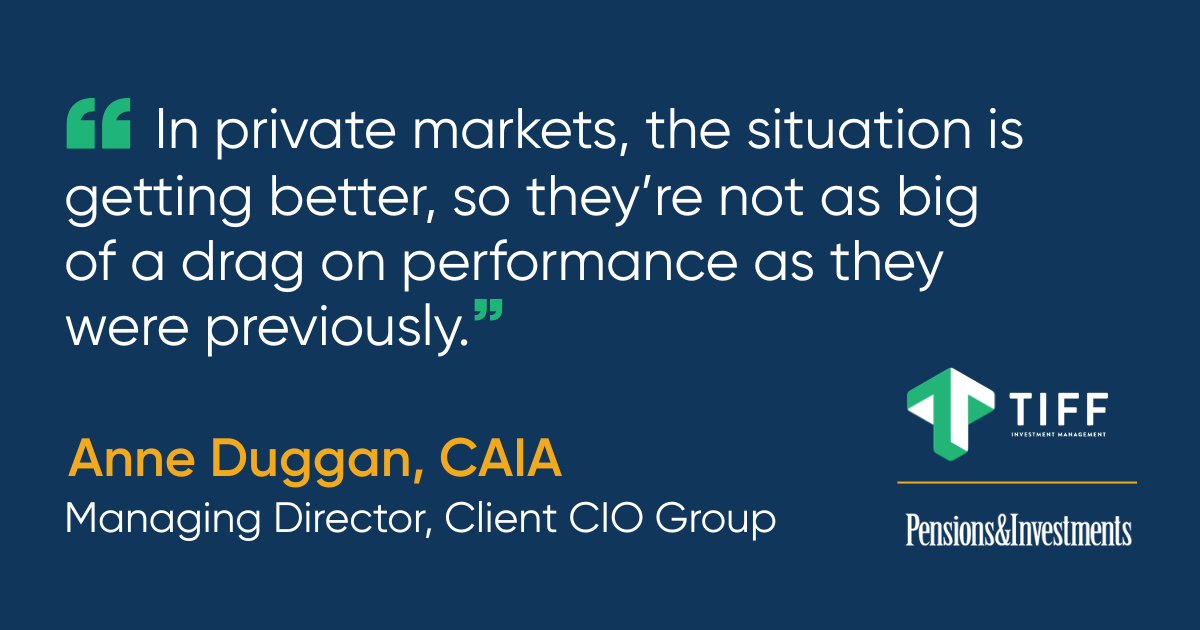
Anne Duggan, Managing Director, Client CIO Group at TIFF, notes that the potential sales of private equity stakes by Ivy League schools are likely driven by private equity underperformance, portfolio clean-up, and federal policy pressures, which are creating substantial liquidity challenges. She emphasizes that while larger endowments might need to shift portfolios or cut budgets, smaller endowments, with more investments in public markets, may adopt a “wait and see” approach.

Read the full article

Disclaimer: To access this article, a subscription may be necessary. Please note that TIFF does not possess the rights to distribute this content.

The materials are being provided for informational purposes only and constitute neither an offer to sell nor a solicitation of an offer to buy securities. These materials also do not constitute an offer or advertisement of TIFF’s investment advisory services or investment, legal or tax advice. Opinions expressed herein are those of TIFF and are not a recommendation to buy or sell any securities.

These materials may contain forward-looking statements relating to future events. In some cases, you can identify forward-looking statements by terminology such as “may,” “will,” “should,” “expect,” “plan,” “intend,” “anticipate,” “believe,” “estimate,” “predict,” “potential,” or “continue,” the negative of such terms or other comparable terminology. Although TIFF believes the expectations reflected in the forward-looking statements are reasonable, future results cannot be guaranteed.