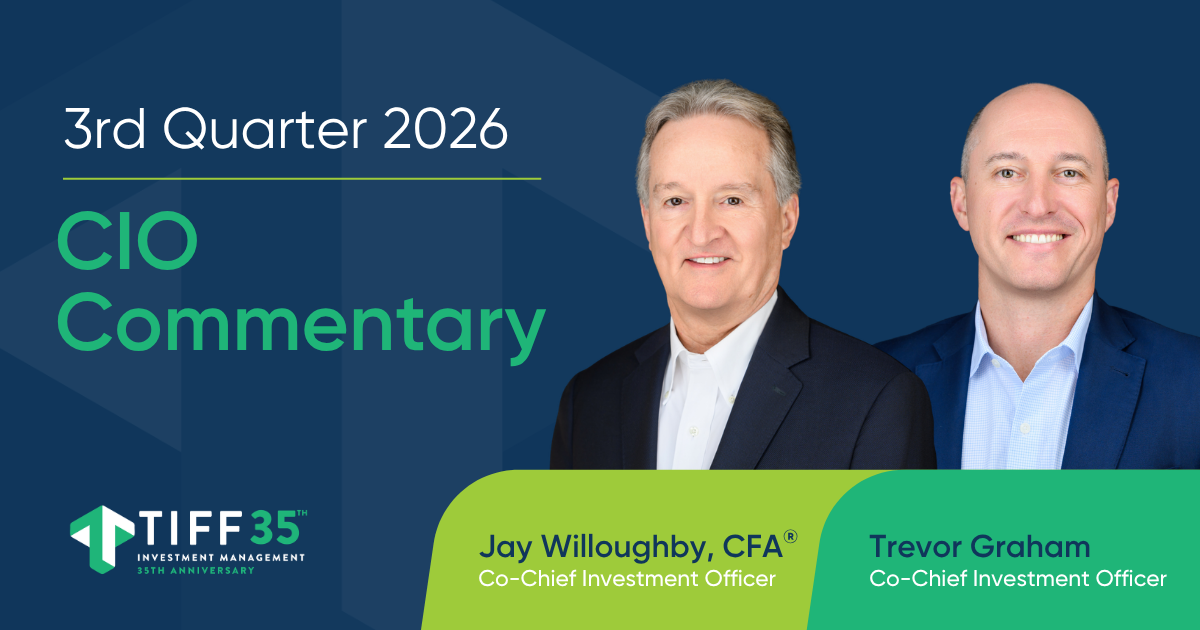
Trevor Graham will serve alongside Jay Willoughby as Co-CIO, with the two working closely together to guide portfolio construction, manager selection, and the firm’s overarching investment strategy and asset allocation. Brad Calder, who has worked in close partnership with Graham, has been named the new Head of Equities.
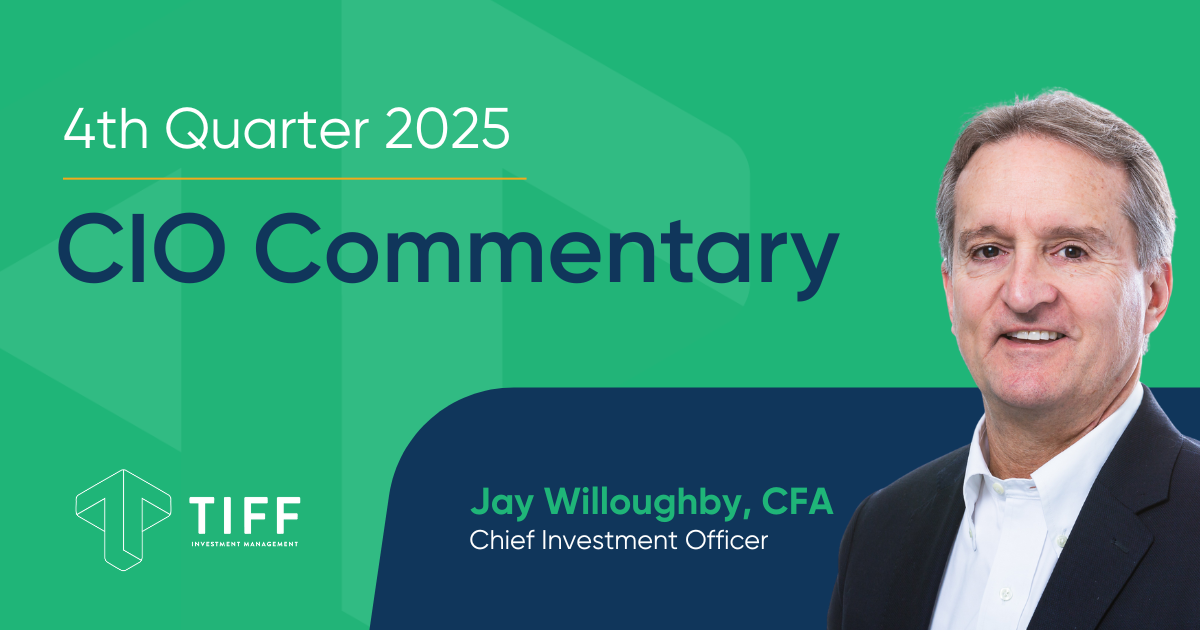
Radnor, PA — March 31, 2026 – TIFF Investment Management, an independent, employee-owned investment firm specializing in OCIO services and alternative investment strategies, announced today that Trevor Graham has been named Co-Chief Investment Officer alongside Jay Willoughby.
Graham, who joined TIFF in 2012, has worked closely with Willoughby for more than a decade and has served as Head of Equities and Deputy CIO, playing an increasingly central role in portfolio construction, implementation, and overall investment leadership. He also has been a member of the Investment Committee for 14 years, contributing valuable insight and supporting the continuity of TIFF’s investment program.
“Trevor is one of the brightest investment minds we have at TIFF and has played a central role in shaping the investment process and philosophy underpinning our client portfolios,” said TIFF CEO Kane Brenan. “His deep experience across asset classes, including public equities, hedge funds, and private markets makes him uniquely qualified to excel as an investment leader in the OCIO world. Jay and Trevor have worked very closely for the last decade, and it is great to see this partnership continuing.”
Graham and Willoughby will serve as Co-CIOs as part of a thoughtful, ongoing leadership transition, with Willoughby expected to gradually shift from day-to-day responsibilities and continue supporting TIFF in an advisory capacity.
I’ve worked closely with Jay for many years and have been part of building the investment approach we have today,” Graham said. “As Co-CIO, I’m focused on strengthening that approach while working to deliver consistent results for our clients. We have a phenomenal team, and we believe in the structural advantages in manager access, which I am thrilled to continue leveraging.”
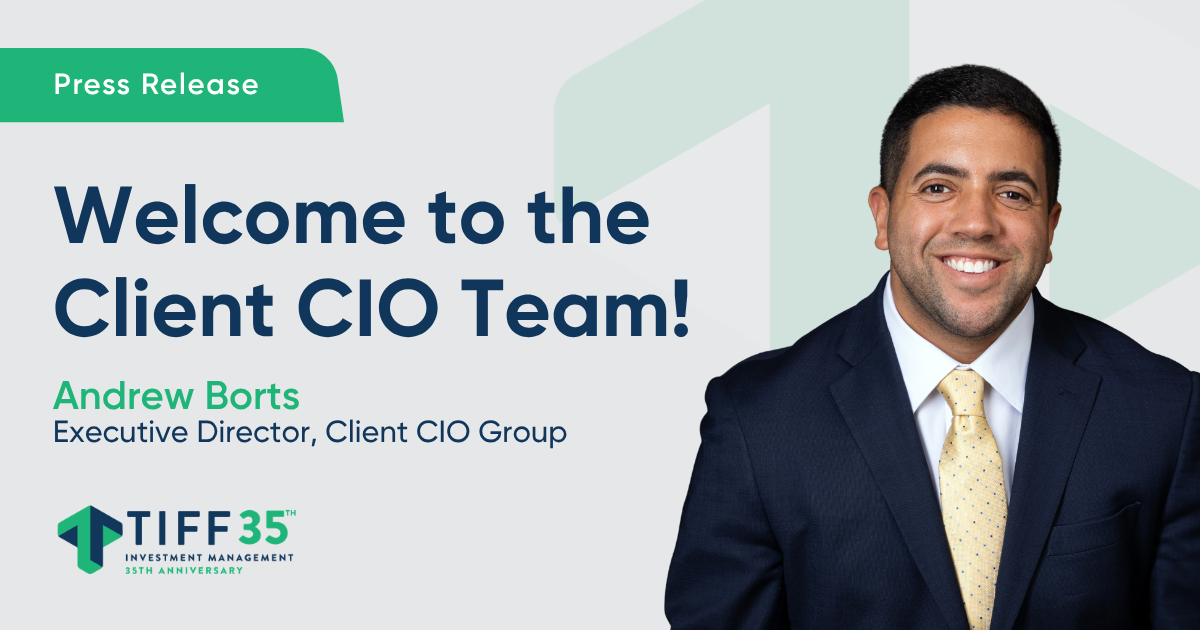
In addition to Graham’s appointment as Co-CIO, Brad Calder has been named Head of Equities and will join the Investment Committee. Having worked closely with Graham on the equities program for over a decade, Calder’s appointment ensures continuity in a core area of TIFF’s investment platform.
Trevor has been deeply involved in our investment process and a trusted partner for many years,” said Jay Willoughby. “He has the experience and perspective that defines our approach, and I look forward to continuing to work with him in this role.”
About TIFF Investment Management
TIFF Investment Management is an independent, employee-owned investment firm specializing in OCIO services and alternative investment strategies, including private equity, venture capital, and hedge funds. Founded in 1991, with approximately $10Bi in assets under management, TIFF draws on decades of experience to serve nonprofits, family offices, RIAs, and other sophisticated investors. As a certified B CorporationTM, TIFF embeds accountability, transparency, and sustainability into its operations and investment process. TIFF combines nonprofit expertise with institutional-quality access, partnering with long-term investors to deliver sustainable growth and enduring results that can advance their objectives over time. Learn more at www.tiff.org.
Past performance is no guarantee of future results and the opinions presented cannot be viewed as an indicator of future performance. There is no guarantee that any particular asset allocation or mix of strategies will meet your investment objectives.
The materials are being provided for informational purposes only and constitute neither an offer to sell nor a solicitation of an offer to buy securities. These materials also do not constitute investment, legal or tax advice. Opinions expressed herein are those of TIFF and are not a recommendation to buy or sell any securities.
These materials may contain forward-looking statements relating to future events. In some cases, you can identify forward-looking statements by terminology such as “may,” “will,” “should,” “expect,” “plan,” “intend,” “anticipate,” “believe,” “estimate,” “predict,” “potential,” or “continue,” the negative of such terms or other comparable terminology. Although TIFF believes the expectations reflected in the forward-looking statements are reasonable, future results cannot be guaranteed.
Footnotes
i TIFF assets under management (AUM) is as of 9/30/25 and includes discretionary and non-discretionary client assets for which TIFF affiliates provide investment management or advisory services. The private markets portion of TIFF AUM is calculated based upon fund net asset value plus unfunded commitments. Calculation of TIFF AUM differs from the calculation of regulatory assets under management in TIFF’s Form ADV filings with the SEC and may differ from the AUM calculation methodologies used by other investment managers.
B Lab is the independent third party that certifies companies as B Corporations when they meet rigorous standards of social and environmental performance, accountability, and transparency. B Lab certified TIFF Advisory Services, LLC as a B Corporation on September 12, 2025. To remain certified, B Corporations must update and verify their information every three years.
There are a few large and somewhat unrelated forces shaping markets today. In this letter, we focus on two, particularly the conflict in the Middle East and the evolving impact of AI. While these topics are very different, both introduce significant uncertainty and cause market volatility.
Some Big Moving Pieces and Lessons to Remember
On the first large force shaping markets today: most of us are familiar with the situation unfolding in the Middle East (ME), where the U.S. and Israel are attacking Iran with the stated goals of preventing Iran from obtaining a nuclear weapon, degrading its missile capabilities, limiting its ability to fund terrorism/proxy groups, and securing the Strait of Hormuz, through which roughly 20% of the world’s oil flows. While the ultimate end-state remains somewhat unclear, most U.S. policymakers – who rarely agree – appear aligned in preferring a short conflict and with no U.S. “boots on the ground.” Our goal here is not to choose a side, but to assess what these developments might mean for our portfolios in the short- and long-term. Our goal also is not to ignore the human consequences of this war, which are large and painful. However, our role is to determine whether this development causes materially different investment outcomes than previously considered.
Energy as the Primary Transmission Channel
From an investment perspective, the primary channel through which this conflict affects the global economy is energy prices. Iran has demonstrated its ability to disrupt up to 20% of global oil supply through the Strait of Hormuz by threatening shipping. If flows remain constrained for an extended period, already elevated oil prices could rise further, pushing inflation higher and slowing growth. The chart below shows how a sustained oil shock could impact growth across countries.
2026 GDP Growth Percent Impact Due to Energy Price Shock1
If disruptions ease, prices should normalize more quickly, limiting the impact on inflation and allowing market volatility to subside. Ultimately, a short, successful conflict could lead to a more stable Middle East, reducing some of the geopolitical “risk premium” currently embedded in oil prices, which would support both equity and bond markets.
What Markets Are Pricing
As you can see below, higher price expectations have already been reflected in forward price curves for oil. What matters now is how quickly the Strait reopens. The longer it stays constrained, the larger the supply shortfall becomes — and the higher prices are likely to go.
U.S. Crude WTI Future Curve Before and After Attack on Iran
The range of possible outcomes is best illustrated by how oil markets are currently pricing different scenarios.
The Goldman Sachs chart above illustrates how oil price expectations vary depending on how long the Strait remains disrupted. Forward curves already reflect higher prices, with a prolonged closure likely pushing them higher still.
GS Estimated Impact on Brent 2027Q4 Prices Under Different Strait of Hormuz Disruption and Recovery Scenarios2
Recent Developments and Path Forward
On March 22, the U.S. administration warned that failure to reopen the Strait of Hormuz within 48 hours could result in strikes on Iran’s energy infrastructure. Iran responded with warnings of potential retaliation against regional energy assets, shipping routes, and U.S. facilities in the Middle East.
Approximately 36 hours after the initial warning, the U.S. administration paused further escalation, citing “constructive talks with Iran,” a characterization Iranian officials disputed. While both sides have continued limited exchanges, larger-scale offensives appear to have eased, at least temporarily. There are indications that talks may be underway, possibly intensifying with face-to-face meetings in Pakistan. With much of the Iranian leadership removed, it is unclear who ultimately has negotiating authority, which adds another layer of uncertainty. There also appear to be some differences within the remaining Iranian leadership, as most of the oldest hardliners are gone. If a more reformist-minded leader such as President Masoud Pezeshkian ascends, or if the new hardline Supreme Leader Mujtaba Khameini takes a less active role, some experts suggest Iran may become less combative. This would be a positive outcome. If not, the status quo since 1979 or worse may result.
Potential Outcomes
Our view today is cautiously hopeful. If Iran softens its traditional position and the U.S. remains open to an off-ramp, a deal that allows both sides to save face is possible.
The challenge, of course, is that each side’s stated objectives remain far apart. Iran has sought security guarantees, sanctions relief, reparations, removal of U.S. military bases and greater control over the Strait, while the U.S. objectives outlined earlier are largely unacceptable to Iran.
Any resolution would therefore require meaningful concessions from both sides. One possible framework could involve Iran foregoing its pursuit of a nuclear weapon and limiting its missile and drone capabilities, in exchange for security assurances, sanctions relief, and potentially some form of economic support.
While this may seem unlikely today, an outcome that allows both sides to claim some degree of success may be the clearest path to a more stable Middle East. Our hopeful scenario would mark the end of Iran’s 47-year history of destabilization both for themselves and hopefully also for the Middle East. If so, oil prices may embed a permanently lower risk premium. This could lead to lower inflation and stronger global growth in the future.
Lessons for Investors
Against this backdrop, it is worth stepping back and remembering a few lessons that have served investors well:
Warren Buffett’s oft quoted observation: “The stock market is a device for transferring money from the impatient to the patient.”
Over the last four decades, there have been 21 U.S. airstrike campaigns in the MENA region, and eight weeks later the SPX was higher 95% of the time.
Historical Asset Class Performance Eight Weeks After Initial U.S. Airstrike Operations in the Middle East and North Africa3
Positioning Implications
With global equity markets down nearly 7% since the conflict began, and analysts’ earnings estimates showing continued upward revisions in the U.S., we sense some modest upside potential in stocks. While we are not taking large positions in the portfolio in either direction based upon what we know and what we’ve heard, we do own a few small bullish call option positions that would benefit the portfolio some if this were to occur. Additionally, we are keeping a close eye on 10-year Treasury yields. A break above 4.5% would interest us, as any energy inspired inflation would likely revert quickly if a deal can be struck, allowing rates to fall back to lower levels. If we are wrong and conditions in the ME deteriorate further, we will be positioned very close to our benchmarks and will have all the flexibility to make more impactful changes after better opportunities have presented themselves.
The range of possible outcomes in the Middle East is very wide, and the ramifications if energy or desalination infrastructure is struck and / or more countries join the fray should not be underestimated. However, while geopolitics may be driving incredible near-term market uncertainty (even hour by hour), a separate and potentially more impactful force is shaping longer-term market expectations: the impact of AI.
AI’s Impact on Jobs and the Economy
A central question in markets today is AI’s potential impact on the economy and employment. Past technological advances have helped humans live safer and easier lives (fire/electricity), move goods and people more efficiently (the wheel/trains/cars), communicate faster (telephones/the internet), and make better decisions (computers/software). AI may be different. For the first time, we may be developing a technology capable of thinking and making decisions in place of humans, raising important questions about employment and long-term economic growth.
Bear Case: Those who believe AI can disintermediate jobs quickly see a technology that works non-stop without supervision and improves itself at an ever-increasing pace. You don’t pay it a wage or health care benefits, it never sleeps or complains, and if it cannot do what you want today, it likely will in a few weeks (or less). (And this is putting aside the ultimate Bear case, which envisions a dystopian humankind versus machine battle.)
Bull Case: Those who believe AI won’t take all of our jobs point to its lack of 1) human creativity or 2) access to all data (as critical databases are inaccessible because uninvited sharing of sensitive data could be an existential threat). They believe that, like previous technological advances, AI will free humans to focus on higher-value work, increasing productivity and creating jobs we cannot yet imagine, much like a software engineer could not have been imagined before a computer was invented.
The Potential SaaSpocalypse
Ground zero of this debate is the SaaS (software as a service) stocks. There are others, but AI believers expect that, over time, companies will be able to task their own internal AI to build software stacks that replace some of the SaaS services they currently use for internal processes. They believe companies understand their own “hotspots” and where they cannot afford software mistakes and will continue to test in-house AI-developed solutions until they are reliable. While these solutions may not be ready to take over from current vendors today, they could be more viable in the future.
Those who doubt AI will rapidly cannibalize jobs see AI as a productivity accelerator. They believe in the human processes that require time to investigate, understand, gain trust, run trials, debug, and then slowly begin to implement a solution that may represent an existential decision. If you implement a big change to your enterprise resource planning (ERP) process (software) you are betting your company on it working.
Before tackling an example, it is worth briefly defining what ERP software does: it “pulls data and workflows from finance, supply chain, HR, sales, and other functions into a single platform, allowing a company to operate on one consistent set of real-time information.”
One of the best examples of this dynamic is SAP, a company several of our managers own. SAP is one of the leading global providers of enterprise resource planning (ERP) software and is also working to incorporate AI into its own offerings.
Importantly, the company’s fundamentals remain strong. Revenues and earnings are expected to grow at an accelerating pace over the next several years, with consensus estimates pointing to continued double-digit earnings growth.
Source: Bloomberg. In USD as of 03/25/26 at 11:50AM.
That is a very attractive earnings profile! With the stock today at $176, that is a PE of 21x 2026 and only 11.3x 2030 earnings estimates. The average PE over the last 10 years is 31x.
Nevertheless, the stock price has declined by 28% YTD and is down 44% from its July 2025 high. This is not due to weakening near-term earnings, but rather a reassessment of the durability of the business. The market is increasingly pricing in potential AI-driven erosion of SAP’s franchise and terminal value.
As a result, earnings are rising while the stock is falling — a reminder that markets are forward-looking discounting mechanisms. At times, investors simply do not believe the future will look as strong as the past, regardless of current earnings estimates.
Currently, it is hard for the SAP bulls to combat the AI believer’s assertions. Only time will tell if AI will become another tool, assimilated in the same way the internet was, creating some of the greatest businesses ever – think Google and Amazon, or if in time AI will take over all aspects of what SAP (and many companies) currently does for its customers and slowly (but quickly when it comes) put them out of business. As we sit here today, the AI bulls appear to be winning, but several of our managers believe this is creating attractive opportunities for new investments.
Productivity and the Power Constraint
We are more aligned with the bulls. Our current belief is that AI will become more pervasive across corporate America. It will make businesses large and small more productive. Rising productivity enhances living standards and tends to reduce inflation. AI can help with both. We have been using AI in our investment process and firm operations and have indeed been astounded by its capabilities when prompted well. (As an interesting example, please see the Appendix which combines AI insights with the Middle East War.)
The limiting constraint to AI growth may be electricity generation. We continue to push the grid, because we need ever more power in order to grow AI at the breakneck speeds we have to this point. Substituting AI for people will require more electricity. Some investors argue that the productivity improvement AI brings may be meaningfully offset by the increased cost of powering the AI. It seems unlikely that AI electricity will cost more than a human, but the scale and cost of the required electricity build out could surprise us all.
This is a complex situation. AI has the potential to make the global economy more efficient — provided it augments, rather than replaces, human work.
Capital Expenditure of U.S. Investor-Owned Electric Utilities vs. U.S. Electricity Demand4
Today’s Positioning
Bringing these topics together, we turn to how we are positioning portfolios.
We have not made major changes to our strategic asset allocation or overall portfolio construction. Within equities, we remain close to benchmark on “Level 1” factor exposures such as sector and geography, while maintaining our longstanding modest underweight to megacap stocks in favor of medium (mostly) and small cap companies. Despite limited factor risk, the portfolio continues to reflect our highest-conviction ideas, with most deviation from the benchmark driven by idiosyncratic security selection.
Within diversifiers, we maintain exposure to a mix of strategies designed to have low correlations to one another, and we have recently added merger arbitrage and equity capital markets strategies in anticipation of increased corporate activity.
Within fixed income, we remain short duration, reflecting concerns about the U.S.’ deteriorating fiscal position and the potential for higher inflation if the situation in the Middle East worsens.
While we are always looking for tactical opportunities, we recognize these are among the most difficult decisions to get right. Historically, the most attractive opportunities have come when sentiment is extremely negative. Today, markets are highly focused on developments in the Middle East, and unless disruption escalates meaningfully, a compelling entry point may not emerge. While that is not a desirable outcome, we would be prepared to respond if conditions were to deteriorate. Should tensions escalate further—through broader regional conflict or a prolonged disruption to the Strait of Hormuz—opportunities may develop later in the year. For now, we remain balanced and flexible, relying on security selection to drive value, as we have over most of TIFF’s history.
Despite a difficult start to the year, the investment backdrop could still improve as we move forward. If earnings estimates remain firm and inflation pressures from energy prove temporary, 2026 could still be a positive year for markets. While uncertainty is elevated, markets have handled it relatively well. A short conflict with no U.S. boots on the ground would likely represent the most favorable outcome for markets.
As always, we greatly appreciate the opportunity to manage your capital and help you achieve your organization’s goals. We are here to assist in any way possible, so please feel free to reach out to us with any questions or needs.
Your TIFF Investment Team
Appendix: Applying AI Capabilities to Middle East War Potential Outcomes
Additional Context on the War in Iran
Because the range of potential outcomes in the Middle East is unusually wide, we used AI as a tool to help frame possible scenarios and stress-test our thinking. It is important to emphasize that AI is not used to make investment decisions, but rather to extend the team’s research capabilities and explore a broader set of inputs and perspectives.
For this exercise, we asked a well-known Large Language Model (LLM) AI engine (on March 24, 2026) to outline what it viewed as the most likely scenarios based on its synthesis of a large body of available information (the underlying analysis drew from hundreds of sources). What follows is a condensed version of that output. These scenarios do not represent the views of the TIFF team, nor should they be interpreted as forecasts. As with any model, the results are sensitive to changing inputs, and different conditions or prompts would likely produce different outcomes. We hope you find this content useful.
Strait of Hormuz Crisis: Scenario Analysis The March 28 Deadline and What Comes Next
Current State of Play
Twenty-five days into the U.S.-Israeli military campaign against Iran, the air war is largely won — over 9,000 targets struck, 140+ naval vessels destroyed, missile launch rates down roughly 90%. But Iran’s most consequential weapon remains deployed: the effective closure of the Strait of Hormuz. Tanker transits have collapsed 94% from pre-war levels. The IEA has called this the largest supply disruption in the history of the global oil market. On March 21, Trump issued an ultimatum demanding Iran fully reopen the Strait within 48 hours or face strikes on power infrastructure. That deadline was postponed five days on March 23 after the administration claimed productive conversations with Iran through mediators. Tehran has denied direct talks. As of March 24, fighting continues: Israel launched fresh strikes on Tehran; Iran fired ballistic missiles at Tel Aviv and hit a Kuwaiti oil refinery. Pakistan has offered to host in-person negotiations. The new deadline expires Saturday, March 28.
Three Scenarios from the March 28 Deadline
Scenario A — Negotiated De-escalation (~30%)
Backchannel talks produce a framework agreement by early April. Iran agrees to phased Strait reopening in exchange for a halt to energy infrastructure strikes and a pathway toward broader negotiations. Brent retreats to $75–85 by end of Q2, settling near $70–75 by Q4 as flows normalize. GDP drag is contained to roughly -0.3 to -0.5 percentage points for full-year 2026. Headline CPI spikes to 3.0–3.5% in Q2 before moderating. The Fed holds through June and delivers one or two 25bp cuts in H2. Recession is avoided. Key trigger: Any confirmed in-person meeting between US and Iranian representatives, or a visible increase in Hormuz tanker transits from the current 4–5 per day toward 20+.
Scenario B — Protracted Standoff (~45%)
The most likely outcome. March 28 passes without resolution. Trump may extend deadlines, impose limited additional strikes on non-energy targets, or begin selective strikes while claiming a phased approach. Iran maintains the Strait’s contested status using mines, drone threats, and the $2 million per-transit toll it has already imposed. The conflict shifts from intense kinetic operations to a grinding attritional phase. Houthi entry becomes probable, extending maritime disruption to the Bab el-Mandeb. Brent oscillates in a $95–120 band through Q2, with spikes above $120 on escalation headlines. A sustained $30–40 increase from pre-war WTI levels implies -0.30 to -0.40pp of GDP drag and +0.84 to +1.12pp on headline CPI. Core PCE reaches 2.8–3.2%. Recession probability rises to 35–45%. The Fed remains frozen — unable to cut into rising inflation, unwilling to hike into weakening growth. Key trigger: Houthi military action in the Red Sea or Bab el-Mandeb, or further Iranian drone strikes on Saudi Arabia’s Yanbu bypass port.
Scenario C — Escalation Spiral (~25%)
March 28 passes and Trump orders strikes on Iranian power plants and energy infrastructure. Iran retaliates by mining the entire Persian Gulf, striking Gulf state desalination plants (90%+ of freshwater supply), and ordering Houthi attacks on Red Sea shipping simultaneously. Brent breaches $130–150, potentially exceeding the 2008 record. Goldman’s extreme scenario envisions daily prices above $147. Gas prices nationally exceed $5.50–6.00/gallon. Recession becomes the base case: Dallas Fed modeling shows oil at $132 by year-end with growth remaining negative. The Fed faces a Volcker-era dilemma. Credit markets, currently showing modest stress (HY spreads at the 38th percentile), widen violently. Key trigger: Any strike on Iranian power generation infrastructure — Iran’s explicit threat to mine the entire Gulf in response makes this a bright-line escalation event.
Note: These three scenarios sum to roughly 100% of estimated probability. A 5–10% residual tail of outcomes outside this framework exists — most notably regime collapse in Tehran, a Chinese-brokered grand bargain, or a direct Iranian nuclear test — each carrying non-linear market implications that resist probabilistic framing.
Decision-Relevant Signposts
The single highest-leverage variable is the physical status of the Strait of Hormuz. Windward and Lloyd’s List Intelligence provide near-real-time tanker tracking — any sustained increase above 20 transits per day would confirm de-escalation before official announcements. Beyond that: the March 28 deadline outcome, any Houthi belligerency declaration, the April 5 OPEC+ meeting (spare capacity sits on the wrong side of the Strait), and the April 28–29 FOMC (the Fed’s next decision point on whether oil-driven inflation merits a hawkish pivot).
What This Means for Long-Term Allocators
The range of plausible outcomes over the next 60 days is unusually wide — spanning from a swift normalization that unwinds the oil risk premium to a sustained supply crisis that tips the US economy into recession. For institutional investors with multi-decade horizons, the analytical frame matters more than any single scenario: the most decision-relevant variable is not oil prices themselves but the duration of the Strait’s disruption, which determines whether the shock is a transient repricing or a structural regime change in energy, inflation, and growth. History favors the transient outcome, but history has never seen 20% of global petroleum transit shut simultaneously for this long.
End Notes
The materials are being provided for informational purposes only and constitute neither an offer to sell nor a solicitation of an offer to buy securities. These materials also do not constitute an offer or advertisement of TIFF’s investment advisory services or investment, legal or tax advice. Opinions expressed herein are those of TIFF and are not a recommendation to buy or sell any securities.
These materials may contain forward-looking statements relating to future events. In some cases, you can identify forward-looking statements by terminology such as “may,” “will,” “should,” “expect,” “plan,” “intend,” “anticipate,” “believe,” “estimate,” “predict,” “potential,” or “continue,” the negative of such terms or other comparable terminology. Although TIFF believes the expectations reflected in the forward-looking statements are reasonable, future results cannot be guaranteed.
Footnotes
Source: Eurasia Group.
Source: Goldman Sachs Global Investment Research. The estimated impact is relative to GS pre-war forecast for Brent 2027Q4 at $69/bbl. Days of disruptions indicate number of days when flows through the Strait of Hormuz are below 10% of normal. GS assumes a gradual 30-day recovery after the initial disruption window is over.
Source: Goldman Sachs Investment Strategy Group, Turning Point Market Research.
Source: ICF analysis of power industry forecast and planning documents, EEI.
Originally presented as: “AI in Action: Best Practices for Using LLMs in Mission-Driven Work.”
This piece is written by Remy Reya, Director of AI and Thought Leadership at Compass Pro Bono. Compass Pro Bono is a nonprofit that helps other nonprofits strengthen their impact through strategic support. In this piece, Remy Reya shares practical ways organizations can approach AI as a thought partner.
Many nonprofits have begun exploring how AI tools can amplify their work and free up staff time to focus on the warm-touch, relational activities that power our missions.
It can be exciting and empowering to figure out how AI can support our work. It can also feel exhausting trying to keep up with all the new platforms, features, and techniques emerging seemingly every day—especially for a bandwidth-stretched nonprofit leader.
Luckily, you don’t actually need to keep up with everything; most of us in the nonprofit sector can get outsized value by focusing on just a few core tools and techniques. In the webinar below, Compass Pro Bono shares some tried-and-true best practices for using large language models (LLMs) in mission driven work: prompt engineering, deep research, reasoning, customization, connectors/integrations, and more.
Watch the Replay:
As you begin to implement these techniques and integrate AI more deeply into your work, you will also have to contend with where it should fit in, and how to engage these tools in ways that keep your critical thinking and creativity at the center.
One technique we recommend is to bake this philosophy into the tools you use. For example, most large language models (LLMs) allow users to set custom instructions that shape every conversation (sometimes called “personalization features”). Instructions on how to configure these in Claude here, ChatGPT here.
Personalization Language:
We’ve designed these custom instructions to help you stay in control when using LLMs. We hope you’ll read them over, customize as needed, and paste into your LLM of choice:
I like to use [preferred LLM] as a thought partner. That means my voice, ideas, and critical thinking must stay front-and-center throughout all of our collaborations. Your job is to augment my cognition and creativity.
When I ask you to help with a complex task, start by asking me clarifying questions to surface what I’ve already thought through on my own. Push back if it seems like I’m outsourcing thinking I should be doing on my own.
After completing a task, if appropriate, share something I might not know about the topic we’ve been discussing (an interesting concept, an unexpected connection, a robust counterargument, etc.) along with a link to an article, podcast, or resource where I can go deeper.
Default to helping me think, not thinking for me. Offer frameworks, questions, starting points, and syntheses rather than finished products (unless I explicitly ask for a finished product).
Finally, do not proactively offer to complete a new task after completing a request I make. Wait for me to decide what I need next, even if that’s just asking you what should come next; I want to stay in the driver’s seat.
Explore additional resources in the accompanying slide deck here.
The materials are being provided for informational purposes only and constitute neither an offer to sell nor a solicitation of an offer to buy securities. These materials also do not constitute an offer or advertisement of TIFF’s investment advisory services or investment, legal or tax advice. Opinions expressed herein are those of TIFF and are not a recommendation to buy or sell any securities.
These materials may contain forward-looking statements relating to future events. In some cases, you can identify forward-looking statements by terminology such as “may,” “will,” “should,” “expect,” “plan,” “intend,” “anticipate,” “believe,” “estimate,” “predict,” “potential,” or “continue,” the negative of such terms or other comparable terminology. Although TIFF believes the expectations reflected in the forward-looking statements are reasonable, future results cannot be guaranteed.
You are now leaving TIFF Investment Management’s website and are going to a website that is not operated by TIFF Investment Management. We are not responsible for the content or availability of linked sites, and our inclusion of links to third-party websites does not imply any endorsement, approval, verification or monitoring by us of any of such linked sites’ content.