TIFF CIO Jay Willoughby on How Private Equity and Hedge Funds May Strengthen Endowment Portfolios Amid Market and Policy Pressures
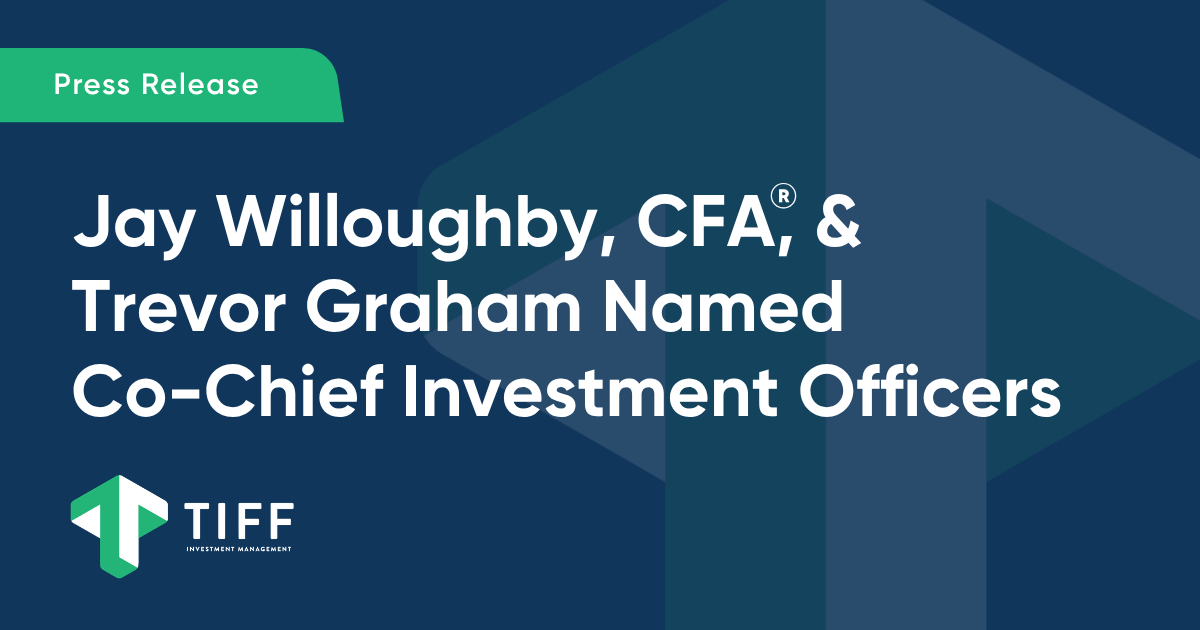
Jay Willoughby, CFA
Co-Chief Investment Officer & Board Member of TIFF Advisory Services
Jay Willoughby, CFA, CIO of TIFF Investment Management, was featured in FIN News sharing how private equity and hedge funds may help endowment portfolios under fiscal pressure, including tax burdens and federal funding cuts.
Read the full article
Disclaimer: To access this article, a subscription is necessary. Please note that TIFF does not possess the rights to distribute this content.
The materials are being provided for informational purposes only and constitute neither an offer to sell nor a solicitation of an offer to buy securities. These materials also do not constitute an offer or advertisement of TIFF’s investment advisory services or investment, legal or tax advice. Opinions expressed herein are those of TIFF and are not a recommendation to buy or sell any securities.
These materials may contain forward-looking statements relating to future events. In some cases, you can identify forward-looking statements by terminology such as “may,” “will,” “should,” “expect,” “plan,” “intend,” “anticipate,” “believe,” “estimate,” “predict,” “potential,” or “continue,” the negative of such terms or other comparable terminology. Although TIFF believes the expectations reflected in the forward-looking statements are reasonable, future results cannot be guaranteed.
How Private Equity Avoided Major Tax Hits from One Big Beautiful Bill
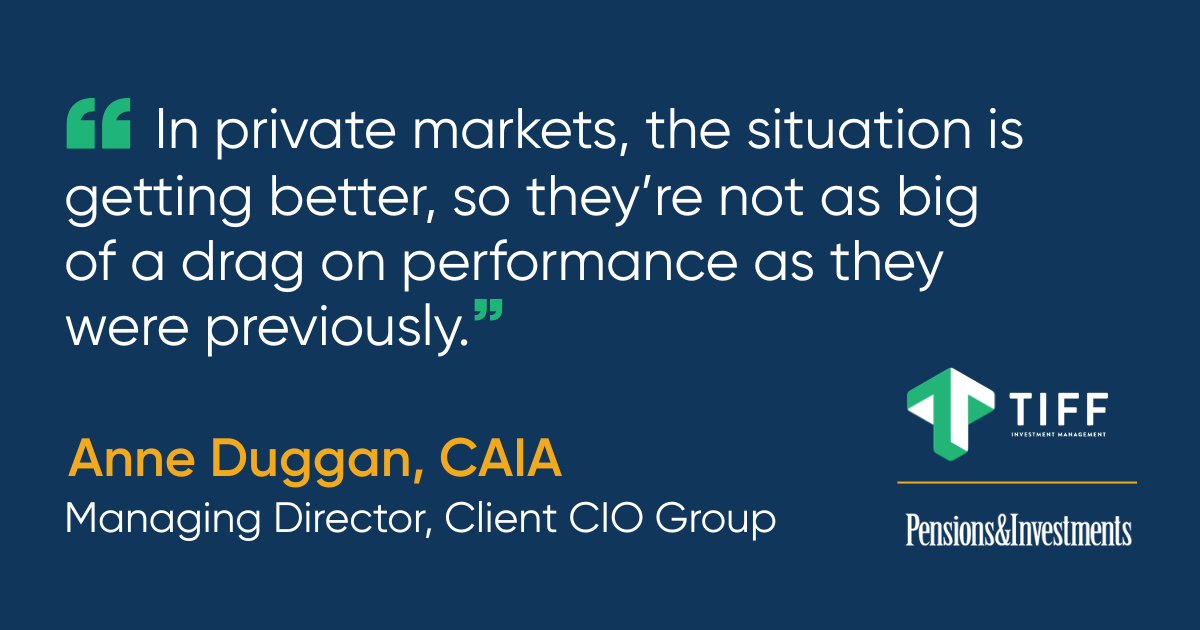
Anne Duggan, CAIA
Managing Director, Client CIO Group
Anne Duggan, Managing Director, Client CIO Group at TIFF Investment Management, spoke with reporter Rod James at The Wall Street Journal about how scaled-back endowment taxes in the new legislation may prevent major shifts in university investment strategies. She noted that in response, some endowments might turn to tax-loss harvesting to manage the new burden effectively.
The materials are being provided for informational purposes only and constitute neither an offer to sell nor a solicitation of an offer to buy securities. These materials also do not constitute an offer or advertisement of TIFF’s investment advisory services or investment, legal or tax advice. Opinions expressed herein are those of TIFF and are not a recommendation to buy or sell any securities.
These materials may contain forward-looking statements relating to future events. In some cases, you can identify forward-looking statements by terminology such as “may,” “will,” “should,” “expect,” “plan,” “intend,” “anticipate,” “believe,” “estimate,” “predict,” “potential,” or “continue,” the negative of such terms or other comparable terminology. Although TIFF believes the expectations reflected in the forward-looking statements are reasonable, future results cannot be guaranteed.
TIFF Webinar – Why Venture Capital Still Works (early-stage VC that is)
Chris Anderson
Managing Director, Private Markets
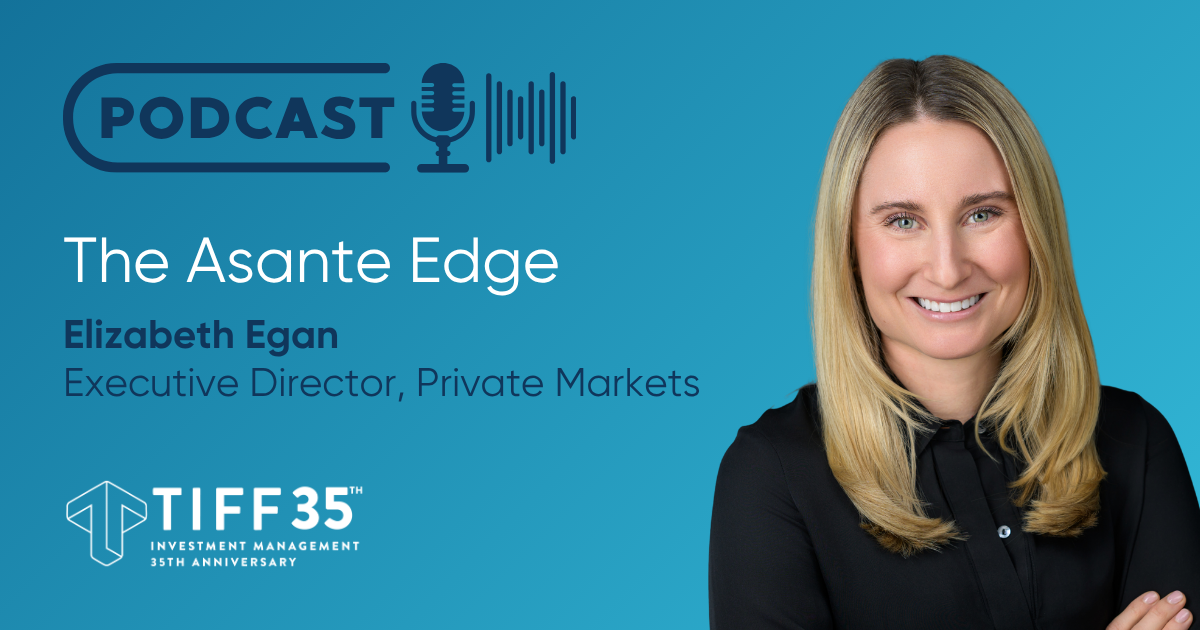
Elizabeth Egan
Executive Director, Private Markets
On April 2, 2025, TIFF hosted a webinar exploring insights from the white paper, “Why Venture Capital Still Works (early-stage VC that is),” led by Chris Anderson and Elizabeth Egan.
In this session Chris and Elizabeth highlighted the bear and bull case for why early-stage venture capital in today’s environment. Topics covered:
This webinar is for general informational purposes only and constitute neither an offer to sell nor a solicitation of an offer to buy securities. These materials also do not constitute an offer or advertisement of TIFF’s investment advisory services or investment, legal or tax advice. The asset classes discussed may not be suitable for all investors. Opinions expressed herein are those of TIFF and are not a recommendation to buy or sell any securities. Past performance does not guarantee future results. All investments are subject to risk, including the possible loss of principal.
These materials may contain forward-looking statements relating to future events. In some cases, you can identify forward-looking statements by terminology such as “may,” “will,” “should,” “expect,” “plan,” “intend,” “anticipate,” “believe,” “estimate,” “predict,” “potential,” or “continue,” the negative of such terms or other comparable terminology. Although TIFF believes the expectations reflected in the forward-looking statements are reasonable, future results cannot be guaranteed.
How I Invest Podcast – Strategies Institutions Need
Brendon Parry, CFA
Head of Private Markets, Deputy CIO
Brendon Parry, Head of Private Markets, Deputy CIO, and Managing Director at TIFF Investment Management is featured on How I Invest with David Weisburd.
The conversation explores:
TIFF’s Mission: How TIFF Investment Management supports nonprofits with specialized investment solutions.
Private Markets Expertise: Insights into early-stage venture capital, lower middle market buyout, and growth equity investments.
Partnership Approach: How TIFF collaborates with nonprofits of various sizes to customize portfolios and deliver long-term returns.
Legacy of Leadership: The influence of David Swensen, former Yale CIO, on TIFF’s investment philosophy.
Hidden Gem of Lower Middle Market PE: Learn how we believe the lower middle market’s less competitive landscape, coupled with operational improvement potential, makes it an attractive space especially when investing alongside independent sponsors.
Career Insights: Lessons from Brendon’s journey in private equity and investment management.
Disclaimer: Brendon Parry, CFA, is the Head of Private Markets, Deputy CIO at TIFF Investment Management. All views expressed by him on this podcast are solely his opinions and do not reflect the opinions of TIFF. You should not treat any opinions expressed by Brendon as a specific endorsement to make a particular investment. References to any securities are for informational purposes only and do not constitute an investment recommendation or offer to provide investment advisory services. Any past performance discussed is not indicative of future results. Please keep in mind that investment in a fund entails a high degree of risk, including the risk of loss. Please note that the ads featured in this podcast are not endorsed by TIFF, and TIFF is not a sponsor of these ads.
How I Invest is hosted by David Weisburd, a Venture Capitalist who has raised over $2B+ in institutional capital and is passionate about connecting Limited Partners (Endowments, Pension Funds, and Family Offices) with General Partners. The podcast, by their definition, interviews the world’s leading institutional investors.
Past performance is no guarantee of future results and the opinions presented cannot be viewed as an indicator of future performance. There is no guarantee that any particular asset allocation or mix of strategies will meet your investment objectives.
The materials are being provided for informational purposes only and constitute neither an offer to sell nor a solicitation of an offer to buy securities. These materials also do not constitute investment, legal or tax advice. Opinions expressed herein are those of TIFF and are not a recommendation to buy or sell any securities.
These materials may contain forward-looking statements relating to future events. In some cases, you can identify forward-looking statements by terminology such as “may,” “will,” “should,” “expect,” “plan,” “intend,” “anticipate,” “believe,” “estimate,” “predict,” “potential,” or “continue,” the negative of such terms or other comparable terminology. Although TIFF believes the expectations reflected in the forward-looking statements are reasonable, future results cannot be guaranteed.
Reading headlines about venture capital today may give investors pause on the health of the market and the opportunity set for capital deployment into venture-backed businesses. Some of the key concerns observed include:
Lack of liquidity
Substantial universe of private companies waiting for an exit
Depressed fundraising, deal pace, and valuations have the industry in a bit of a malaise
Increasing misalignment with the large multi-stage VC firms
Risk of an overhyped AI market
We believe there are silver linings to today’s macro backdrop that reinforce our excitement in venture capital. Investing in early-stage venture capital affords access to tomorrow’s groundbreaking companies at deep valuation discounts relative to what later-stage VCs pay. Early-stage investment is an important component of generating strong alpha in venture. Disciplined allocation consistently across cycles remains critical as markets cannot be timed. We’re bullish on today’s dynamics, despite the headline concerns, for numerous reasons:
Great companies are formed across market cycles – and will find an exit path in time
The scope of innovation and, thus disruptive businesses, is large and growing – we want to own the best, most innovative emerging companies
The bar has been raised on business quality, founder motivation, and alignment
Entrepreneurship in the US is alive and well
Less available capital means less competition and improved deal dynamics for investors
Introduction
The roller-coaster headlines on venture capital keep coming. Since we wrote about our perspectives on venture capital in February 2024, Capturing Venture Innovation Across Market Cycles, a casual observer might conclude that very little has improved in the venture landscape. In some respects, that is quite true. We still find that much of the venture capital market remains in a lull following the 2021 peak of venture activity and valuation euphoria; fundraising, deal activity, and liquidity are all dramatically lower today. However, in other respects, we are increasingly confident in – and excited about – the opportunity set that we believe is developing before us. As you’ve heard us say time and again, investors cannot time private markets. The most groundbreaking and innovative companies have been created at times that do not obviously correlate to market cycles. We believe that keeping a steady allocation to a high-quality roster of seed- and early-stage venture capital managers improves our probability of capturing a share of tomorrow’s next breakthrough companies and the outsized return potential generated from accessing them at their earliest stages.
Let’s take inventory of what we see as the deepest challenges the market needs to overcome, as well as the ingredients and rationale for the key opportunities ahead. For simplicity, we’ll call this TIFF’s assessment of the “bear case” and the “bull case” for venture capital today.
The Bear Case:
Limited Liquidity via IPO Market: We have witnessed a drought in liquidity from venture portfolios since late 2021. Unfortunately, the IPO window, a bellwether for the health of the VC world, is still not yet signaling that public markets are fully open for business. The bar is undoubtedly high for public market investors to buy new offerings, as they are still digesting a large number of IPOs that priced in the COVID-era froth. According to Preqin, there were 86 IPOs of venture-backed companies in the US during 2021, but only 27 in the following 3 years combined. As of February 28th, 2025, only 11 of those 2021 IPOs were trading above their original offering prices. Public markets investors now demand that businesses seeking a public offering meet more stringent performance criteria that emphasize both growth and profitability metrics. Many of these underwater IPOs were simply priced too aggressively, fail to meet these criteria today, or both. Public markets have a way to go to fully digest these losses, and strategic acquirers have also remained subdued, which doesn’t help the liquidity picture.
Mountainous Backlog of Venture-backed Unicorns: The lack of liquidity has led to a growing inventory of unicorns (a private company valued at $1 billion or more) looking for an exit. Today, there are over 750 unicorns in the US, collectively valued at over $2.7 trillion. That represents an astonishing backlog of companies with an enormous collective value, all effectively waiting for an exit. This backlog will extend hold periods for these assets. Many of these companies may also face haircuts to their later stage valuations as well.
US Unicorn Count and Aggregate Post-money Valuation
Source: Q4 2024 PitchBook-NVCA Venture Monitor Summary as of 12/31/2024.
Continued Fallout from COVID ERA VC “Bubble”: The venture ecosystem likely faces additional fallout from the COVID-era VC froth, potentially causing companies (and even VC firms) to fail, while also risking a broader decline in new company formation. What might losses look like from the two or three vintages before and after 2021? These losses might come simply from mark downs of expensive later round valuations or outright shutdowns of companies that failed to create sustainable businesses. The chart shows the recent uptick in down rounds (follow-on rounds at a lower entry valuation) and is one measure of the pain that the VC ecosystem is suffering. With a tougher fundraising environment, many VC firms could also fail to raise new capital and become “zombie funds.” Less capital in the ecosystem could contribute to a decline in entrepreneurship, as founders become more cautious or dissuaded entirely from taking the entrepreneurial plunge.
US Capital Raised ($B)
Share of VC Deal Count by Up/Down/Flat
Source: Pitchbook data as of 10/31/2024.
Source: Pitchbook data as of 12/31/2024.
Venture is Consolidating among misaligned Large Asset Gatherers: We have recently observed a substantial concentration of venture dollars in the larger, multi-stage platforms. According to Pitchbook, in 2024, 30 firms raised 75% of all venture capital commitments from LPs. Nine firms raised 50% of the capital. Smaller and newer emerging managers struggled to raise new funds, while many larger LPs increased their allocations to the large, established asset managers. With such large fund size and management fee streams, there is a natural risk, as we have believed consistently over the years, that these managers abandon an exclusive focus on return generation and prioritize capital deployment and AUM growth over all else.
Lack of discipline around Artificial Intelligence investing: New investments in AI companies have dominated venture deal activity. According to Crunchbase, 2024 investment in US AI venture-backed deals represented nearly half of all capital invested, up from 14% in 2022 and 25% in 2023. This AI feeding frenzy has created round size and valuation inflation and reeks of consensus-driven investing. Are investors paying reasonable valuations for entry into the hottest sector on the planet, or are they succumbing to FOMO and paying whatever is necessary to “win”? Are there too many “me too” AI companies getting funded? There’s a real risk that some venture capitalists are materially overpaying for the 5th best AI company targeting a particular opportunity; one or a small number of companies will eventually win, leaving many failed companies in the wake. With so much capital chasing these AI deals, there is a distinct risk that this may precipitate significant losses for some investors.
The Bull Case:
Great Companies will Eventually find an Exit … and will Keep Growing in the Meantime: While the near-term picture for liquidity remains murky, we remain convinced that investing year-over-year in disruptive, high-growth venture-backed companies at the earliest stages with significant ownership at low valuations is the key to long-term alpha generation. Great companies are founded at times that do not coincide with market cycles, and those great companies will compound capital for investors even if the hold period ends up extending.
For example, TIFF manager First Round Capital was the first investor in the now well-known ride-hailing app Uber in 2010 and supported the business through its 2019 IPO that valued it at over $75 billion. An investment in a brand-new category (ride-hailing) that got its start one year into the Global Financial Crisis was far from being an obvious winner to most people. First Round had the conviction to be a first-mover, and investors benefitted massively.
Another very recent example is Mucker Capital’s investment in cloud-based risk management and compliance software company AuditBoard. Mucker seeded the company in 2015 and helped the management team grow the business over 9 years. Despite the challenging VC exit market, AuditBoard was able to achieve a $3B exit in July 2024 to large-cap PE growth investor Hg Capital.
As we focus on investments in smaller funds that access early-stage companies, we have seen how great fund-level returns can potentially be generated by early ownership in businesses like Uber and AuditBoard. Net investor returns from early-stage fund investments are usually determined by a manager’s ability to “stock” pick – ultimately finding a small handful of companies that will really matter – and not singularly relying on macro venture trends.
Early-Stage Venture Growth and Innovation Across Market Cycles (2000 to 2020)1
The Scope of Innovative Companies is Substantially Larger Today: Investing in venture capital is often investing in innovation. This century, the venture ecosystem thrived from the platform shift to mobile, the shift to cloud-based software and services, and the emergence of blockchain. Today, new markets and platform shifts are creating new opportunities for the next generation of groundbreaking businesses. Yes, AI is a large part of this, and we are in the very early innings. AI enablement should allow these new companies to be leaner, build products faster, find product-market fit more efficiently, and scale faster. Innovation by no means stops there. Today, new businesses are being formed to solve some of the world’s toughest problems in categories like space, healthcare, sustainable energy, and government services. These expansive markets create significant potential for value creation by founders and venture investors.
Thinning the herd: The fundraising market has been undoubtedly very difficult in recent years. US VC fundraising skyrocketed to $175 billion from LPs in 2021 and $186 billion in 2022, and then subsequently fell by roughly half in 2023 and declined another 22% in 2024. Additionally, the number of new VC firms started annually (new entrants to the market) has steeply declined from nearly 450 new firms in 2021 to just 57 in 2024.2 Frankly, we are relieved to see the air come out of the balloon. One of the direct impacts is a reduction in competition for new deals, allowing for more attractive entry deal dynamics and higher expected returns. This also means that investors who do have capital to allocate to VC can access or increase allocations to historically access-constrained managers. We are leveraging this today.
Number of New Venture Capital Firms (Global)
Source: Preqin data as of 12/31/2024.
Positives around the higher Opportunity Cost for Founders: With less capital available to fund new start-ups, the opportunity cost pendulum for typical founders has swung from low to high. Until fundraising rapidly declined three years ago, raising capital for a new venture was not as formidable, considering the large amount of capital available and number of VCs to invest it. In that easier money environment, the stakes for a founder to start a new venture were lower. Today, the more challenging VC market acts as a forcing function on the conviction that a founder has in themselves and their business idea. We believe this has likely raised the bar on founder quality and quality of their businesses. It also enforces stronger discipline in generating profitable and efficient growth in venture-backed businesses, ideally reducing excessive cash burn in the industry.
Entrepreneurship is still on the Rise: Entrepreneurship has always been a cornerstone and strength of the US economy. The appeal of captaining your own vessel and making a difference are all contributors to this rise. Increased remote work has decreased certain obstacles to some for founding their very own businesses and building high-caliber team anywhere in the US or the world. According to the Commerce Institute, 5.5 million new businesses were formed in the US in 2023, an incredible rise from the 3.5 million formed in each of 2018 and 2019. While these are not all venture-backed, this is a positive signal that entrepreneurship remains on the rise and the opportunity set for venture capitalists will continue to grow.
Annual Business Formations in the US (M)
Source: US Census Bureau as of 12/31/2023.
The Innovation and Investment Opportunity Ahead
Macro headwinds clearly persist in the venture markets worldwide today. As discussed above, the venture market faces numerous challenges and questions. These challenges certainly may cause institutional investors to reduce or even abandon their commitments to venture, if they believe the doom and gloom that might signal venture is dead.
Sounds ominous, right? We don’t think so. We still believe in the long-term durability of the opportunity in early-stage venture for high caliber institutional LPs and that the issues that venture capital has been working through over the last several years will lead to a better investing environment. We remain bullish on early-stage venture market over the longer term and continue to find thoughtful and aligned partnerships that are poised to back the next era of technology disruptors. Increased capital scarcity is favorable for entry valuations and for instilling discipline in founders’ strategy for capital efficient growth. We’re seeing new, large frontiers for business creation, and the most innovative businesses may emerge from this period with much higher quality and disciplined financial and operational profiles.
We cannot time markets and, therefore, have and will continue to consistently allocate to high conviction venture managers. There are many reasons to be excited about the opportunity set before us, and we are thrilled to move ahead and capture the value created by the innovation ahead.
The materials are being provided for informational purposes only and constitute neither an offer to sell nor a solicitation of an offer to buy securities. These materials also do not constitute an offer or advertisement of TIFF’s investment advisory services or investment, legal or tax advice. Opinions expressed herein are those of TIFF and are not a recommendation to buy or sell any securities.
These materials may contain forward-looking statements relating to future events. In some cases, you can identify forward-looking statements by terminology such as “may,” “will,” “should,” “expect,” “plan,” “intend,” “anticipate,” “believe,” “estimate,” “predict,” “potential,” or “continue,” the negative of such terms or other comparable terminology. Although TIFF believes the expectations reflected in the forward-looking statements are reasonable, future results cannot be guaranteed.
Footnotes
TIFF. Time horizon represents transactions that have been given an opportunity to reach a degree of growth and maturity. This exhibit is included for illustrative purposes only.
You are now leaving TIFF Investment Management’s website and are going to a website that is not operated by TIFF Investment Management. We are not responsible for the content or availability of linked sites, and our inclusion of links to third-party websites does not imply any endorsement, approval, verification or monitoring by us of any of such linked sites’ content.