Endowment Spend Policy: Why Methodology Matters

Executive Summary

  • Spend policy methodology often receives less attention than the spending rate itself, despite having an equally meaningful impact on the dollars flowing into an institution’s budget.
  • While Investment Committees and organizations carefully review the rate annually, the implications and trade-offs of the calculation methodology are often not well understood.
  • The key trade-off is between spending stability and long-term endowment growth.
  • Each organization should assess its own needs and priorities to ensure the methodology selected aligns with objectives.
  • All organizations should be aware that market factors influence each methodology differently.
  • Over its 35 years of experience, TIFF has guided clients to understand and select the best spending methodology to meet its objectives.

Rethinking Spend Policy: Why Methodology Matters More Than You Think

Spend policy methodology often receives less attention than the spending rate itself, despite having an equally meaningful impact on the dollars flowing into an institution’s budget. While Investment Committees focus on the rate carefully and annually approve it, they don’t often consider with the same rigor how the spend is calculated, even though the methodology has immense impact on the amount of dollars going into the budget on an annual basis.

Based on various studies, the trailing average market value is the most popular spend methodology.1 However, there are a multitude of other methodologies, each with their own trade-offs. A methodology will perform differently depending on the current economic environment and generally falls along a spectrum of ensuring consistency/growth of spend and protecting the endowment corpus (especially in times of drawdown).

This article provides a framework for institutions to consider their objectives and needs when it comes to their spend, and which methodology might best fit those needs.

The Three Main Types of Methodologies

Our Spend Policy 101 whitepaper gave an overview of the most commonly used and discussed methodologies. A brief summary is below:

  1. Endowment Market Value: A predetermined percent of endowment market value, often on a trailing multi-year average basis.
  2. Inflation-Based: Last year’s spend value increased by inflation, sometimes within a band.
  3. Hybrid: A combination of market value and inflation.

There are other less common methodologies that we will not discuss in this article.

Trade-offs Among the Methodologies: A Framework for Consideration

Understanding what is important to your institution will help determine the best-aligned spend methodology. These factors should be documented in an institution’s spend policy, to ensure future leaders and fiduciaries understand the choices made. Each organization should assess their organizational preferences and objectives to help determine the best spend policy.

At a high level, institutions must balance institutional needs for consistency of spend value and what best helps build endowment value for the long term. TIFF has outlined conceptually where each methodology falls across these two considerations.
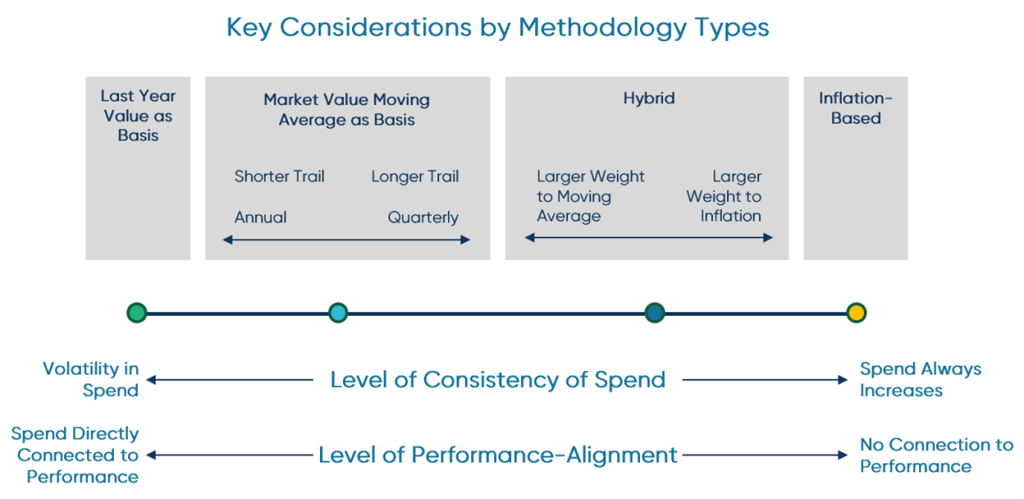
Key Considerations by Methodology Types
Source: TIFF internal analysis, representative view of consistency of spend.

A helpful starting point is assessing the institution’s sensitivity to changes in annual distributions. Organizations that rely heavily on endowment spending to fund their operating budget, or that have limited flexibility in other revenue sources, may prioritize policies that provide greater stability in spending levels. Institutions with more diversified or flexible funding sources may be better positioned to tolerate some variability in annual distributions in order to keep spending more closely aligned with investment performance.

Institutions should also consider their longer-term priorities for the endowment. Policies that prioritize consistency in spending can support budgeting and program stability but may require distributions during periods when the endowment is under pressure (e.g. taking out money during a market drawdown). Approaches that more closely track market performance may introduce short-term variability but can better protect the endowment’s ability to support future generations.

Key Questions for Institutions

To help an institution assess its endowment needs and what spend methodology might be appropriate, TIFF recommends focusing on the following questions:

  • How dependent is the institution’s operating budget on endowment spending, and how much variability in annual distributions can it realistically absorb?
  • If endowment spending declined meaningfully in a given year (e.g. 10–30%), how would the institution adjust its budget or operations?
  • How important is it for annual spending to grow consistently to keep pace with inflation and rising operating costs?
  • To what extent should spending be aligned with investment performance to protect the endowment’s long-term purchasing power?

This will help institutions assess their financial flexibility, reliance on endowment funding, need for predictable growth, and priority placed on endowment growth over time.

How Market Outlook Impacts Methodology

While it is difficult to predict future market and economic performance, it is important to recognize these factors, though out of any individual’s control, have an impact on the dollars in the institution’s pocket depending on the chosen methodology. While TIFF doesn’t support selecting a spend methodology based on market outlook, institutions should still be aware of the impact market factors have on their choice.

An institution can broadly anticipate each methodology to perform better in a different environment. While there are multiple inputs in the various spend methodologies, there are three key market factors across all of the approaches: (1) inflation, (2) market performance, and (3) market volatility.

A moving average will provide the highest dollars in the withdrawal when market performance is high and inflation is low (e.g. during the 2010s). An inflation-based methodology will produce the highest spend in a stagflation environment, where the spend increases to match inflation as the markets are flat (if not down). Hybrid, as it is a blend, typically ends in the middle of outcomes between market- and inflation-based approaches.

Chart: Case Study of Market Factor Impact on Spending Value
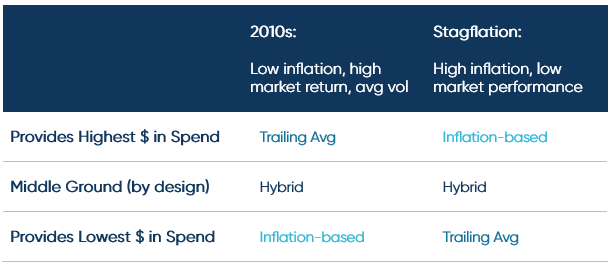
Case Study of Market Factor Impact on Spending Value
Source: TIFF Internal analysis, representative of average approach of each type.

Conclusion

Endowment spending policy is ultimately a reflection of an institution’s financial priorities, risk tolerance, and long-term mission. While the spend rate often receives the most attention, the methodology used to calculate that spending can have an equally meaningful impact on both annual budget support and the preservation of the endowment over time. By thoughtfully considering the trade-offs between spending stability and long-term endowment growth, and by aligning methodology with the institution’s financial structure and objectives, organizations can adopt a policy that supports both present needs and future generations. A well-documented approach ensures that these decisions remain intentional and well understood by future leaders and fiduciaries.

For 35 years, TIFF has helped endowed nonprofits achieve their investment goals to support their missions. One element of that support involves providing strategic governance advice to institutions as they navigate these challenging and “no-right-answer” topics. TIFF helps guide institutions toward the answer that best aligns with their organization’s financial structure, priorities, and mission.

Other Articles by TIFF on Spending Policy

Spend Policy 101

So, You are Considering Changing Your Spend Rate

Past performance is no guarantee of future results and the opinions presented cannot be viewed as an indicator of future performance. There is no guarantee that any particular asset allocation or mix of strategies will meet your investment objectives. 

The materials are being provided for informational purposes only and constitute neither an offer to sell nor a solicitation of an offer to buy securities. These materials also do not constitute investment, legal or tax advice. Opinions expressed herein are those of TIFF and are not a recommendation to buy or sell any securities. 

These materials may contain forward-looking statements relating to future events. In some cases, you can identify forward-looking statements by terminology such as may, will, should, expect, plan, intend, anticipate, believe, estimate, predict, potential, or continue, the negative of such terms or other comparable terminology. Although TIFF believes the expectations reflected in the forward-looking statements are reasonable, future results cannot be guaranteed. 

The referenced case study is included for illustrative purposes only, and was selected for inclusion based on objective, investment guidelines-based criteria for the purpose of describing the investment processes and analyses that TIFF uses to evaluate such investments. 

Footnotes

  1. FY25 Commonfund-NACUBO Study of Endowments, FY25 Commonfund-NBOA Study of Independent Schools.
Why Does Holdings-Level Detail Matter?

Executive Summary

  • Holdings transparency is essential to TIFF’s equity investment process.
  • Security-level holdings reveal portfolio factor exposures.
  • They allow TIFF to isolate managers’ idiosyncratic stock risk from factor risk, illuminating manager value-add.
  • Granular holdings data enables precise portfolio construction and risk management.
  • TIFF utilizes these elements in portfolio construction, risk management and manager selection.

Overview

For the marketable equity allocations, one of the most important portfolio analysis views is provided by security-level holdings. For most of our marketable equity managers, TIFF receives security-level detail, meaning what stock is held and at what size. This information is in addition to traditional exposure reports most managers provide. This level of detail allows TIFF to have a more robust and accurate view of our portfolio and to manage our exposures appropriately. The multi-dimensional, timely detail inherent in holdings is critical to TIFF’s risk management and equity portfolio construction approach.

Why are holdings so important? There are three key reasons:

  1. Granularity & Specificity: Holdings tell us the magnitude and sources of exposures at the most granular possible level.
  2. Idiosyncratic Risk Identification: Active managers’ specific stock views are the primary source of value in TIFF portfolios. The only way to identify and measure the individual risk and impact of these individual positions net of their generic factor exposures is to know the positions in detail.
  3. Actionable Risk Management: Knowing detailed manager holdings enables TIFF to manage portfolio risk with passive exposures and hedges with more efficacy and precision, and with less chance of overlooking an important exposure or of inadvertently offsetting managers’ specific stock views. Tracking the performance of individual stocks allows us to track these factor exposures in near-real time without having to rely on manager updates.

1. Granularity & Specificity

Security-level holdings allow us to understand our exposures, both magnitude and sources, at the most granular level possible. TIFF works with its managers to get holdings level data beyond the traditional exposure returns, allowing TIFF a better understanding of those exposures. Granularity below the summary level matters, sometimes very much.

Active equity managers will generally provide summaries of portfolio exposures at the regional level (e.g., US, EAFE, EM) or sector level (e.g., healthcare, IT). They may bucket market capitalization in broad categories (e.g., mega, large, small cap). To the extent they track style factors, the information they share is generally qualitative (e.g., “overweight growth”). Style factors are security-specific characteristics, such as Value (price:book), Profitability (profit:revenue) or Momentum, that help explain risk and return of a stock.

Case Study: Sector Distinctions that Matter

These kinds of industry-level distinctions are significant more often than not.

  • Healthcare comprises both large cap value-like pharmaceuticals (J&J, Pfizer), and small cap volatile biotech. It is one thing to have no net exposure to either industry and a very different thing to report no net healthcare exposure while being 5% overweight biotech and 5% underweight pharma.
  • Both software and semiconductors are components of IT, recently displaying dramatically different behaviors.

Case Study: Style Factor Decomposition

For style factors, granularity illuminates how a given factor is arising. Style factors are defined on a spectrum comparing a given portfolio’s exposure to the average exposure of the full equity investing universe. A style such as a Profitability overweight can arise via larger holdings in stocks that are more profitable than average or, instead, via underweights to unprofitable stocks. These are very different portfolio constructions that look the same at the qualitative “overweight Profitability” level.

2. Idiosyncratic Risk Identification

TIFF primarily aims to add value by identifying and investing with active managers that take idiosyncratic risk, risk over and above the factor risk inherent in their portfolios. A number of such TIFF managers take a “fundamental” approach, characterized by concentrated portfolios of stocks with relatively long-term investment theses (i.e., not high-frequency trading strategies), each of which is selected to deliver outperformance vs. similar stocks with similar factor profiles. The only way to understand the portfolio’s sources of idiosyncratic risk and their performance is to analyze these at the individual stock level.

Even among very similar stocks the differences in ex-ante risk and ex-post performance can often be dramatic. Although Nvidia and Analog Devices are both larger cap semiconductor designers, there has been a massive difference between these stocks over the past few years. This year, there has been extreme dispersion between AI “winners” and “losers” within the software industry.

Absent holdings data, it is very difficult to tell how effectively fundamental managers are taking idiosyncratic risk. While they will generally manage to self-selected benchmarks such as the S&P 500 (SPX), or even much more specific ones such as the NASDAQ Biotechnology Index (NBI), they will generally take on factor risks with respect to these benchmarks. Without knowing their factor-driven performance we cannot identify their idiosyncratic performance. Even if a manager were to report total idiosyncratic performance, we are very interested in the details. Did a manager rely on a single Nvidia-like outperformer? Or did they generate idiosyncratic alpha across their portfolio?

Longer term, the factor postures and idiosyncratic risk efficacy of our managers are critical to understanding whether a manager is adding value and whether we maintain, upsize or redeem our positions.

3. Actionable Risk Management

The detail we get from holdings only really matters if it is actionable. We use this information to fine-tune our portfolio factor exposures through a few techniques including:

  • passive ETF exposure
  • custom baskets of individual stocks, designed to offset any unwanted factor exposures at an equally granular and timely level. Knowing our managers’ intentional idiosyncratic risk-generating stock selections, we exclude any such overweighted stocks from our custom factor hedges to avoid inadvertently negating managers’ views.

Where Holdings-Level Doesn’t Matter

We are equally careful not to overuse holdings information. Alongside fundamental managers, we intentionally allocate to “systematic” managers (including multi-manager portfolios). These strategies are characterized by much more diversified portfolios with many more individual stocks and are also often characterized by higher-frequency trading strategies. Many systematic managers are not seeking to generate idiosyncratic risk via fundamental stock analysis but rather via proprietary strategies that take advantage of factor-like characteristics that are different from the common factors that we concentrate on in our factor analysis.

Knowing the holdings of these strategies does not help us; but, critically, we know that these managers carefully manage their traditional factor exposures. That means that if they say they are managing to a benchmark such as SPX or NBI, we can count on them to match the factor exposures of that benchmark. We can then confidently use the benchmark’s holdings as a proxy in our holdings-based factor analysis. We can also confidently ascribe all their performance vs. that benchmark to idiosyncratic risk. In this way, we appropriately combine holdings detail across different types of managers in our analyses and portfolio management.

Holdings-Level Detail Matters

Holdings detail is central to our equity portfolio management. Whether via fundamental manager individual stock holdings or very reliable proxies for systematic managers, we rely on it and would feel partially blind without it — to the extent that this information is a prerequisite for inclusion in our portfolios. We use it to efficiently and effectively construct portfolios with only the factor exposures we seek, minimizing unwanted, unproductive factor risk. In doing so, we allocate more of our risk budget to productive idiosyncratic risk, the area where our managers differentiate themselves and add value.

The materials are being provided for informational purposes only and constitute neither an offer to sell nor a solicitation of an offer to buy securities. These materials also do not constitute an offer or advertisement of TIFF’s investment advisory services or investment, legal or tax advice. Opinions expressed herein are those of TIFF and are not a recommendation to buy or sell any securities.

These materials may contain forward-looking statements relating to future events. In some cases, you can identify forward-looking statements by terminology such as “may,” “will,” “should,” “expect,” “plan,” “intend,” “anticipate,” “believe,” “estimate,” “predict,” “potential,” or “continue,” the negative of such terms or other comparable terminology. Although TIFF believes the expectations reflected in the forward-looking statements are reasonable, future results cannot be guaranteed.

Leveling Up: How TIFF Uses AI to Elevate the Investment Process

Executive Summary

  • AI allows our investment process to be deeper, faster, and more consistent.
  • Our team can shift resources away from mechanical tasks and toward higher-value analytical and judgement-driven work, aiming to improve our qualitative research, meeting preparation, thematic analysis, and performance attribution.
  • While we are adding these capabilities into existing workflows iteratively, decisions still require meaningful human judgement, interpretation, and oversight.
  • Next steps include exploring the use of AI for forecasting manager outcomes.

How AI Enhances our Investment Process

Over the past two years TIFF has integrated AI into our investment process, and it has already proven to be a worthwhile investment. At a high level, AI enables us to move faster without cutting corners, analyze more information without losing rigor, and apply a more consistent analytical framework across managers, strategies, and time periods. The result is a deeper, more scalable research process that supports better-informed decisions.

More Structured and Auditable Qualitative Analysis

One of AI’s most powerful contributions has been transforming how we handle qualitative information. Investment research is inherently text-heavy, encompassing manager letters, pitch decks, due diligence questionnaires, meeting notes, and internal memos. Historically, synthesizing this information has been time-consuming.

  • Dynamic Summary of a Manager’s Entire Investment History with TIFF: Prior to implementing our AI system, an analyst seeking to understand the investment thesis for a manager would have needed to navigate our research management system, locate the investment memo, review subsequent update notes, synthesize the information, and then form a view—a process that could take hours. Today, we can query a large language model that has already incorporated our entire research library to summarize a manager’s investment history with TIFF in under a minute. Importantly, all outputs are fully auditable and directly tied to source underlying documents.
  • Ingestion of Incoming Manager Information: AI also allows us to systematically ingest, structure, and analyze incoming text through a process as simple as forwarding an email. Previously, tagging, uploading, and filing materials required significant manual effort. Now, we use built-in tools that automatically detect, summarize, and email quarterly letter summaries to the investment team.
  • Consistent and Robust Manager Comparison Matrix: A particularly valuable capability is matrix-style analysis, which allows us to compare and contrast managers using multiple documents or time horizons. This approach enables us to identify common themes, points of divergence, recurring risks, and key differentiators far more quickly than traditional manual review. For example, we can construct a matrix that queries the most recent quarterly letters from all public markets managers and then directly interact with the results to understand areas of agreement and disagreement across our portfolio. What once required a week of effort can now be accomplished in under an hour, freeing time for deeper interpretation and discussion.
  • Consistent “First-Pass” Review for New Managers: When evaluating new managers, we use a matrix to compare each underwriting criterion at the sub-strategy level (e.g., applying our pre-defined manager-ranking criteria, conducting a scoring exercise, and supporting an answer in less than 100 words). Where AI’s perspective differs from our own, it suggests areas for further investigation—augmenting, rather than replacing, human judgment.1

Improved and Consistent Meeting Preparation

AI has also become central to how we prepare for manager meetings. Using structured, in-depth research workflows, we now produce concise overviews of a manager’s strategy, history, public reputation, strengths, weaknesses, and potential areas of concern prior to both initial and follow-up meetings. Importantly, AI also helps identify gaps, inconsistencies, or areas where information is sparse—often among the more productive areas to explore in conversation. Where risks or uncertainties warrant external validation, we use AI to help structure diligence plans, including suggested data requests and lines of inquiry for in-person meetings.2

Faster, More Targeted, and Deeper Thematic and Industry Research

AI materially improves our ability to capitalize on new strategies, industries, and market themes. When exploring unfamiliar areas, speed matters—but so does breadth. AI allows us to quickly synthesize large bodies of third-party research, expert commentary, and historical context to build a foundational understanding before engaging in deeper primary diligence.

This capability is particularly valuable in early-stage thematic work, where the goal is not precision forecasting, but rather understanding the landscape: how a strategy works, what risks tend to matter, where returns come from, and how different approaches compare.3

Clearer Performance Attribution and Risk Understanding

On the quantitative side, AI-enhanced tools improve how we analyze portfolio performance and risk exposures. Traditional multi-factor regressions remain useful, but machine learning techniques allow us to go further by identifying which factors truly matter statistically and offer better ways of isolating idiosyncratic returns (skill) from systematic returns. For example, we use techniques such as lasso regressions to determine which among the dozens of equity style factors are most closely related to a manager’s results. This leads to clearer attribution and more informative conversations about portfolio construction, diversification, and risk management.4

Next Step, Forecasting

While our systematic managers are using AI methods to directly forecast asset prices, TIFF is not currently using AI methods to forecast manager-level outcomes. Over the next year, we aim to examine this area further, as we believe that layering our unstructured text data with our structured numerical data could enhance our forecasting capabilities and support better decision-making.

Conclusion

AI is enhancing TIFF’s investment process by enabling a deeper, faster, and more consistent approach to research while reinforcing the central role of human judgment. By shifting time away from mechanical tasks and toward thinking, discussion, and decision-making, AI helps our team operate more productively. Assessing incentives, motivation, alignment, strategy coherence, portfolio fit and sizing remain fundamentally human responsibilities. AI simply allows us to bring more informed data, improved consistency, and a broader perspective to those judgments. As AI technology capabilities continue to level up, we see opportunities to further strengthen our research process.

The materials are being provided for informational purposes only and constitute neither an offer to sell nor a solicitation of an offer to buy securities. These materials also do not constitute an offer or advertisement of TIFF’s investment advisory services or investment, legal or tax advice. Opinions expressed herein are those of TIFF and are not a recommendation to buy or sell any securities.

There can be no guarantee that the use of Artificial Intelligence (“AI”) and Large Language Models (“LLMs”) will lead to investor returns. AI tools and LLMs may contain errors or inaccuracies and should not be relied upon as a substitute for professional advice. Any references to AI tools and LLMs use and advantages should be construed accordingly.

These materials may contain forward-looking statements relating to future events. In some cases, you can identify forward-looking statements by terminology such as “may,” “will,” “should,” “expect,” “plan,” “intend,” “anticipate,” “believe,” “estimate,” “predict,” “potential,” or “continue,” the negative of such terms or other comparable terminology. Although TIFF believes the expectations reflected in the forward-looking statements are reasonable, future results cannot be guaranteed.

Footnotes

  1. These capabilities are enabled primarily through our research management platform, Finpilot AI.

  2. ChatGPT Enterprise is the primary tool supporting this workflow.

  3. We also utilize external research libraries with AI overlays, such as AlphaSense.

  4. These capabilities are supported through Two Sigma Venn.

So, You Are Considering Changing Your Spend Rate

Executive Summary

  • An institution may consider changing its spend rate for various reasons, such as facing financial challenges and wanting to increase budgetary support or experiencing financial success and aiming to grow the endowment more quickly.
  • When considering a change in spend rate, it is important to understand how it affects the endowment’s future purchasing power and budgetary support.
  • Spend rates require careful balance: they cannot be so low that the institution lacks support, nor so high that maintaining inflation-adjusted principal becomes challenging, as the endowment must earn a return to offset spending plus inflation.
  • Two main trade-offs to consider when changing spend rates:
    • Timing of value: Higher spending today versus more spending dollars in the future due to asset compounding over time
    • Impact to endowment strategy: Rate changes may require adjustments to target return requirements, risk level, and asset allocation

The Decision Framework

Whether driven by financial pressures or strategic opportunity, spend rate adjustments represent one of the most significant decisions an endowment can make. The process requires careful analysis of both quantitative impacts and qualitative institutional factors. As a reminder, spend rate is the percent an institution withdraws from its endowment on an annual basis. Please refer to our Spend Policy 101 for a foundational overview.

Balancing Mission Support and Purchasing Power

At its core, spend rate decisions involve balancing competing institutional priorities. These dual endowment goals—supporting today’s mission while preserving tomorrow’s purchasing power—create a natural tension that requires careful balance. Rates too low fail to adequately support institutional needs, while rates too high make it challenging to maintain real value over time.

Key Trade-offs in Changing the Rate

Timing of the Value

A key consideration in determining if a rate change is appropriate is identifying when the institution would benefit most from its endowment funds.

For example, funds left in the endowment will grow and compound creating a larger spend in the future, while funds taken from the endowment will provide an immediate budget impact today.

Case Study

The example below highlights the trade-off in a $100M endowment of raising a 3-year trailing average spend of 4% to 4.5%. The numbered commentary corresponds to the charts that follow.

  1. There is an immediate impact on spend to support the budget, which continues for several years.
  2. However, all else being equal, this larger spend reduces the size of the endowment.
  3. At a certain point, the spend to the institution is now less at 4.5% than 4%, because the endowment size has been reduced over time.
By the Numbers: Trade-off between Increasing the Rate
Source: TIFF analysis; assumes 3-year annual trailing spend methodology and a 7% annualized return.

Factors to Consider

When having these discussions, pairing quantitative analysis with collaborative discussion is important. Here are some key factors worth considering:

  • Value of the change: Consider the net present value of the marginal budget support
    • For rate increases, determine whether they support long-term value or address one-time, short-term uses
  • Duration of spend rate change: Spend rate changes are not permanent and can be changed again in the future
  • Spend methodology: How the institution calculates the spend will impact the trade-offs
  • Endowment portfolio construction: Consider target returns, long-term expected real returns excluding spend, and risk level
  • Inflation expectations: These impact target returns as well as budget and potentially spend methodology
  • Institutional factors: Evaluate current and future funding requirements, and the organization’s broader financial situation (revenue sources and stability, debt, etc.)
  • Industry trends/perspective: Peer comparisons on both endowment and institutional factors exist to help contextualize each institution’s circumstances

Potential Impacts to the Endowment from Changing the Rate

Changing the rate can also have implications for the endowment, either providing more flexibility to grow or creating challenges to maintain principal. Most institutions maintain their investment strategy when lowering the rate, hoping to compound assets faster and build the endowment’s asset base for the future. The challenge arises when an institution increases its spend rate: can it adjust its risk or asset allocation enough to maintain the inflation-adjusted corpus?

Potential Impacts to the Endowment from Changing the Rate

Conclusion

Changing an institution’s spend rate requires careful consideration, input from a multitude of stakeholders, and thorough analysis of both qualitative and quantitative trade-offs. It is not a decision to be made without robust dialogue with key constituents. If your institution is considering a change to your spend rate, TIFF is ready to help navigate the various considerations and determine the right path for your institution.

Past performance is no guarantee of future results and the opinions presented cannot be viewed as an indicator of future performance. There is no guarantee that any particular asset allocation or mix of strategies will meet your investment objectives.

The materials are being provided for informational purposes only and constitute neither an offer to sell nor a solicitation of an offer to buy securities. These materials also do not constitute investment, legal or tax advice. Opinions expressed herein are those of TIFF and are not a recommendation to buy or sell any securities.

These materials may contain forward-looking statements relating to future events. In some cases, you can identify forward-looking statements by terminology such as “may,” “will,” “should,” “expect,” “plan,” “intend,” “anticipate,” “believe,” “estimate,” “predict,” “potential,” or “continue,” the negative of such terms or other comparable terminology. Although TIFF believes the expectations reflected in the forward-looking statements are reasonable, future results cannot be guaranteed.

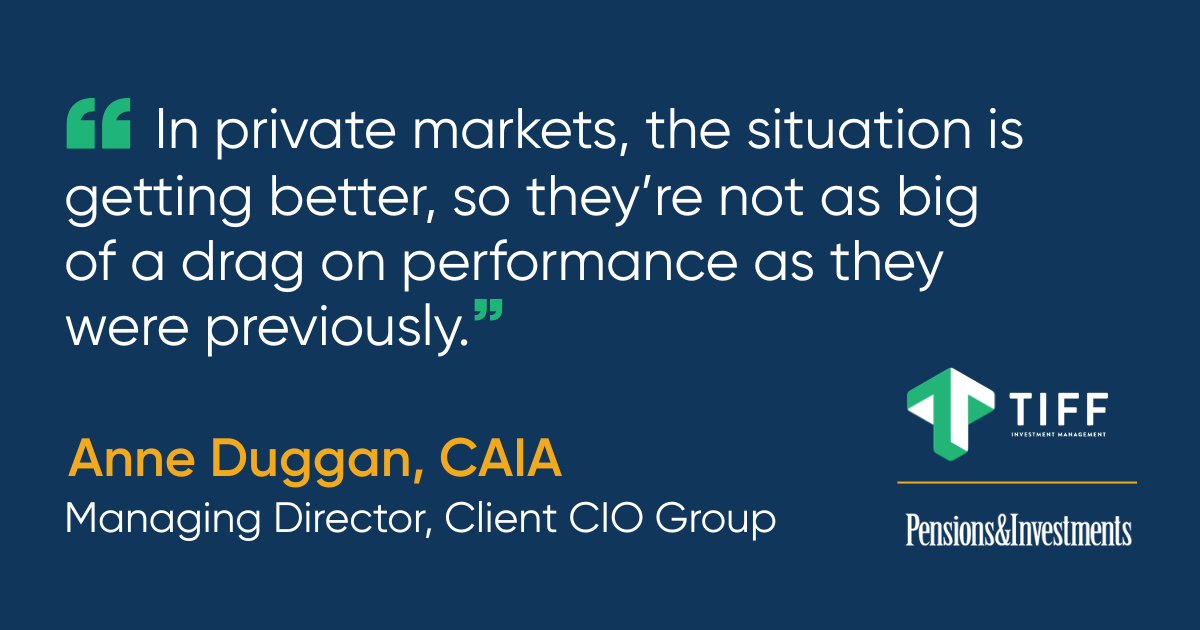
Traditional endowment playbook meets reality check. Money managers see opportunities.

In Pensions & Investments’ latest article, Anne Duggan of TIFF Investment Management highlights why strong, ongoing manager relationships are crucial — especially when markets are volatile. Access to closed or limited-capacity strategies often hinges on being in the conversation early.

Read the full article
Disclaimer: To access this article, a subscription is necessary. Please note that TIFF does not possess the rights to distribute this content.

The materials are being provided for informational purposes only and constitute neither an offer to sell nor a solicitation of an offer to buy securities. These materials also do not constitute an offer or advertisement of TIFF’s investment advisory services or investment, legal or tax advice. Opinions expressed herein are those of TIFF and are not a recommendation to buy or sell any securities.

These materials may contain forward-looking statements relating to future events. In some cases, you can identify forward-looking statements by terminology such as “may,” “will,” “should,” “expect,” “plan,” “intend,” “anticipate,” “believe,” “estimate,” “predict,” “potential,” or “continue,” the negative of such terms or other comparable terminology. Although TIFF believes the expectations reflected in the forward-looking statements are reasonable, future results cannot be guaranteed.