Can AI Outperform Human Investors? The Hedge Fund Perspective.

Executive Summary

  • The hedge fund industry is no stranger to AI, but recent advancements have improved the way hedge funds invest.
  • Data is a key competitive advantage for hedge funds leveraging AI. However, investors should understand how that data is sourced, processed, and interpreted.
  • Key impediments to broader AI adoption include the high cost of computing power and difficulty attracting top-tier talent.
  • Despite AI’s growing role, human judgment remains a critical component of investment decision-making.

Introduction

Leopold Aschenbrenner, a 23-year-old former OpenAI engineer and founder of the $1.5 billion hedge fund Situational Awareness, wrote recently that “Everyone is talking about AI, but few have the faintest glimmer of what is about to hit them.1

For an industry that hires some of the smartest people in the world and prides itself on innovative investment approaches, how vulnerable is the hedge fund industry to an AI invasion?

In reality, hedge funds have been incorporating forms of AI for decades. Large systematic (quantitative) funds have existed since the 1980s. Even more recent funds like Numerai, which relies on public tournaments to crowdsource quantitative trading signals, have been around for over a decade.2

Let’s explore how hedge funds are deploying AI today, along with the challenges that still exist.

Data and Delusion

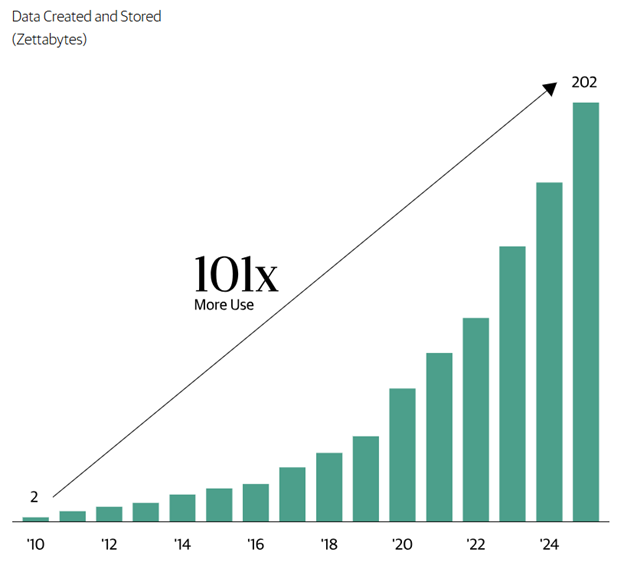
Put simply, AI models take large amounts of data and aim to predict the future of market movements based on this data (Figure 1). Yet we often hear the question: “Isn’t data just data? Can’t everyone just buy the same data?”

Not so. In practice, we have found that access to proprietary, well-structured data has become one of the key differentiators in determining which hedge funds have an edge in the AI race.

Global Data Creation and Storage Has Grown 101x Since 2010
Figure 1. Global Data Creation and Storage Has Grown 101x Since 20103
Systematic funds represent some of the earliest and most prominent adopters of AI in the hedge fund industry. They utilize vast quantities of data to identify patterns and generate predictive signals. Investors often assume these funds have pristine data and can forecast with precision. In reality, many predictions are based on small tidbits of information. The process can sometimes be like trying to guess a picture of a dog when all you are given is 5 pixels. Many systematic funds operate with hit rates slightly over 50%, but small gains with enough repetition can lead to large gains. Unsurprisingly, systematic funds have invested heavily in their data capabilities in recent years.

Ben Wellington from Two Sigma highlighted this point on a recent podcast, emphasizing the importance of being present at the moment data is created to ensure proper categorization.4 In this podcast, he shared an example from the post-financial crisis era: after 2008, a major newspaper retroactively labeled articles from 2006 and 2007 as “subprime.” A researcher relying only on these labels might mistakenly conclude that the sudden rise in “subprime” mentions was a powerful predictive signal. In reality, it reflected backfill bias—a postmortem reclassification rather than a true early warning.

One area within hedge funds where data aggregation has shown its worth is in the event-driven space. Long-tenured Equity Capital Markets (ECM) funds investing in deals such as IPOs, M&A, and issuances have been able to accumulate a treasure trove of data on past transactions, which in turn helps make surprisingly accurate predictions about outcomes of future events.

For example, by identifying situations that are likely to lead to a deal break, an M&A fund could limit its exposure to left-tail events, thereby enhancing its overall return profile of the fund.

Moving forward, we believe those funds with the deepest, richest, and most proprietary data will retain a significant edge. More recent entrants will need to demonstrate more creativity in how they use available data to leapfrog incumbents.

Talent and Technology

Nvidia’s staggering ~1,200% performance5 over the past five years has demonstrated the importance of computing power to AI development. More processing power means faster hypothesis testing and portfolio optimization which may lead to faster and better signal development. For systematic funds, this could translate directly into alpha. The downside is that processing power is expensive and difficult to scale. Leasing costs for data centers for a large systematic fund can run into hundreds of millions of dollars per year, thus limiting the amount of AI a smaller hedge fund can realistically deploy.

More important than processing costs is the ability to attract talent. It is often said that 20% of researchers generate 80% of the successful signals in a given year, though the challenge is that no one knows in advance which 20%. For this reason, it is important to keep a wide cast of highly talented (and highly paid) staff on the payroll. Hedge funds are competing with technology firms for top AI talent, with pay packages now exceeding $1 million per year.  What’s more, each AI developer needs to have a supporting cast of data engineers and developers to help turn theory into reality.

That said, we have seen increasing success rate among more entrepreneurial managers who strike out on their own with assistance from AI, particularly those focused on a specific niche.

Judgement and Justification

For all of AI’s capabilities, there remain areas of investing where human judgment is difficult to replicate. Manager discretion is one of the most significant. Fundamental strategies retain an edge in situations where decision-making depends on conviction, contrarian thinking, or nuanced human interactions. For example, when a portfolio manager chooses to concentrate on a handful of high-conviction positions, or makes a contrarian trade based on direct engagement with company management, the driver is individual judgment rather than an algorithmic signal.

Management meetings underscore this distinction. Whether investors are receptively learning or seeking to influence outcomes through activism, these activities remain firmly in the fundamental toolkit, not the quantitative one. Human relationships and qualitative assessments are central to investment due diligence, and AI has not yet shown an ability to replicate these dynamics. Many of the top-performing fundamental hedge funds demonstrate a proclivity to execute judgment calls that may rest on nothing more than pattern recognition honed over years of experience in a particular market segment.

This is not to say AI cannot aid the traditional investment process. We often find that today’s fundamental investors are using AI to help them summarize information and build a baseline understanding. Tools capable of reading decades of company filings in minutes, updating financial models post earnings in seconds, and distilling real-time company news into bullet points have given these managers much greater efficiency in their decision-making.

Conclusion

We remain optimistic about AI’s potential and believe it will continue to reshape the landscape of the hedge fund industry. However, managers should be cautious not to rely so heavily on AI that they lose their judgment.

The materials are being provided for informational purposes only and constitute neither an offer to sell nor a solicitation of an offer to buy securities. These materials also do not constitute an offer or advertisement of TIFF’s investment advisory services or investment, legal or tax advice. Opinions expressed herein are those of TIFF and are not a recommendation to buy or sell any securities.

These materials may contain forward-looking statements relating to future events. In some cases, you can identify forward-looking statements by terminology such as “may,” “will,” “should,” “expect,” “plan,” “intend,” “anticipate,” “believe,” “estimate,” “predict,” “potential,” or “continue,” the negative of such terms or other comparable terminology. Although TIFF believes the expectations reflected in the forward-looking statements are reasonable, future results cannot be guaranteed.

Footnotes

  1. Leopold Aschenbrenner, Situational Awareness: The Decade Ahead, 2025. https://situational-awareness.ai/introduction

  2. Justina Lee, “JPMorgan Pledges $500 Million to Crowdsourcing Hedge Fund Numerai,” Bloomberg, April 16, 2024. https://www.bloomberg.com/news/articles/2024-04-16/jpmorgan-pledges-500-million-to-crowdsourcing-hedge-fund-numerai

  3. Blackstone, Cutting Through the Noise: The Long-Term Case for Data Centers, The Connection, 2024. https://www.blackstone.com/the-long-term-case-for-data-centers

  4. “Ben Wellington: ML for Finance, NYC Open Data, and Communicating with Maps,” The Gradient: Perspectives on AI, Apple Podcasts, January 10, 2024. https://podcasts.apple.com/us/podcast/ben-wellington-ml-for-finance-and-storytelling/id1569777340?i=1000649209968

  5. Kif Leswing, “Nvidia Hits $3 Trillion Market Cap on Back of AI Boom,” CNBC, June 5, 2024. https://www.cnbc.com/2024/06/05/nvidia-briefly-passes-3-trillion-market-cap-on-back-of-ai-boom.html

So, You Are Considering Changing Your Spend Rate

Executive Summary

  • An institution may consider changing its spend rate for various reasons, such as facing financial challenges and wanting to increase budgetary support or experiencing financial success and aiming to grow the endowment more quickly.
  • When considering a change in spend rate, it is important to understand how it affects the endowment’s future purchasing power and budgetary support.
  • Spend rates require careful balance: they cannot be so low that the institution lacks support, nor so high that maintaining inflation-adjusted principal becomes challenging, as the endowment must earn a return to offset spending plus inflation.
  • Two main trade-offs to consider when changing spend rates:
    • Timing of value: Higher spending today versus more spending dollars in the future due to asset compounding over time
    • Impact to endowment strategy: Rate changes may require adjustments to target return requirements, risk level, and asset allocation

The Decision Framework

Whether driven by financial pressures or strategic opportunity, spend rate adjustments represent one of the most significant decisions an endowment can make. The process requires careful analysis of both quantitative impacts and qualitative institutional factors. As a reminder, spend rate is the percent an institution withdraws from its endowment on an annual basis. Please refer to our Spend Policy 101 for a foundational overview.

Balancing Mission Support and Purchasing Power

At its core, spend rate decisions involve balancing competing institutional priorities. These dual endowment goals—supporting today’s mission while preserving tomorrow’s purchasing power—create a natural tension that requires careful balance. Rates too low fail to adequately support institutional needs, while rates too high make it challenging to maintain real value over time.

Key Trade-offs in Changing the Rate

Timing of the Value

A key consideration in determining if a rate change is appropriate is identifying when the institution would benefit most from its endowment funds.

For example, funds left in the endowment will grow and compound creating a larger spend in the future, while funds taken from the endowment will provide an immediate budget impact today.

Case Study

The example below highlights the trade-off in a $100M endowment of raising a 3-year trailing average spend of 4% to 4.5%. The numbered commentary corresponds to the charts that follow.

  1. There is an immediate impact on spend to support the budget, which continues for several years.
  2. However, all else being equal, this larger spend reduces the size of the endowment.
  3. At a certain point, the spend to the institution is now less at 4.5% than 4%, because the endowment size has been reduced over time.
By the Numbers: Trade-off between Increasing the Rate
Source: TIFF analysis; assumes 3-year annual trailing spend methodology and a 7% annualized return.

Factors to Consider

When having these discussions, pairing quantitative analysis with collaborative discussion is important. Here are some key factors worth considering:

  • Value of the change: Consider the net present value of the marginal budget support
    • For rate increases, determine whether they support long-term value or address one-time, short-term uses
  • Duration of spend rate change: Spend rate changes are not permanent and can be changed again in the future
  • Spend methodology: How the institution calculates the spend will impact the trade-offs
  • Endowment portfolio construction: Consider target returns, long-term expected real returns excluding spend, and risk level
  • Inflation expectations: These impact target returns as well as budget and potentially spend methodology
  • Institutional factors: Evaluate current and future funding requirements, and the organization’s broader financial situation (revenue sources and stability, debt, etc.)
  • Industry trends/perspective: Peer comparisons on both endowment and institutional factors exist to help contextualize each institution’s circumstances

Potential Impacts to the Endowment from Changing the Rate

Changing the rate can also have implications for the endowment, either providing more flexibility to grow or creating challenges to maintain principal. Most institutions maintain their investment strategy when lowering the rate, hoping to compound assets faster and build the endowment’s asset base for the future. The challenge arises when an institution increases its spend rate: can it adjust its risk or asset allocation enough to maintain the inflation-adjusted corpus?

Potential Impacts to the Endowment from Changing the Rate

Conclusion

Changing an institution’s spend rate requires careful consideration, input from a multitude of stakeholders, and thorough analysis of both qualitative and quantitative trade-offs. It is not a decision to be made without robust dialogue with key constituents. If your institution is considering a change to your spend rate, TIFF is ready to help navigate the various considerations and determine the right path for your institution.

Past performance is no guarantee of future results and the opinions presented cannot be viewed as an indicator of future performance. There is no guarantee that any particular asset allocation or mix of strategies will meet your investment objectives.

The materials are being provided for informational purposes only and constitute neither an offer to sell nor a solicitation of an offer to buy securities. These materials also do not constitute investment, legal or tax advice. Opinions expressed herein are those of TIFF and are not a recommendation to buy or sell any securities.

These materials may contain forward-looking statements relating to future events. In some cases, you can identify forward-looking statements by terminology such as “may,” “will,” “should,” “expect,” “plan,” “intend,” “anticipate,” “believe,” “estimate,” “predict,” “potential,” or “continue,” the negative of such terms or other comparable terminology. Although TIFF believes the expectations reflected in the forward-looking statements are reasonable, future results cannot be guaranteed.

Underweighting Equities is Usually a Bad Idea

Executive Summary

  • Investors considering timing equities should proceed with caution
  • Forecasting returns, particularly over short-time horizons, is very difficult
  • Underweighting equities often results in unattractive opportunity costs
  • Successfully timing the decision to return to a normal long-term allocation requires extreme fortitude

The past few months have been a period of very high volatility in equities due to several factors. Items weighing on investors likely include a combination of President Trump’s decision to increase tariffs on imports, continued tensions between the US and China, unclear resolutions to the armed conflicts in Gaza and Ukraine, and uncertainty from the DOGE initiative, which could either help balance the budget resulting in a more efficient US government or weaken a variety of strategically important social services and government programs. We have started to receive some questions from clients about the merits of underweighting equities relative to their long-term strategic targets. In general, we do not recommend that course of action for several reasons:

1. Forecasting Challenges

It would add material value if we could avoid the very worst months or quarters in equities. Unfortunately, forecasting in investments is unlike forecasting in most other fields. Predicting outcomes over the next month or year is not that difficult in most industries. Most owners and operators of businesses have a good idea of how their company will perform over the next month or quarter. However, forecasting business outcomes over the next ten years is much more difficult, if not impossible, for most sectors. For example, many publicly traded companies provide guidance for the next year but very few provide detailed guidance beyond that. Forecasting in investments is exactly the opposite. The range of annualized returns for monthly or quarterly data points is very wide. If we instead looked at rolling five-year outcomes and annualized those results, the range of IRRs would be considerably tighter. In investments, the longer the time horizon becomes, the easier it is to accurately predict the rate of return. The table below illustrates that shorter periods show a wider range of outcomes, with a 72% spread between the best and worst months. In contrast, longer periods, like five years, have a much narrower range, with approximately a 10% spread.

Range of Annualized Returns at Different Measurement Intervals, 1945-20241

Annualized Returns by Measurement Interval

We observe the challenges in short-term forecasting when evaluating managers. One of the methods we use to evaluate equity long/short hedge funds is to decompose the sources of excess returns into three categories: longs, shorts, and value-added from variance in net exposure. Across a growing library of several hundred different managers, we have seen very little evidence of statistically significant value-added from short-term variance in the net by equity-oriented hedge fund managers. We utilize a similar strategy for long-only managers who prefer to hold cash. It is very rare for the managers’ actual realized results to outperform a pro forma portfolio that grosses up their holdings such that they would have been at least 95% fully invested at all times. Even among trend-following managers, who are much more focused on market timing, we have seen mixed results. Short-term forecasting is very difficult.

2. Opportunity Costs

If we instead rely on longer-term forecasts, which are typically more accurate, we encounter a different problem. For an institutional portfolio, the meter is always running. We do not get to call capital when interesting opportunities arise and give it back when there are less attractive options. When we reduce equities, the capital must go somewhere else. The most obvious alternative to stocks when people are concerned about the risk of losing money is bonds or cash. The problem we face as investors is there are not many periods when bonds or cash outperform stocks over reasonable forecast horizons. We have used the S&P 500 and the benchmark 10-year Treasury bond for our analysis below.

Average Relative Results: Stocks vs. Bonds2

Stocks v Bonds

Even if the next five or ten years will in fact turn out to be one of these unusual periods when the return on equity is disappointing, it is important to evaluate the alternative use of capital. Revisiting the first chart and assuming the next five years will generally be a bottom-quartile return period for stocks, we can roughly estimate a 5% annualized return. The problem is that the yield to maturity on the 10-year Treasury bond is only 4.2%3. Selling something with an estimated return of roughly 5% to buy something that we should reasonably expect to return 4% is still a long-term expected performance concession. As outlined in Jay Willoughby’s Q4 2024 CIO Commentary and given some of the fiscal challenges the US faces, we think a much higher starting yield to maturity on bonds would be required for investors to consider materially underweighting equities in favor of bonds.

3. Psychology and the Pattern of Returns

For an equity market timing strategy to be successful, investors need to get two calls correct, not one. Those who underweight their long-term strategic targets will eventually need to decide when to return the equity allocation to its normal level. This second decision is key because, in equities, the big days are very important. Since 1945, the annualized return on the S&P 500 is roughly 7.9%4. If we exclude the top 1% return days, the annualized return would be a loss of -1.8%. Market prices tend to overshoot the changes to long-term fundamentals. As a result, equities are often undervalued at the bottoms of drawdowns. Also, markets discount anticipated economic conditions. When sentiment finally improves at the bottom of a drawdown, prices can move back up very quickly. The tables below show the best single day returns for the S&P 500 since 1945. All of them occurred during points in the cycle when uncertainty and volatility were very high. Because the absolute best days and worst days tend to cluster together, mistiming one of the two decisions, even by a day, can be very damaging. The best time to add to equities will often be at the point in the cycle in which doing so feels the most uncomfortable. The average investor who tries to time the market is highly likely to miss at least the first part of the recovery. Missing these big days often locks in long-term underperformance.

Highest Single Day Returns for the S&P 500, 1945 – 20245

Highest Single Day Returns from the S&P 500

Conclusion

While equity market volatility can be unsettling, maintaining a long-term perspective on equities is crucial for achieving optimal investment outcomes. Predicting short-term market movements is highly challenging, and the costs of missing key recovery days can be significant. By sticking to a long-term strategy around equities, investors can avoid market-timing pitfalls and benefit from the growth potential of owning stocks. Our tactical adjustments to equity exposure tend to be small because we understand how difficult it is to do this well. We tend to be biased to overweights because that improves our odds of generating good returns.

The materials are being provided for informational purposes only and constitute neither an offer to sell nor a solicitation of an offer to buy securities. These materials also do not constitute an offer or advertisement of TIFF’s investment advisory services or investment, legal or tax advice. Opinions expressed herein are those of TIFF and are not a recommendation to buy or sell any securities.

These materials may contain forward-looking statements relating to future events. In some cases, you can identify forward-looking statements by terminology such as “may,” “will,” “should,” “expect,” “plan,” “intend,” “anticipate,” “believe,” “estimate,” “predict,” “potential,” or “continue,” the negative of such terms or other comparable terminology. Although TIFF believes the expectations reflected in the forward-looking statements are reasonable, future results cannot be guaranteed.

Footnotes

  1. Source: Bloomberg.

  2. Source: Bloomberg and Federal Reserve.

  3. Bloomberg as of 4/30/25.

  4. Equity price data sourced from Bloomberg.

  5. Source: Bloomberg.

How Endowments and Foundations Can Manage Inflation Risk

Executive Summary

  • Hedging inflation in endowment and foundation portfolios is challenging because many hedging instruments have proven largely ineffective for two reasons:
    1. Low reliability: they do not reliably respond to inflation in the way theory suggests.
    2. High opportunity cost: they supplant productive core portfolio allocations and underperform when inflation is benign.
  • Many “classic” hedging allocations such as real estate, real assets, and gold fall in this camp, suffering from unreliability and/or high net cost.
  • Other strategies, including portfolio duration management and inflation swap overlays, have shown efficacy with carefully managed implementation.

The Challenge of Hedging Inflation

Of all the risks faced by endowment and foundation (E&F) investors, inflation is among the most challenging to hedge. Over time an actively managed portfolio consistently focused on equities, taking prudent advantage of private investments and appropriately diversified, has the best chance of delivering a robust real return over inflation. However, as we’ve been reminded over the last few years, spikes in inflation can make this goal harder to achieve. An inflation hedging allocation seeks to mitigate these periodic challenges.

The theory is straightforward – two types of assets should work as hedges:

  1. Those with intrinsic value that will make their prices grow with inflation. For most portfolios, the investable version of such assets is commodities, including gold, and some commodity-like real assets such as timber.
  2. Those with the ability to increase their cash yields in line with inflation. These assets include rent-generating real estate, infrastructure real assets such as toll roads or utilities, and inflation-indexed securities such as the US Treasury’s TIPS.

Of course, the reality is anything but straightforward for two basic reasons. First, the economy hardly sits by passively when inflation emerges (or recedes) – consumers, producers, and government all react, impacting demand, supply, interest rates, and fiscal policy in ways that can overwhelm the theoretical responses of inflation hedges, making them less reliable. Second, inflation hedges have meaningful opportunity cost as they generally underperform when inflation is benign and also supplant part of the core elements of an investment portfolio, costs which can outweigh their benefits.

Which Classic Strategies Have Worked?

So, if inflation hedges are unreliable and costly, how does one decide which (if any) to employ? One approach is to assess reliability and opportunity cost practically by modeling an investable hedging strategy and observing whether it would have added value to the type of portfolio E&Fs actually employ. Let us first look at the impact of the classic hedging strategies mentioned above: commodities, including gold; real estate and real assets; and TIPS. We focus on practical liquid implementations that i) are accessible to typical E&Fs and ii) can be added to or removed from a portfolio as inflation risks warrant.

We look at rolling 1-year periods, both inflationary and non-inflationary, during the past 40 years*. We choose 1-year periods because the response of hedges to inflation1 can take time, and shorter periods, such as a quarter-year, may not show a relationship, while longer multi-year periods often incorporate both an increase and subsequent decrease in inflation, again muddying the relationship. For each asset, first, we check reliability by observing the correlation of returns with inflation – is there evidence that the asset responds to inflation as hoped?

If there is a meaningful correlation, we will then check the cost/benefit: the excess return generated by the hedged portfolio vs the unhedged portfolio. To assess this cost/benefit correctly, the core portfolio must be representative – what core investment do we forgo and replace with a hedge? E&Fs are endlessly diverse in many dimensions, but at a high level share a fundamental investment goal: funding their missions reliably and effectively over the very long term. Parsing this goal leads to common requirements for their portfolios:

  • Funding requires ready liquidity for distributions, while their long-term horizon often permits prudent but meaningful high-potential illiquid private investment.
  • Continued effectiveness requires, at a minimum, growth with inflation net of distributions, while reliability requires volatility management via diversification.

To achieve these requirements, a typical TIFF client portfolio might have an illiquid budget of 10-35%, with the balance in liquid assets, and about 2/3rds of assets in growth-driving equities with the balance in volatility-reducing diversifying investments. For this exercise, we assume a core portfolio of 45% liquid equity2, 20% private equity3, and 35% fixed income4.

Commodities and gold

A broad basket of commodities5 has a correlation of about 0.64 over this period, indicating that statistically about 40% of its return is explained by inflation and that it has some promise as an inflation hedge. In contrast, gold6, perhaps the most “classic” inflation hedging instrument, has a correlation of approximately zero. While there is little doubt that gold has some inherent inflation hedging power, this inflation response has generally been overwhelmed by all the other market forces driving its value. We do not rule out gold as a hedge but cannot call it reliable.

Having established that commodities have some reliability, we test adding commodities to the portfolio. Commodities are volatile but have very little correlation with equities, so they replace part of the core portfolio’s non-equity diversifying allocation, 10% of it for our test.

Commodities Hedged Portfolio Annual Excess Return vs Annual CPI

Commodities Hedged Portfolio Annual Excess Return vs Annual CPI

We observe the high volatility and limited reliability of the hedge, particularly in years when inflation is not extreme: while about 40% of commodity return is explained by inflation, 60% is due to market forces unrelated to inflation. However, in the most inflationary (and deflationary) years the relationship between commodities and inflation is more apparent. Across all observed periods, the commodity hedge generates approximately 0.75% additional return for each 1% rise in inflation—a significant contribution when endowments and foundations typically target a 5% real return. Commodities do not make sense to us as a permanent hedging allocation, but they can be valuable if selectively employed when inflation risks are emerging.

Real estate and real assets

Both liquid real estate7 and liquid real assets8 have correlations with inflation of about 0.1, indicating that inflation explains almost none of their returns. Some of their unreliability stems from factors noted above, such as the fact that in a dynamic economy, they may be unable to increase rents and other cash flows in line with inflation to the extent theory suggests. But the bigger factor degrading their hedging power is interest rate sensitivity. Real estate and real assets are inherently illiquid, but they are made liquid and readily investable via securitization in real estate investment trusts (REITs) and similar real asset structures. These structures are companies that borrow (typically 50% of assets or more) to grow and achieve equity-like returns and are negatively impacted by the rising rates that generally accompany inflation.

TIPS

A broad TIPS index9 has a correlation of approximately zero. This observation seems counterintuitive for an instrument indexed to inflation, but again, the reason is interest rate sensitivity. TIPS are bonds with duration, and on average their inflation indexing benefit is offset by their sensitivity to rising rates during emerging inflation.

What Other Strategies Can Help?

Short Duration

Since rising rates often accompany inflation, one approach could be simply to reduce the interest rate sensitivity (duration) of the portfolio. We model this strategy by exchanging longer-duration diversifying assets for cash-like very short-duration treasuries10:

Duration Hedged Portfolio Annual Excess Return vs Annual CPI

Duration Hedged Portfolio Annual Excess Return vs Annual CPI

Similar to the commodity hedge, there is much volatility in most years as the return of interest rate exposure is, in general, not highly correlated with inflation; however, the relationship is again clearer in more extreme inflation regimes. Reducing portfolio duration when inflation-driven interest rate increases are anticipated clearly makes sense, but it’s equally important to increase duration again ahead of interest rate reductions. The cost/benefit is moderate on average, as even if replacing the full 35% longer-duration allocation with cash (illustrated in the plot above), the portfolio’s return increases by 0.5% for every 1% increase in inflation. Similar to commodities, shortening portfolio duration makes sense as an inflation hedge when applied selectively when risks are disproportionately towards higher inflation and rates.

Illiquid Real Estate / Real Assets

Another possibility is to replace some of the core portfolio’s private equity allocation with private real estate or real assets. In illiquid form, these assets can be held directly without leverage and, therefore, with much less interest rate sensitivity. While private asset data is too sparse for the statistical analysis we have done here for liquid assets, we do believe that directly held real estate and assets demonstrate reliability against inflation.  However, we also believe that for the typical endowment portfolio their opportunity cost is too great. The upside potential of private equity is too high to forgo for inflation hedging when there is a limited illiquid asset budget available. And unlike liquid hedges, an effective private asset hedge cannot be employed periodically but instead must be committed to and left in place through complete inflation cycles.  Private asset hedges can make sense for the largest endowments with very substantial illiquid allocations, particularly those with ancillary needs for real estate investment (such as universities and hospitals) and the very large scale necessary to consistently outperform in these sectors.

Inflation Swaps

An inflation swap is a derivative contract in which the payer pays an agreed-upon fixed rate at the outset of the swap while the receiver pays a rate equal to the inflation that is actually experienced during the swap’s duration. The fixed-payer rate is thus effectively the prevailing breakeven inflation rate for the period. If realized inflation proves higher than this breakeven, the payer receives the difference, while if it comes in lower, the payer pays the difference. This instrument is purpose-built for inflation hedging and has several advantages.  First, it is liquid and can be put on and taken off on a daily basis.  Second, it has no direct interest-rate exposure, not only to rate duration but also to short-term rates. Third, while this market breakeven rate changes continuously, it is not very volatile (~2% annual volatility over the past ~25 years that this swap has been implementable**) compared to the core portfolio or the other hedges described above, which all have annual volatilities in the teens. This low volatility means an inflation swap can be added to the portfolio in large notional size without increasing overall portfolio risk. For illustration, consider 1-year swaps11, which pay out based on realized inflation over 12 months:

Inflation Swap Hedged Portfolio Annual Excess Return vs Annual CPI

Inflation Swap Hedged Portfolio Annual Excess Return vs Annual CPI

We observe very high correlation (~0.9) with inflation as hoped. At a size consistent with the swap’s very low volatility (~75% of portfolio NAV), the portfolio, on average, gains a respectable ~0.65% for every 1% increase in in inflation. However, the swap is not a panacea because, as expected of any liquid market hedge, it is, over time, fairly valued: when inflation risks are high, the price of insurance goes up. During this period, these swaps post a gain in ~55% of rolling years and a loss in the other ~45%. Over very long periods, we expect a 50-50 track record. We believe inflation swaps can be very effective but, like other hedging tools, must be employed selectively when risks are elevated.

Conclusion

TIFF’s approach to managing against inflation reflects these real-world observations. TIFF has largely eschewed gold as well as liquid real estate and real assets, and while we do not rule out private real estate and real assets as attractive investments per se, we have not deployed illiquid capacity to them for the purpose of inflation hedging, keeping the illiquid allocation focused on private equity. We will periodically employ the strategies supported by our observations:

  • We may add passive broad commodity baskets, as well as maintain long-term investments in active equity managers who themselves will take on commodity exposure (e.g. in the metals and mining industry)
  • We may shorten the portfolio’s duration
  • We may employ inflation swaps, either directly or in the form of short-term TIPS, which are effectively an inflation swap combined with a duration-reducing short-term treasury note

A common theme is that these hedges are not effective as “set and forget” permanent allocations; rather they must be managed and deployed periodically with an eye towards current inflation risks. TIFF implements these strategies for its clients selectively when warranted based on real time pricing and data around inflation expectations.

We find inflation hedging as challenging as does the rest of the investment world. Ultimately, we believe the best defense is a good offense: to maintain focus on generating long-term excess real return via an actively managed, equity-oriented portfolio with a prudent private investment allocation.  We believe that running up the score with this approach, combined with some modest, carefully employed hedging, gives our clients the best long-term protection against inflation.

The materials are being provided for informational purposes only and constitute neither an offer to sell nor a solicitation of an offer to buy securities. These materials also do not constitute an offer or advertisement of TIFF’s investment advisory services or investment, legal or tax advice. Opinions expressed herein are those of TIFF and are not a recommendation to buy or sell any securities.

These materials may contain forward-looking statements relating to future events. In some cases, you can identify forward-looking statements by terminology such as “may,” “will,” “should,” “expect,” “plan,” “intend,” “anticipate,” “believe,” “estimate,” “predict,” “potential,” or “continue,” the negative of such terms or other comparable terminology. Although TIFF believes the expectations reflected in the forward-looking statements are reasonable, future results cannot be guaranteed.

* Why 40 years? Beyond that time, the forms of inflation hedges that typical E&F investors can practically access were much less available, and data for them is sparse. For instance, TIPS were only introduced in 1997. More importantly, we believe the response of the economy and policy makers to inflation is meaningfully different since the devastating inflation of the 1970s and the massive response of the Volcker Fed wound down in the early 1980s.

** The inflation swap is equivalent to a position owning a TIPS and selling short a nominal treasury of exactly equal duration. The swap exists as a liquid instrument because of the introduction of TIPS in 1997.

Footnotes

  1. US CPI Urban Consumers SA YoY as of December 31, 2024. Bloomberg.

  2. S&P 500 Total Return Index as of December 31, 2024. Bloomberg.

  3. Bloomberg Buyout Private Equity Index and Bloomberg Venture Capital Index as of December 31, 2024. Bloomberg.

  4. Bloomberg US Aggregate Total Return Value Unhedged USD as of December 31, 2024. Bloomberg.

  5. Bloomberg Commodity Index Total Return as of December 31, 2024. Bloomberg.

  6. Bloomberg Gold Subindex Total Return as of December 31, 2024. Bloomberg.

  7. Dow Jones Equity REIT Total Return Index as of December 31, 2024. Bloomberg.

  8. MSCI World Infrastructure Net Total Return USD Index as of December 31, 2024. Bloomberg.

  9. Bloomberg US Treasury Inflation-Linked Bond Index as of December 31, 2024. Bloomberg.

  10. Bloomberg Short Treasury: 1-3 Months Total Return Index Unhedged as of December 31, 2024. Bloomberg.

  11. USD Inflation Swap Zero Coupon 1 Year as of December 31, 2024. Bloomberg.

Why Venture Capital Still Works

Executive Summary

Reading headlines about venture capital today may give investors pause on the health of the market and the opportunity set for capital deployment into venture-backed businesses. Some of the key concerns observed include:

  • Lack of liquidity
  • Substantial universe of private companies waiting for an exit
  • Depressed fundraising, deal pace, and valuations have the industry in a bit of a malaise
  • Increasing misalignment with the large multi-stage VC firms
  • Risk of an overhyped AI market

We believe there are silver linings to today’s macro backdrop that reinforce our excitement in venture capital. Investing in early-stage venture capital affords access to tomorrow’s groundbreaking companies at deep valuation discounts relative to what later-stage VCs pay. Early-stage investment is an important component of generating strong alpha in venture. Disciplined allocation consistently across cycles remains critical as markets cannot be timed. We’re bullish on today’s dynamics, despite the headline concerns, for numerous reasons:

  • Great companies are formed across market cycles – and will find an exit path in time
  • The scope of innovation and, thus disruptive businesses, is large and growing – we want to own the best, most innovative emerging companies
  • The bar has been raised on business quality, founder motivation, and alignment
  • Entrepreneurship in the US is alive and well
  • Less available capital means less competition and improved deal dynamics for investors

Introduction

The roller-coaster headlines on venture capital keep coming. Since we wrote about our perspectives on venture capital in February 2024, Capturing Venture Innovation Across Market Cycles, a casual observer might conclude that very little has improved in the venture landscape. In some respects, that is quite true. We still find that much of the venture capital market remains in a lull following the 2021 peak of venture activity and valuation euphoria; fundraising, deal activity, and liquidity are all dramatically lower today. However, in other respects, we are increasingly confident in – and excited about – the opportunity set that we believe is developing before us. As you’ve heard us say time and again, investors cannot time private markets. The most groundbreaking and innovative companies have been created at times that do not obviously correlate to market cycles. We believe that keeping a steady allocation to a high-quality roster of seed- and early-stage venture capital managers improves our probability of capturing a share of tomorrow’s next breakthrough companies and the outsized return potential generated from accessing them at their earliest stages.

Let’s take inventory of what we see as the deepest challenges the market needs to overcome, as well as the ingredients and rationale for the key opportunities ahead. For simplicity, we’ll call this TIFF’s assessment of the “bear case” and the “bull case” for venture capital today.

The Bear Case:

  • Limited Liquidity via IPO Market: We have witnessed a drought in liquidity from venture portfolios since late 2021. Unfortunately, the IPO window, a bellwether for the health of the VC world, is still not yet signaling that public markets are fully open for business. The bar is undoubtedly high for public market investors to buy new offerings, as they are still digesting a large number of IPOs that priced in the COVID-era froth. According to Preqin, there were 86 IPOs of venture-backed companies in the US during 2021, but only 27 in the following 3 years combined. As of February 28th, 2025, only 11 of those 2021 IPOs were trading above their original offering prices. Public markets investors now demand that businesses seeking a public offering meet more stringent performance criteria that emphasize both growth and profitability metrics. Many of these underwater IPOs were simply priced too aggressively, fail to meet these criteria today, or both. Public markets have a way to go to fully digest these losses, and strategic acquirers have also remained subdued, which doesn’t help the liquidity picture.
  • Mountainous Backlog of Venture-backed Unicorns: The lack of liquidity has led to a growing inventory of unicorns (a private company valued at $1 billion or more) looking for an exit. Today, there are over 750 unicorns in the US, collectively valued at over $2.7 trillion. That represents an astonishing backlog of companies with an enormous collective value, all effectively waiting for an exit. This backlog will extend hold periods for these assets. Many of these companies may also face haircuts to their later stage valuations as well.

US Unicorn Count and Aggregate Post-money Valuation

US Unicorn Count and Aggregate Post-money Valuation
Source: Q4 2024 PitchBook-NVCA Venture Monitor Summary as of 12/31/2024.
  • Continued Fallout from COVID ERA VC “Bubble”: The venture ecosystem likely faces additional fallout from the COVID-era VC froth, potentially causing companies (and even VC firms) to fail, while also risking a broader decline in new company formation. What might losses look like from the two or three vintages before and after 2021? These losses might come simply from mark downs of expensive later round valuations or outright shutdowns of companies that failed to create sustainable businesses. The chart shows the recent uptick in down rounds (follow-on rounds at a lower entry valuation) and is one measure of the pain that the VC ecosystem is suffering. With a tougher fundraising environment, many VC firms could also fail to raise new capital and become “zombie funds.” Less capital in the ecosystem could contribute to a decline in entrepreneurship, as founders become more cautious or dissuaded entirely from taking the entrepreneurial plunge.

US Capital Raised ($B)

Share of VC Deal Count by Up/Down/Flat

  • Venture is Consolidating among misaligned Large Asset Gatherers: We have recently observed a substantial concentration of venture dollars in the larger, multi-stage platforms. According to Pitchbook, in 2024, 30 firms raised 75% of all venture capital commitments from LPs. Nine firms raised 50% of the capital. Smaller and newer emerging managers struggled to raise new funds, while many larger LPs increased their allocations to the large, established asset managers. With such large fund size and management fee streams, there is a natural risk, as we have believed consistently over the years, that these managers abandon an exclusive focus on return generation and prioritize capital deployment and AUM growth over all else.
  • Lack of discipline around Artificial Intelligence investing: New investments in AI companies have dominated venture deal activity. According to Crunchbase, 2024 investment in US AI venture-backed deals represented nearly half of all capital invested, up from 14% in 2022 and 25% in 2023. This AI feeding frenzy has created round size and valuation inflation and reeks of consensus-driven investing. Are investors paying reasonable valuations for entry into the hottest sector on the planet, or are they succumbing to FOMO and paying whatever is necessary to “win”? Are there too many “me too” AI companies getting funded? There’s a real risk that some venture capitalists are materially overpaying for the 5th best AI company targeting a particular opportunity; one or a small number of companies will eventually win, leaving many failed companies in the wake. With so much capital chasing these AI deals, there is a distinct risk that this may precipitate significant losses for some investors.

The Bull Case:

  • Great Companies will Eventually find an Exit … and will Keep Growing in the Meantime: While the near-term picture for liquidity remains murky, we remain convinced that investing year-over-year in disruptive, high-growth venture-backed companies at the earliest stages with significant ownership at low valuations is the key to long-term alpha generation. Great companies are founded at times that do not coincide with market cycles, and those great companies will compound capital for investors even if the hold period ends up extending.
    • For example, TIFF manager First Round Capital was the first investor in the now well-known ride-hailing app Uber in 2010 and supported the business through its 2019 IPO that valued it at over $75 billion. An investment in a brand-new category (ride-hailing) that got its start one year into the Global Financial Crisis was far from being an obvious winner to most people. First Round had the conviction to be a first-mover, and investors benefitted massively.
    • Another very recent example is Mucker Capital’s investment in cloud-based risk management and compliance software company AuditBoard. Mucker seeded the company in 2015 and helped the management team grow the business over 9 years. Despite the challenging VC exit market, AuditBoard was able to achieve a $3B exit in July 2024 to large-cap PE growth investor Hg Capital.

As we focus on investments in smaller funds that access early-stage companies, we have seen how great fund-level returns can potentially be generated by early ownership in businesses like Uber and AuditBoard. Net investor returns from early-stage fund investments are usually determined by a manager’s ability to “stock” pick – ultimately finding a small handful of companies that will really matter – and not singularly relying on macro venture trends.

Early-Stage Venture Growth and Innovation Across Market Cycles (2000 to 2020)1

Early-Stage Venture Growth and Innovation Across Market Cycles

  • The Scope of Innovative Companies is Substantially Larger Today: Investing in venture capital is often investing in innovation. This century, the venture ecosystem thrived from the platform shift to mobile, the shift to cloud-based software and services, and the emergence of blockchain. Today, new markets and platform shifts are creating new opportunities for the next generation of groundbreaking businesses. Yes, AI is a large part of this, and we are in the very early innings. AI enablement should allow these new companies to be leaner, build products faster, find product-market fit more efficiently, and scale faster. Innovation by no means stops there. Today, new businesses are being formed to solve some of the world’s toughest problems in categories like space, healthcare, sustainable energy, and government services. These expansive markets create significant potential for value creation by founders and venture investors.
  • Thinning the herd: The fundraising market has been undoubtedly very difficult in recent years. US VC fundraising skyrocketed to $175 billion from LPs in 2021 and $186 billion in 2022, and then subsequently fell by roughly half in 2023 and declined another 22% in 2024. Additionally, the number of new VC firms started annually (new entrants to the market) has steeply declined from nearly 450 new firms in 2021 to just 57 in 2024.2 Frankly, we are relieved to see the air come out of the balloon. One of the direct impacts is a reduction in competition for new deals, allowing for more attractive entry deal dynamics and higher expected returns. This also means that investors who do have capital to allocate to VC can access or increase allocations to historically access-constrained managers. We are leveraging this today.

Number of New Venture Capital Firms (Global)

Number of New Venture Capital Firms (Global)
Source: Preqin data as of 12/31/2024.
  • Positives around the higher Opportunity Cost for Founders: With less capital available to fund new start-ups, the opportunity cost pendulum for typical founders has swung from low to high. Until fundraising rapidly declined three years ago, raising capital for a new venture was not as formidable, considering the large amount of capital available and number of VCs to invest it. In that easier money environment, the stakes for a founder to start a new venture were lower. Today, the more challenging VC market acts as a forcing function on the conviction that a founder has in themselves and their business idea. We believe this has likely raised the bar on founder quality and quality of their businesses. It also enforces stronger discipline in generating profitable and efficient growth in venture-backed businesses, ideally reducing excessive cash burn in the industry.
  • Entrepreneurship is still on the Rise: Entrepreneurship has always been a cornerstone and strength of the US economy. The appeal of captaining your own vessel and making a difference are all contributors to this rise. Increased remote work has decreased certain obstacles to some for founding their very own businesses and building high-caliber team anywhere in the US or the world. According to the Commerce Institute, 5.5 million new businesses were formed in the US in 2023, an incredible rise from the 3.5 million formed in each of 2018 and 2019. While these are not all venture-backed, this is a positive signal that entrepreneurship remains on the rise and the opportunity set for venture capitalists will continue to grow.

Annual Business Formations in the US (M)

Annual Business Formations in the US (M)
Source: US Census Bureau as of 12/31/2023.

The Innovation and Investment Opportunity Ahead

Macro headwinds clearly persist in the venture markets worldwide today. As discussed above, the venture market faces numerous challenges and questions. These challenges certainly may cause institutional investors to reduce or even abandon their commitments to venture, if they believe the doom and gloom that might signal venture is dead.

Sounds ominous, right? We don’t think so. We still believe in the long-term durability of the opportunity in early-stage venture for high caliber institutional LPs and that the issues that venture capital has been working through over the last several years will lead to a better investing environment. We remain bullish on early-stage venture market over the longer term and continue to find thoughtful and aligned partnerships that are poised to back the next era of technology disruptors. Increased capital scarcity is favorable for entry valuations and for instilling discipline in founders’ strategy for capital efficient growth. We’re seeing new, large frontiers for business creation, and the most innovative businesses may emerge from this period with much higher quality and disciplined financial and operational profiles.

We cannot time markets and, therefore, have and will continue to consistently allocate to high conviction venture managers. There are many reasons to be excited about the opportunity set before us, and we are thrilled to move ahead and capture the value created by the innovation ahead.

The materials are being provided for informational purposes only and constitute neither an offer to sell nor a solicitation of an offer to buy securities. These materials also do not constitute an offer or advertisement of TIFF’s investment advisory services or investment, legal or tax advice. Opinions expressed herein are those of TIFF and are not a recommendation to buy or sell any securities.

These materials may contain forward-looking statements relating to future events. In some cases, you can identify forward-looking statements by terminology such as “may,” “will,” “should,” “expect,” “plan,” “intend,” “anticipate,” “believe,” “estimate,” “predict,” “potential,” or “continue,” the negative of such terms or other comparable terminology. Although TIFF believes the expectations reflected in the forward-looking statements are reasonable, future results cannot be guaranteed.

Footnotes

  1. TIFF. Time horizon represents transactions that have been given an opportunity to reach a degree of growth and maturity. This exhibit is included for illustrative purposes only.

  2. Preqin data as of 12/31/2024.