Pensions & Investments: How AI Drove University Endowments Higher in FY25

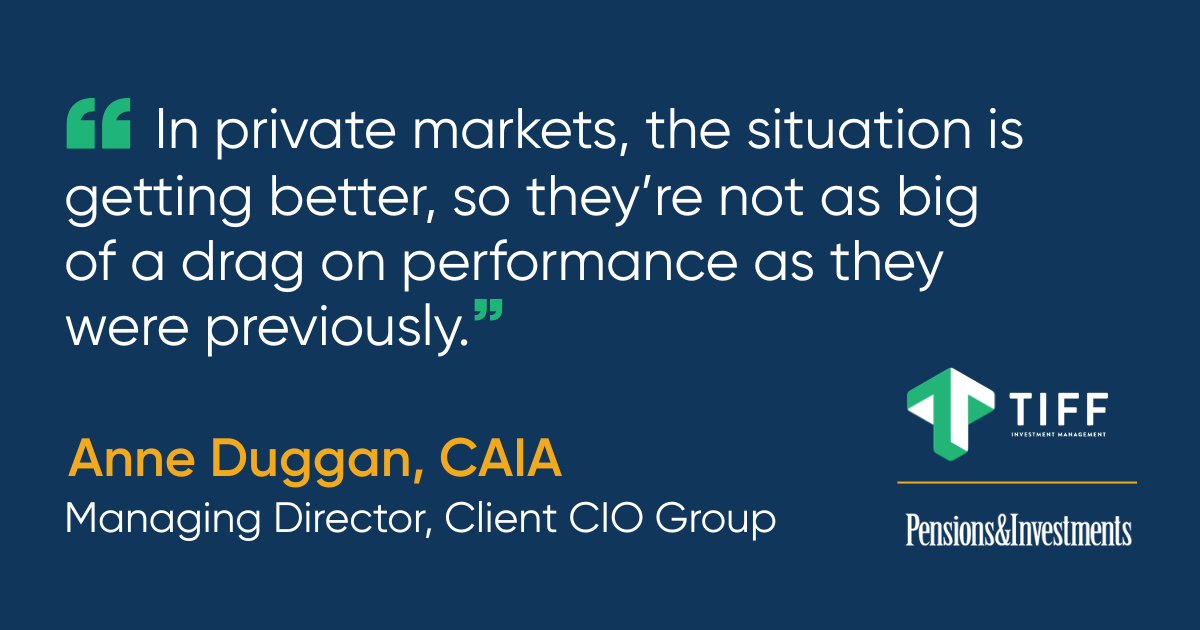
Pensions & Investments recently interviewed TIFF Managing Director, Client CIO Group, Anne Duggan, for a piece discussing university endowment performance in FY25. Duggan shared her analysis that, as the spread between public and private markets has begun to narrow, endowments with private exposure have seen positive returns.

Read the full article here

Disclaimer: To access this article, a subscription is necessary. Please note that TIFF does not possess the rights to distribute this content.

The materials are being provided for informational purposes only and constitute neither an offer to sell nor a solicitation of an offer to buy securities. These materials also do not constitute an offer or advertisement of TIFF’s investment advisory services or investment, legal or tax advice. Opinions expressed herein are those of TIFF and are not a recommendation to buy or sell any securities.

These materials may contain forward-looking statements relating to future events. In some cases, you can identify forward-looking statements by terminology such as “may,” “will,” “should,” “expect,” “plan,” “intend,” “anticipate,” “believe,” “estimate,” “predict,” “potential,” or “continue,” the negative of such terms or other comparable terminology. Although TIFF believes the expectations reflected in the forward-looking statements are reasonable, future results cannot be guaranteed.

Unpacking the Top-Performing Large University Endowments in FY25

Higher Ed Dive recently covered TIFF’s article, “FY25 Performance Drivers: Insights from the Biggest University Endowments.” Written by Anne Duggan, Managing Director, Client CIO Group, the article analyzes the factors that led large endowments to post double-digit returns in FY25 and suggests that private markets investments served as a major catalyst for the strong performance.

To learn more about the TIFF’s analysis, read the press article here.

The materials are being provided for informational purposes only and constitute neither an offer to sell nor a solicitation of an offer to buy securities. These materials also do not constitute an offer or advertisement of TIFF’s investment advisory services or investment, legal, or tax advice. Opinions expressed herein are those of TIFF and are not a recommendation to buy or sell any securities.

These materials may contain forward-looking statements relating to future events. In some cases, you can identify forward-looking statements by terminology such as “may,” “will,” “should,” “expect,” “plan,” “intend,” “anticipate,” “believe,” “estimate,” “predict,” “potential,” or “continue,” the negative of such terms or other comparable terminology. Although TIFF believes the expectations reflected in the forward-looking statements are reasonable, future results cannot be guaranteed.

FY25 Performance Drivers: Insights from the Biggest University Endowments

October is when the biggest university endowments − those with over $1B − share their annual investment results. From these early reports, we can glean what performance drivers we will see, ahead of the full NACUBO-Commonfund Study of Endowments, which comes out in February 2026.

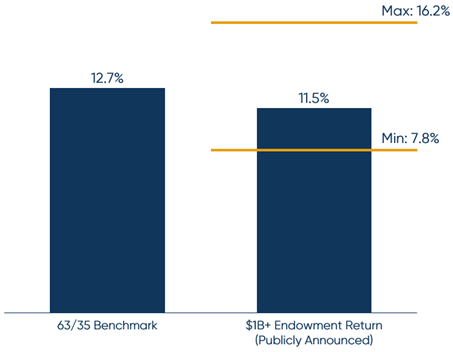
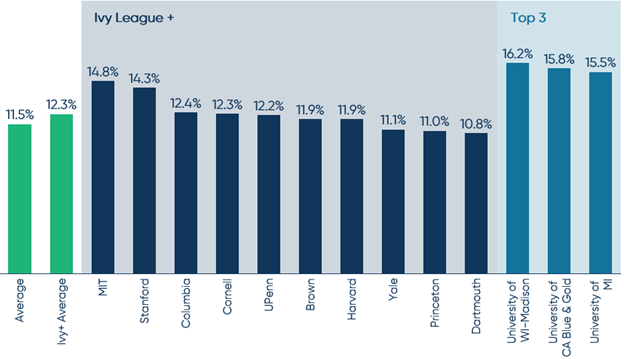
The average return of $1B+ university and college endowments that publicly announce is 11.5% vs. 12.7% for the 65% MSCI ACWI / 35% Bloomberg Agg. This represents the second consecutive year of double-digit gains, following an 11.2% average 1-year performance for all institutions in FY24, per the NACUBO-Commonfund Study of Endowments. However, the trends of what drove performance have shifted in FY25.

FY25 Endowment Returns


FY25 Endowment Returns
Source: Endowment returns as reported by Pensions & Investments, as of October 29, 2025. Represents 40 university and college endowments. 65% MSCI All Country World Index, 35% Bloomberg US Aggregate Bond Index.

What is driving the returns?

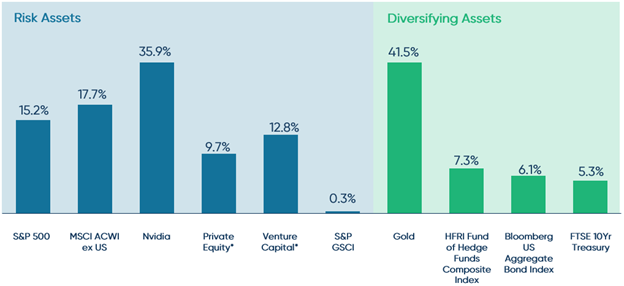
  1. A return to long-term trends: top-performing endowments have large private equity allocations. Certain sub-asset classes like growth or pre-IPO private equity outperformed. Broadly, the return spread between the allocations appears to be narrowing with private equity and venture posting high single digit/low double digit returns vs. 15.2% for the S&P 500, a spread of only 300-500bp.
  2. Strong absolute returns in an unusual year where both equities and bonds contributed positive returns. Both risk and diversifying assets performed well, highlighting broad macro and economic concerns despite strong equity returns.
  3. AI continues to drive equity markets. Portfolios with exposure to AI-related themes like Nvidia outperformed.
  4. Return of international performance. FY25 made the case for international diversification in equities, with MSCI ACWI ex US (17.7%) outperforming the S&P 500 (15.2%).
  5. Broad performance in diversifying assets, including gold. Investors looked for and received performance in a swath of uncorrelated asset classes, including gold, hedge funds and traditional fixed income.

Finally, the Endowment Tax is coming. Multiple private universities commented on the forthcoming increase in tax rate in their FY25 annual reports and endowment return press releases. The increase in the Endowment Tax rates goes into effect for taxable years beginning after December 31, 2025. For institutions with a fiscal year end of June 30, this means the new tax rate would apply starting July 1, 2026.

FY25 Asset Class Returns

FY25 Asset Class Returns
*As reported State Street Investment Management. Source: State Street.

How did individual endowments do?

When looking at individual returns, the Ivy League and other renowned private endowments returned slightly above the total group. The top three returns came from public universities, with University of Wisconsin-Madison the highest FY25 performer with 16.2%.

FY25 Returns Publicly Announced

FY25 Returns Publicly Announced
Source: Pensions & Investments.

Case study: private allocation of top performers

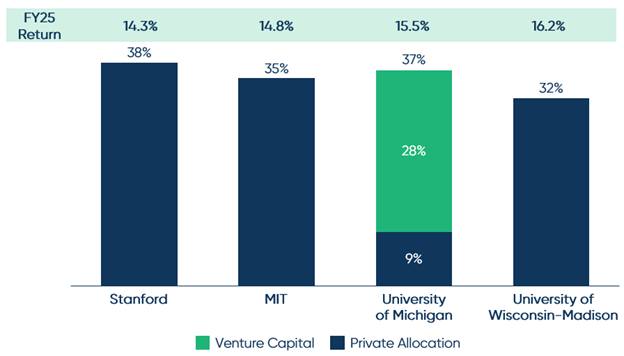
Looking at top performers’ asset allocation, it’s clear that the two-year trend of large private allocations being a detractor has come to a conclusion. Among the top performers that publicly release their asset allocation, each had approximately one-third or greater invested in private equity. A standout example on the strength in late-stage venture/growth is University of Michigan, which returned 15.5%. University of Michigan states that 28% of its portfolio is in venture capital with an additional 9% in private equity.

FY25 Top Returners Private Allocation

FY25 Top Returners Private Allocation
Source: University of Michigan FY 2025 Financial Statement; MIT Report of the Treasurer FY2025; Standford Management Company website, pulled 10/8/25; University of Wisconsin Foundation website, pulled 10/22/25.

The materials are being provided for informational purposes only and constitute neither an offer to sell nor a solicitation of an offer to buy securities. These materials also do not constitute an offer or advertisement of TIFF’s investment advisory services or investment, legal or tax advice. Opinions expressed herein are those of TIFF and are not a recommendation to buy or sell any securities.

These materials may contain forward-looking statements relating to future events. In some cases, you can identify forward-looking statements by terminology such as “may,” “will,” “should,” “expect,” “plan,” “intend,” “anticipate,” “believe,” “estimate,” “predict,” “potential,” or “continue,” the negative of such terms or other comparable terminology. Although TIFF believes the expectations reflected in the forward-looking statements are reasonable, future results cannot be guaranteed.

Private Foundation Tax Could Change Charitable Giving

Anne Duggan of TIFF Investment Management tells Chief Investment Officer that proposed changes to the foundation tax could have varied effects depending on asset size. While the impact on returns is minimal for most, Duggan notes that larger foundations may reconsider their investment strategies or turn to donor-advised funds to help manage the added tax burden.

Read the full article

The materials are being provided for informational purposes only and constitute neither an offer to sell nor a solicitation of an offer to buy securities. These materials also do not constitute an offer or advertisement of TIFF’s investment advisory services or investment, legal or tax advice. Opinions expressed herein are those of TIFF and are not a recommendation to buy or sell any securities.

These materials may contain forward-looking statements relating to future events. In some cases, you can identify forward-looking statements by terminology such as “may,” “will,” “should,” “expect,” “plan,” “intend,” “anticipate,” “believe,” “estimate,” “predict,” “potential,” or “continue,” the negative of such terms or other comparable terminology. Although TIFF believes the expectations reflected in the forward-looking statements are reasonable, future results cannot be guaranteed.

Private Foundations: Navigating the Tiered Excise Tax in the One Big Beautiful Bill

Coauthored by:
Mallory Dennis, Executive Director, Client CIO Group, TIFF Investment Management
Gregory W. Hayes, CPA, Partner, MST

Overview

On May 22, 2025, the House passed the One Big Beautiful Bill Act, which introduces a tiered excise tax structure on net investment income (NII) for private foundations.1 This marks a departure from the longstanding flat 1.39% rate and introduces implications for foundation operations, investment strategy, and grantmaking.

Private foundations with larger asset bases may face higher excise tax rates under the new tiered structure, but for most, the financial impact will be modest and manageable with thoughtful planning. The key is not to overreact, but to understand how the new rules interact with spending, investment, and grantmaking decisions.

What’s New for Private Foundations

For a broader overview of the bill’s structure and legislative context, see TIFF’s earlier white paper: ‘Big Beautiful Bill’ Refines Endowment & Foundation Taxes with Tiers (May 21, 2025). A summary of the tiered tax framework referenced in the paper is provided below:

Tiered Excise Tax Rates2

The bill replaces the flat 1.39% excise tax with a four-tier system based on total asset value:

Private Foundations Tiered Excise Tax Proposal

Key Distinctions:

  • No exclusions for assets used in direct charitable activity, which may increase taxable assets.
  • Related entities’ assets may be aggregated to determine the applicable tier, which may put an institution into a higher tax tier.
  • Valuation is based on year-end assets, which may increase unpredictability and raise the risk of unintentionally moving into a higher tax tier.

Clarifying the 5% Payout Rule

Under current IRS guidance, the excise tax on net investment income continues to be treated as a qualifying distribution for purposes of satisfying the 5% minimum payout requirement. While the total distribution obligation remains unchanged, the composition of that payout may shift — allocating a greater share to tax liabilities rather than to charitable grantees.

This structural nuance, though not new, takes on greater significance under the tiered excise tax regime. Foundations subject to higher tax rates may find that a more substantial portion of their required payout is absorbed by excise tax, effectively reducing the funds available for direct philanthropic activity. This dynamic underscores the importance of integrating tax exposure into both grantmaking and spending policy decisions.

While the 5% payout is a statutory minimum, foundations may choose to distribute more. In the context of higher excise tax obligations, exceeding the minimum may be necessary to sustain current levels of charitable activity.

Implications for Foundations

Grantmaking

Higher excise taxes will reduce the portion of the 5% payout available for direct charitable grants. Foundations may need to reassess their grantmaking strategies, adjusting discretionary commitments, prioritizing core grantees, or shifting toward fewer but larger grants to maximize impact under tighter financial constraints.

Spending Policy

For foundations in higher tax tiers, spending policy decisions become more complex. Some may choose to exceed the 5% minimum payout to sustain current grantmaking levels. While this can preserve programmatic continuity and support to grantees, it may increase pressure on long-term endowment sustainability.

At the same time, tax planning to manage excise tax exposure becomes a critical part of spending strategy. Because tier placement is based on year-end asset values, market volatility can lead to unanticipated tax increases. This dynamic introduces new constraints on available resources and may reduce the portion of the payout available for direct charitable activity.

Foundations should evaluate how spending decisions interact with tax liability, investment performance, and corpus preservation to ensure alignment with both mission-driven goals and financial resilience.

Investment Strategy

Maintaining higher spending while absorbing increased taxes could erode principal over time if not offset by stronger investment returns. Foundations may seek to revisit their strategic asset allocation to ensure it continues to support both spending needs and long-term capital preservation. Modest increases in risk tolerance or shifts toward asset classes with higher expected returns could help offset the incremental tax burden. The key is to evaluate portfolios holistically and consider the net of fee, after-tax outcomes over time.

Liquidity planning also becomes more important under this new regime. Foundations must ensure sufficient flexibility to meet grant and tax obligations without disrupting long-term investment strategy. Because tier placement is based on year-end asset values, market volatility can introduce unpredictability. Scenario modeling can help assess how different market and spending paths may affect tax liabilities and portfolio sustainability.

Next Steps: A Measured Approach

The introduction of a tiered excise tax structure is a meaningful policy change, but the impact is expected to be modest.

This context is important: most foundations — including those served by TIFF and MST — are unlikely to experience a significant increase in tax burden. The actual impact on net returns will be modest — often a fraction of a percent — and can be offset by thoughtful planning and strong investment performance.

Foundations should consider the following:

  • Model potential tax tier outcomes based on projected year-end asset values to understand exposure and plan accordingly.
  • Review spending and investment policies to ensure they remain aligned with long-term goals, especially in light of slightly reduced net returns.
  • Communicate proactively with grantees about any potential implications for funding, particularly if multi-year commitments are involved.
  • Evaluate investment structure and tax efficiency. The data shows that well-constructed portfolios can continue to deliver strong after-tax outcomes even with a modest increase in excise tax. It may not be necessary to make any meaningful changes to the current approach.

In summary, this is a moment for strategic reflection. Foundations that take a proactive but balanced approach will be well-positioned to navigate the new landscape without compromising their mission or long-term sustainability.

TIFF and MST will continue to monitor developments and provide guidance as the bill progresses through the Senate.

This piece was written in partnership with Gregory Hayes, CPA, Partner at MST. Greg specializes in accounting and strategic tax planning for private foundations and brings expertise to the evolving regulatory landscape.

The materials are being provided for informational purposes only and constitute neither an offer to sell nor a solicitation of an offer to buy securities. These materials also do not constitute an offer or advertisement of TIFF’s investment advisory services or investment, legal or tax advice. Opinions expressed herein are those of TIFF and are not a recommendation to buy or sell any securities.

These materials may contain forward-looking statements relating to future events. In some cases, you can identify forward-looking statements by terminology such as “may,” “will,” “should,” “expect,” “plan,” “intend,” “anticipate,” “believe,” “estimate,” “predict,” “potential,” or “continue,” the negative of such terms or other comparable terminology. Although TIFF believes the expectations reflected in the forward-looking statements are reasonable, future results cannot be guaranteed.

Footnotes

  1. H.R.1 — One Big Beautiful Bill Act, 119th Congress (2025–2026), accessed June 5, 2025, https://www.congress.gov/bill/119th-congress/house-bill/1/text.

  2. Ways and Means Committee, “Summary of the One Big Beautiful Bill,” accessed June 5, 2025, https://waysandmeans.house.gov/wp-content/uploads/2025/05/The-One-Big-Beautiful-Bill-Section-by-Section.pdf.