TIFF & Do Good Institute Webinar: Fundraising in a Time of Uncertainty
Jessica Portis, CFA
Chief Client Officer & Board Member of TIFF Advisory Services
On Wednesday, May 7th, TIFF Investment Management and The Do Good Institute hosted a webinar on fundraising in a time of uncertainty. TIFF’s Chief Client Officer Jessica Portis was joined by Ebonie Johnson Cooper, Faculty Director at The Do Good Institute, and Martin Sanders, Adjunct Faculty at the University of Maryland’s School of Public Policy, to discuss how nonprofit organizations can navigate financial uncertainty and ensure their programs and services continue uninterrupted.
Key takeaways from the discussion include:
Understanding the Policy Landscape: Ebonie opened with an overview of current federal policy developments and how they affect nonprofit organizations.
Tools for Financial Preparedness: Martin shared practical resources for scenario planning and financial forecasting to help nonprofits make informed decisions.
Fundraising Strategies in Uncertain Times: Ebonie emphasized the importance of:
Using storytelling to communicate impact,
Leveraging technology to reach and engage supporters,
Strengthening and activating existing donor relationships.
Mindset Shift: Ebonie encouraged organizations to move their fundraising approach “from scarcity to possibility.”
The materials are being provided for informational purposes only and constitute neither an offer to sell nor a solicitation of an offer to buy securities. These materials also do not constitute an offer or advertisement of TIFF’s investment advisory services or investment, legal or tax advice. Opinions expressed herein are those of TIFF and are not a recommendation to buy or sell any securities.
These materials may contain forward-looking statements relating to future events. In some cases, you can identify forward-looking statements by terminology such as “may,” “will,” “should,” “expect,” “plan,” “intend,” “anticipate,” “believe,” “estimate,” “predict,” “potential,” or “continue,” the negative of such terms or other comparable terminology. Although TIFF believes the expectations reflected in the forward-looking statements are reasonable, future results cannot be guaranteed.
Proposed Endowment Tax Hikes Would Further Complicate University Investment Strategies
Anne Duggan, CAIA
Managing Director, Client CIO Group
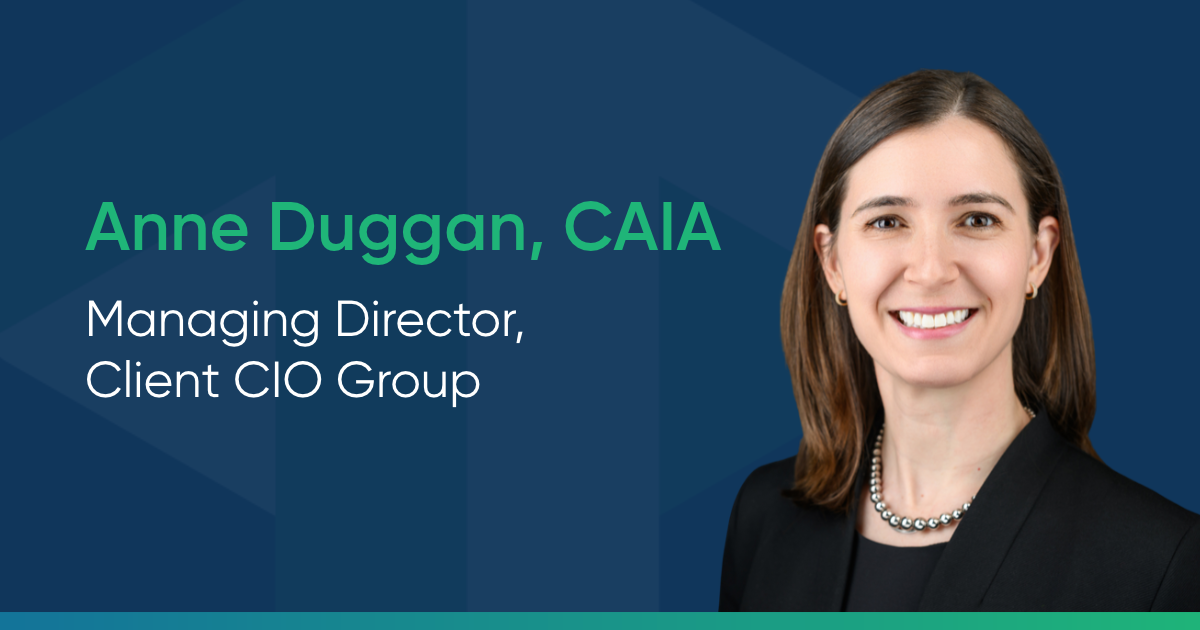
Anne Duggan, Managing Director, Client CIO Group of TIFF Investment Management, offers a key perspective on how proposed endowment tax hikes could force universities to rethink investment strategies amid rising liquidity pressures.
The materials are being provided for informational purposes only and constitute neither an offer to sell nor a solicitation of an offer to buy securities. These materials also do not constitute an offer or advertisement of TIFF’s investment advisory services or investment, legal or tax advice. Opinions expressed herein are those of TIFF and are not a recommendation to buy or sell any securities.
These materials may contain forward-looking statements relating to future events. In some cases, you can identify forward-looking statements by terminology such as “may,” “will,” “should,” “expect,” “plan,” “intend,” “anticipate,” “believe,” “estimate,” “predict,” “potential,” or “continue,” the negative of such terms or other comparable terminology. Although TIFF believes the expectations reflected in the forward-looking statements are reasonable, future results cannot be guaranteed.
Nonprofits in the United States are facing unprecedented financial hardship. Swift federal policy changes have left organizations in a state of urgency and confusion as the government grants and contracts they have regularly relied on have been canceled or held in limbo. How does the changing policy landscape impact nonprofits’ ability to deliver their services? What can fundraisers do to ensure they can secure funding to continue to deliver their services?
How did we get here?
The federal government has used the nonprofit sector to provide services to address poverty and social issues since the Johnson administration. The sector has also seen tremendous growth over time, with the number of nonprofits increasing by 60% between 1998-2023. The government’s investment in the sector is critical: as an Urban Institute report shows “[i]n every state, every congressional district, and more than 95% of counties in the United States, public charities receive government grants” which totals to $267B. As the Trump administration moves away from providing government grants to nonprofits, fundraisers are left with a huge gap to fill.
How can fundraisers address this moment?
While the sheer size of this funding gap is daunting, there are strategies leaders can take to educate their teams, engage existing supporters, and secure funding to maintain services:
Stay up to date: Organizations like the National Council of Nonprofits regularly provide updates and resources on policy changes that impact nonprofits. By finding similar resources for your industry, fundraisers can keep abreast of changes without overwhelming themselves.
Mobilize your donor base: If organizations are transparent with supporters about the financial risk they face, donors may step up to invest in your organization in new and meaningful ways. Consider how you can solicit your individual donors differently to fund programs or build up your corporate partnerships.
Connect with fellow fundraisers: No individual or organization should address uncertainty in isolation. Find avenues to connect with professional development groups and attend conferences to both learn from and support your peers.
Access emergency funding: Foundations and philanthropists are providing emergency funding to nonprofits during this turbulent time. The Chronicle of Philanthropy is regularly updating its website with information on the different funds available to organizations
To learn more about how you can help your organization navigate financial uncertainty, register for the webinar Fundraising in a Time of Uncertainty on Wednesday, May 7, 2025, from 10-11AM ET. This webinar will feature Jessica Portis, Chief Client Officer at TIFF in conversation with Ebonie Johnson Cooper, Faculty Director, Do Good Institute at the University of Maryland’s School of Public Policy and Martin Sanders, Adjunct Faculty at the University of Maryland’s School of Public Policy.
The materials are being provided for informational purposes only and constitute neither an offer to sell nor a solicitation of an offer to buy securities. These materials also do not constitute an offer or advertisement of TIFF’s investment advisory services or investment, legal or tax advice. Opinions expressed herein are those of TIFF and are not a recommendation to buy or sell any securities.
These materials may contain forward-looking statements relating to future events. In some cases, you can identify forward-looking statements by terminology such as “may,” “will,” “should,” “expect,” “plan,” “intend,” “anticipate,” “believe,” “estimate,” “predict,” “potential,” or “continue,” the negative of such terms or other comparable terminology. Although TIFF believes the expectations reflected in the forward-looking statements are reasonable, future results cannot be guaranteed.
Federal Threats Cause Endowments to Reconsider Investment Strategies
Anne Duggan, CAIA
Managing Director, Client CIO Group
Anne Duggan, CAIA, Managing Director of TIFF Investment Management’s Client CIO Group, recently shared insights with PEI Buyouts on how endowments are adjusting to new federal policies. She discussed the challenge of balancing the need for financial support with the goal of maintaining long-term endowment growth, and how investment strategies are being reconsidered to meet these goals.
Read the full article
Disclaimer: To access this article, a subscription may be necessary. Please note that TIFF does not possess the rights to distribute this content.
The materials are being provided for informational purposes only and constitute neither an offer to sell nor a solicitation of an offer to buy securities. These materials also do not constitute an offer or advertisement of TIFF’s investment advisory services or investment, legal or tax advice. Opinions expressed herein are those of TIFF and are not a recommendation to buy or sell any securities.
These materials may contain forward-looking statements relating to future events. In some cases, you can identify forward-looking statements by terminology such as “may,” “will,” “should,” “expect,” “plan,” “intend,” “anticipate,” “believe,” “estimate,” “predict,” “potential,” or “continue,” the negative of such terms or other comparable terminology. Although TIFF believes the expectations reflected in the forward-looking statements are reasonable, future results cannot be guaranteed.
Our last article focused on endowment tax proposals and how they may impact educational institutions directly.
This article looks at the specific impact on the endowment portfolio.
Today’s 1.4% tax is expected to cause a reduction of 5-15 basis points in net returns, according to TIFF estimates. A tax increase to 10% or above starts to be meaningful.
This tax introduces an issue where institutions may no longer be able to maintain inflation-adjusted purchasing power after spending and tax with their current target returns.
If a 10%+ rate is enacted, institutions will face a delicate balance between reconsidering asset allocation to reduce tax burden, potentially increasing risk to increase expected return, or decrease spending.
TIFF will continue focus on the topic as new information becomes available.
As a Reminder: Summary of Proposals
In our last article, TIFF outlined the various endowment tax proposals. Below is a summary:
Endowment Tax Impact on Portfolio Returns
It is important to remember this tax is levied on net investment income, not total assets, so any headline tax rate is diluted. “Net investment income” includes everything from capital gains to dividends (investment income passively obtained), net of eligible deductions such as advisory and brokerage fees.[i], [ii] This tax is charged on realized gains/income, meaning that even in a negative performance year, the endowment could incur a tax liability.
TIFF has estimated the impact of the current tax (1.4%) and various proposals on after-tax net returns for endowment style portfolios.[iii]
The current tax has minimal impact on after-tax net returns; TIFF estimates this causes a reduction of 5-15 basis points of net returns.
A tax increase to 10% or above starts to be meaningful.
TIFF has added a “plausible compromise” scenario of a 5% tax, which is noticeable, though not dramatic, at an estimated 20-40 basis points drag per year.
Estimated Excise Tax Impact on Net Returns
Source: TIFF internal analysis.
Potential Implications for the Endowment
At a 1.4% tax, institutions are unlikely to adjust their portfolios. However, a tax rate of 10% or higher would likely prompt institutions to explore options to manage the tax impact. There is no single solution to the endowment tax. Addressing the implications of the endowment tax will require a multi-dimensional approach, balancing reconsidering the spend rate, increasing the expected return slightly, and tweaking the investment strategy to reduce the annual tax burden–all while trying to maintain support for the institution and best practices of portfolio construction.
This tax introduces an issue where institutions may no longer be able to maintain inflation-adjusted purchasing power after spending and tax, with their current target returns. The graph below shows an illustrative scenario for a hypothetical educational institution with a 4.5% spend rate. Without tax, their target return is likely around 7.5%. However, the introduction of an endowment tax reduces the net returns available for compounding. TIFF has outlined three potential solutions institutions may look at individually, or in concert, to address this issue.
Hypothetical Target Return Requirement Build-up
Reduce tax burden by revising asset allocation: Tax is on net investment income, which mean it taxes all realized gains in a year equally. Altering the types of investments the endowment is invested in may help to reduce the tax burden. Two broad approaches are:
Increase allocation to assets that defer realizations (e.g., long-hold equities, private equity).
Decrease allocation to assets that have high annual income/gains (e.g., fixed income, high-turnover hedge funds, income-focused core real estate).
Increase target return via increased risk level to (partially) offset the tax: With no change in spend, a tax will increase one’s target return requirements (CPI+spend rate+annual tax rate). However, a balance must be struck between increasing the target return, and therefore overall risk, and decrease in spend rate. This may not be feasible for many institutions who already are at their risk tolerance.
Non-Endowment Option:Decrease the spend to offset the tax: While a difficult conversation depending on how large the tax is, discussing the spend rate and likelihood of hitting an institution’s long-term inflation-adjusted real rates of return post-spend will be important.
Conclusion
This topic is still emerging with various proposals at play. TIFF remains engaged and focused on the topic, helping our clients understand the implications. If your institution believes it might be at risk for inclusion, please reach out to your TIFF team for further discussion.
The materials are being provided for informational purposes only and constitute neither an offer to sell nor a solicitation of an offer to buy securities. These materials also do not constitute an offer or advertisement of TIFF’s investment advisory services or investment, legal or tax advice. Opinions expressed herein are those of TIFF and are not a recommendation to buy or sell any securities.
These materials may contain forward-looking statements relating to future events. In some cases, you can identify forward-looking statements by terminology such as “may,” “will,” “should,” “expect,” “plan,” “intend,” “anticipate,” “believe,” “estimate,” “predict,” “potential,” or “continue,” the negative of such terms or other comparable terminology. Although TIFF believes the expectations reflected in the forward-looking statements are reasonable, future results cannot be guaranteed.
[iii] Endowment style portfolios are defined as portfolios with high allocations to alternatives, including hedge funds, private equity and venture capital.
You are now leaving TIFF Investment Management’s website and are going to a website that is not operated by TIFF Investment Management. We are not responsible for the content or availability of linked sites, and our inclusion of links to third-party websites does not imply any endorsement, approval, verification or monitoring by us of any of such linked sites’ content.