Real-World Lessons in Nonprofit AI Adoption

Artificial Intelligence is transforming how nonprofits operate, communicate, and deliver services.

According to The State of AI in Nonprofits 2025 report by Tech Soup and Tapp Network, “85% of nonprofits have a high interest in tools like Generative AI and Predictive Analysis.” Adoption, however, is uneven. While many leaders see its potential, many organizations lack the staffing, funding, or policies necessary for thoughtful AI adoption.

Consider these realities, from The State of AI in Nonprofits 2025 report:

  • 76% of nonprofits do not have an AI strategy
  • 42% of nonprofits have one to two staff learning to use AI
  • 43% of nonprofits rely on one staff member to make IT and AI decisions
  • 80% of organizations do not have an AI-acceptable use policy

If this sounds familiar, you are not alone.

Join us on Wednesday, November 19 from 12:00 – 12:40 PM EST for the webinar, How to Adopt AI in Your Nonprofit with Real-World Lessons. Anne Duggan, Managing Director, Client CIO Group at TIFF will be joined by Ebonie Johnson Cooper, Faculty Director, Nonprofit Executive Education & Training, The Do Good Institute at the University of Maryland, Remy Reya, Director of AI & Thought Leadership of Compass Pro Bono, and Beverly Ross, Program Director, Compass Pro Bono. Drawing on the real experience of Compass Pro Bono’s own AI journey, you will learn what worked, what didn’t, and key insights to apply to your organization. With an emphasis on change management, this webinar will appeal to early adopters and skeptics alike.

This session will help you:

  • Identify where AI can have the greatest impact in your operations
  • Ask the right strategic questions to guide your team
  • Build a roadmap that empowers your staff

Register today to take a proactive and responsible approach to integrating AI into your organization.

The materials are being provided for informational purposes only and constitute neither an offer to sell nor a solicitation of an offer to buy securities. These materials also do not constitute an offer or advertisement of TIFF’s investment advisory services or investment, legal or tax advice. Opinions expressed herein are those of TIFF and are not a recommendation to buy or sell any securities.

These materials may contain forward-looking statements relating to future events. In some cases, you can identify forward-looking statements by terminology such as “may,” “will,” “should,” “expect,” “plan,” “intend,” “anticipate,” “believe,” “estimate,” “predict,” “potential,” or “continue,” the negative of such terms or other comparable terminology. Although TIFF believes the expectations reflected in the forward-looking statements are reasonable, future results cannot be guaranteed.
FY25 Performance Drivers: Insights from the Biggest University Endowments

October is when the biggest university endowments − those with over $1B − share their annual investment results. From these early reports, we can glean what performance drivers we will see, ahead of the full NACUBO-Commonfund Study of Endowments, which comes out in February 2026.

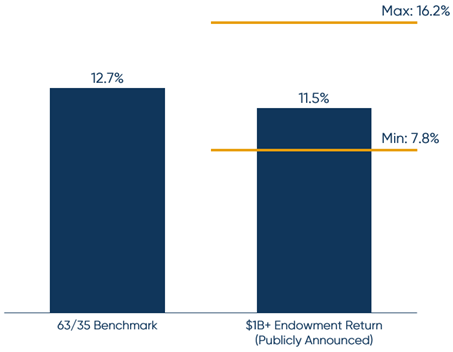
The average return of $1B+ university and college endowments that publicly announce is 11.5% vs. 12.7% for the 65% MSCI ACWI / 35% Bloomberg Agg. This represents the second consecutive year of double-digit gains, following an 11.2% average 1-year performance for all institutions in FY24, per the NACUBO-Commonfund Study of Endowments. However, the trends of what drove performance have shifted in FY25.

FY25 Endowment Returns


FY25 Endowment Returns
Source: Endowment returns as reported by Pensions & Investments, as of October 29, 2025. Represents 40 university and college endowments. 65% MSCI All Country World Index, 35% Bloomberg US Aggregate Bond Index.

What is driving the returns?

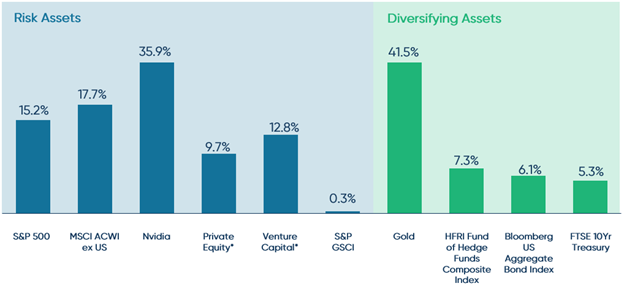
  1. A return to long-term trends: top-performing endowments have large private equity allocations. Certain sub-asset classes like growth or pre-IPO private equity outperformed. Broadly, the return spread between the allocations appears to be narrowing with private equity and venture posting high single digit/low double digit returns vs. 15.2% for the S&P 500, a spread of only 300-500bp.
  2. Strong absolute returns in an unusual year where both equities and bonds contributed positive returns. Both risk and diversifying assets performed well, highlighting broad macro and economic concerns despite strong equity returns.
  3. AI continues to drive equity markets. Portfolios with exposure to AI-related themes like Nvidia outperformed.
  4. Return of international performance. FY25 made the case for international diversification in equities, with MSCI ACWI ex US (17.7%) outperforming the S&P 500 (15.2%).
  5. Broad performance in diversifying assets, including gold. Investors looked for and received performance in a swath of uncorrelated asset classes, including gold, hedge funds and traditional fixed income.

Finally, the Endowment Tax is coming. Multiple private universities commented on the forthcoming increase in tax rate in their FY25 annual reports and endowment return press releases. The increase in the Endowment Tax rates goes into effect for taxable years beginning after December 31, 2025. For institutions with a fiscal year end of June 30, this means the new tax rate would apply starting July 1, 2026.

FY25 Asset Class Returns

FY25 Asset Class Returns
*As reported State Street Investment Management. Source: State Street.

How did individual endowments do?

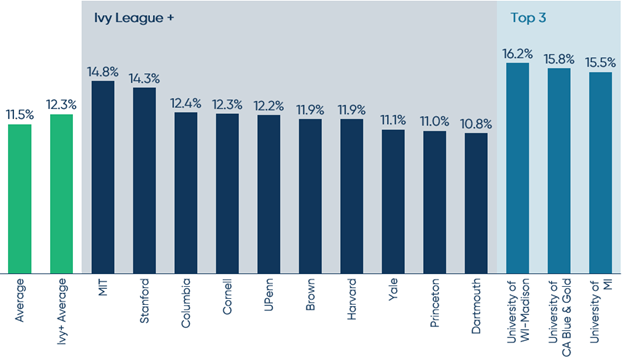
When looking at individual returns, the Ivy League and other renowned private endowments returned slightly above the total group. The top three returns came from public universities, with University of Wisconsin-Madison the highest FY25 performer with 16.2%.

FY25 Returns Publicly Announced

FY25 Returns Publicly Announced
Source: Pensions & Investments.

Case study: private allocation of top performers

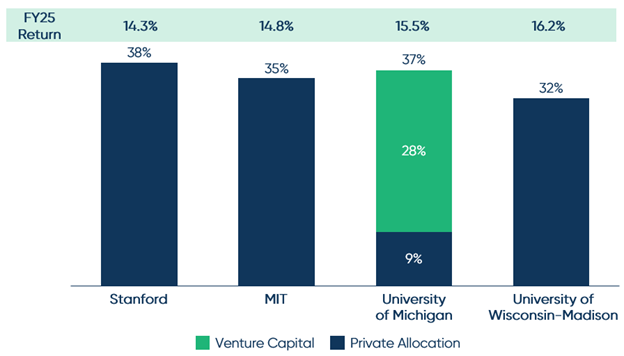
Looking at top performers’ asset allocation, it’s clear that the two-year trend of large private allocations being a detractor has come to a conclusion. Among the top performers that publicly release their asset allocation, each had approximately one-third or greater invested in private equity. A standout example on the strength in late-stage venture/growth is University of Michigan, which returned 15.5%. University of Michigan states that 28% of its portfolio is in venture capital with an additional 9% in private equity.

FY25 Top Returners Private Allocation

FY25 Top Returners Private Allocation
Source: University of Michigan FY 2025 Financial Statement; MIT Report of the Treasurer FY2025; Standford Management Company website, pulled 10/8/25; University of Wisconsin Foundation website, pulled 10/22/25.

The materials are being provided for informational purposes only and constitute neither an offer to sell nor a solicitation of an offer to buy securities. These materials also do not constitute an offer or advertisement of TIFF’s investment advisory services or investment, legal or tax advice. Opinions expressed herein are those of TIFF and are not a recommendation to buy or sell any securities.

These materials may contain forward-looking statements relating to future events. In some cases, you can identify forward-looking statements by terminology such as “may,” “will,” “should,” “expect,” “plan,” “intend,” “anticipate,” “believe,” “estimate,” “predict,” “potential,” or “continue,” the negative of such terms or other comparable terminology. Although TIFF believes the expectations reflected in the forward-looking statements are reasonable, future results cannot be guaranteed.

Is Bitcoin the New Gold?

Executive Summary

  • Economic uncertainty has resulted in an extremely strong year for gold, with the precious metal rallying ~30% as of early September
  • As investors look for safe havens, a discussion has emerged about whether cryptocurrency—specifically bitcoin—could become “the new gold”
  • While bitcoin has not yet achieved the safe-haven status gold enjoys, with time and continued acceptance, it could come to serve a similar role in financial markets
  • There are several similarities between bitcoin and gold, including their scarcity and their role as stores of value. Despite the similarities, however, bitcoin lacks the legitimacy of gold’s 5,000-year history
  • TIFF is cautiously optimistic about crypto’s future and has made small investments to capitalize on innovation in the space

So far, 2025 has been a year of uncertainty. Investors wait anxiously on news of potential tariffs, geopolitical risk remains elevated, and the market swings with each new announcement. It is not surprising, then, that investors are seeking safe havens such as gold. Gold has had a phenomenal year, returning over 30% as of early September. The last time gold saw gains of this magnitude was 15 years ago in 20101. Unlike 2010, however, investors are starting to see another potential safe haven to weather turbulent markets: cryptocurrencies.

It’s important to take a brief step back. Saying that cryptocurrency could be a safe-haven asset is too broad a statement. The crypto universe is incredibly diverse, with different cryptos serving distinct purposes and deriving value in different ways. For example, a stablecoin is different than a utility token. To be more specific, let’s focus primarily on bitcoin. Originally designed to function much like a currency, bitcoin is now the most widely accepted crypto asset, accounting for more than 55% of the total crypto market cap2. Given its primary use case as a store of value and its dominance in the market, we will focus the remainder of this paper on the comparison between gold and bitcoin.

Many have speculated whether bitcoin is or will become the new gold, gradually overtaking the precious metal as the premier safe haven. While it has not yet achieved the safe-haven status that gold enjoys, with time and continued acceptance, bitcoin could come to serve a similar role in financial markets.

Two Sides of the Same Coin

Why has the comparison between these assets been drawn? While there are notable differences between the two, gold and bitcoin share several similarities, beginning with scarcity.

Gold is unique among many major commodities in that it is not typically consumed. While it can be used in items like batteries, producers often substitute other metals due to gold’s high cost. Its supply also grows very slowly. A report from Goldman Sachs states that “new annual production adds just over 1% to the existing stock and is stable and price inelastic.”3 As a result, when demand grows, it is difficult (if not impossible) to quickly increase supply, as producers might with oil, to meet the increase in demand. This constraint ultimately helps drive up gold’s value.

Bitcoin is similar. It has a fixed supply, with the final bitcoin projected to be mined by 2140. In fact, bitcoin’s scarcity is now even greater than gold’s, as measured by its stock-to-flow ratio (the existing supply relative to annual production). In April 2024, bitcoin surpassed gold as the asset with the highest stock-to-flow ratio among liquid and easily tradable assets4.

One of the most important similarities is that both gold and bitcoin function as stores of value, meaning they are expected to preserve their worth over time. This quality is especially important for any asset to be considered a safe-haven. Investors seek assets they believe will protect their wealth during times of uncertainty. Gold acquired this characteristic because it was discovered to be both scarce and durable. Bitcoin, by contrast, was deliberately created as a store of value. Ultimately, however, both rely on shared trust to sustain their worth.

The Test of Time

It is in this need for “buy-in” and belief that we begin to see the key difference between bitcoin and gold. Gold has been considered a source of wealth for 5,000 years. The U.S. once operated under a literal “gold standard,” and even though that ended more than 50 years ago, the term still signifies the highest level of quality. There is no dispute that gold is valuable and will continue to be into the future. Bitcoin, by contrast, lacks that legacy.

This difference is reflected in the respective volatility of the two assets. Gold has a long-term volatility of approximately 15%. Bitcoin’s volatility, meanwhile, has decreased as it has gained greater legitimacy, but over the past five years it has still averaged approximately 40%—more than twice that of public equities. That level of volatility is hardly consistent with what one would expect from an asset used predominantly as a safe haven!

The good news for bitcoin is that it shouldn’t take 5,000 years for it to achieve the same level of legitimacy as gold. Adoption of new technologies and innovations occurs far more quickly now than in the past. As the number of bitcoin investors continues to grow, and if regulation remains favorable, bitcoin may begin to behave more like gold.

There are risks, however, that could change bitcoin’s trajectory. One of the most prominent is the advancement of quantum computing. This poses a significant risk to any digital technology that relies on the difficulty of prime number factorization. In theory, quantum computers can factor huge numbers exponentially faster than classical computers, which could render bitcoin’s mining methods obsolete.

Bitcoin miners and developers are aware of these risks, and upgrades could be implemented to mitigate quantum threats. Another risk is the possibility that a different store-of-value cryptocurrency could eventually supplant bitcoin. As the first cryptocurrency, bitcoin certainly holds a significant edge, but technological advances, regulatory shifts, or investor sentiment could change that.

Positioned for Possibility

Uncertainty notwithstanding, there may be growing validity in the idea that bitcoin is the new gold”—or that it could be in the future. The similarities between gold and bitcoin are evident. What bitcoin still lacks is the confidence in its value that gold has earned over centuries. With time, however, that confidence could still come.

In the interim, we at TIFF still believe it is prudent to have at least a small exposure to crypto in our portfolios. We do this through limited allocations to a relative value crypto strategy, a broad-based liquid crypto index fund, and a crypto-oriented VC strategy. Though the position is small, we believe meaningful innovation will emerge from the crypto ecosystem that ultimately drives genuine value. While we may not yet know what form that value will take, we are confident that when the opportunity becomes clear, we will be well positioned to capture it.

If you have a question about cryptocurrency, gold, or how TIFF can help you manage your portfolio through uncertain times more broadly, please do not hesitate to reach out.

The materials are being provided for informational purposes only and constitute neither an offer to sell nor a solicitation of an offer to buy securities. These materials also do not constitute an offer or advertisement of TIFF’s investment advisory services or investment, legal or tax advice. Opinions expressed herein are those of TIFF and are not a recommendation to buy or sell any securities.

These materials may contain forward-looking statements relating to future events. In some cases, you can identify forward-looking statements by terminology such as “may,” “will,” “should,” “expect,” “plan,” “intend,” “anticipate,” “believe,” “estimate,” “predict,” “potential,” or “continue,” the negative of such terms or other comparable terminology. Although TIFF believes the expectations reflected in the forward-looking statements are reasonable, future results cannot be guaranteed.

Footnotes

  1. Bloomberg Intelligence. “Navigating Crypto Volatility: All Options Considered.” Bloomberg. Published May 6, 2025. Accessed September 17, 2025. https://www.bloomberg.com/professional/insights/markets/navigating-crypto-volatility-all-options-considered/.

  2. CoinGecko. “Global Cryptocurrency Market Cap Charts.” Accessed September 17, 2025. https://www.coingecko.com/en/global_charts.

  3. Goldman Sachs, Precious Analyst Gold Market Primer, August 17, 2025, accessed via Goldman Sachs Marquee.

  4. Bitget Academy, “Understanding the Stock‑to‑Flow Model: Scarcity Drives Value,” Bitget, published April 22, 2025, accessed September 17, 2025. https://www.bitget.com/asia/academy/understanding-stock-to-flow-bitcoin.

Jessica Portis, CFA Named One of Pensions & Investments’ 2025 Influential Women in Institutional Investing

TIFF Investment Management is proud to share that Jessica Portis, CFA, Chief Client Officer, has been recognized by Pensions & Investments as one of the 2025 Influential Women in Institutional Investing. This award celebrates the innovative leaders making an impact on the investment industry. Jessica is one of the key forces delivering exceptional service to TIFF clients, and her vision, expertise, and dedication have made her a true leader in the field.

As part of this honor, Jessica is featured in Pensions & Investments’ September 8th Special Report, highlighting women who are driving progress in the industry. Read more here ➝

Jessica also joined a select group of honorees at the Nasdaq Opening Bell Ceremony on September 8th at the MarketSite in Times Square, where a special tower display celebrates this year’s awardees.

Later this month, she will be honored at the Pensions & Investments Conference and Awards Dinner on September 18th in Chicago, IL.

We are thrilled to see Jessica’s contributions recognized on such a prominent stage—congratulations, Jessica!

The materials are being provided for informational purposes only and constitute neither an offer to sell nor a solicitation of an offer to buy securities. These materials also do not constitute an offer or advertisement of TIFF’s investment advisory services or investment, legal or tax advice. Opinions expressed herein are those of TIFF and are not a recommendation to buy or sell any securities.

These materials may contain forward-looking statements relating to future events. In some cases, you can identify forward-looking statements by terminology such as “may,” “will,” “should,” “expect,” “plan,” “intend,” “anticipate,” “believe,” “estimate,” “predict,” “potential,” or “continue,” the negative of such terms or other comparable terminology. Although TIFF believes the expectations reflected in the forward-looking statements are reasonable, future results cannot be guaranteed.
Interpreting OBBB: New Tax Law Implications for Nonprofits and Philanthropy

Summary

  • One Big Beautiful Bill (“OBBB”) was signed into legislation on July 4, 2025, by President Trump.
  • OBBB contains various components that impact nonprofits and philanthropy at large. While the impact varies by type of institution, OBBB might have the unintended consequence of leaving nonprofits with a greater need to fulfill their mission in support of the community and smaller budgets to do so.
    1. Tax Impact: Broadly neutral, except for large, private higher education institutions with large endowments, who will receive a tax increase. No other tax increases were included.
    2. Charitable Giving Impact: Negative. Positive changes to encourage giving for small donors such as an increase in nonitemized giving are offset by large donor changes (an increase in corporate deduction floor and reduction in itemized giving for top individual taxpayers via 0.5% floor).
    3. Philanthropic Need: Increasing. For higher education, OBBB broadly looks to reduce federal loans and grants, increasing the need for financial aid. For other nonprofits, OBBB has broadly decreased entitlements and services, potentially creating a larger need for nonprofit services and aid.
  • For over 3 decades, TIFF has helped nonprofits align their investment portfolio with institutional priorities. During these times of change, TIFF serves as a resource to clients to ensure their portfolio continues to serve the institution in the best way possible.

Overview

One Big Beautiful Bill is now One Big Beautiful Law. President Trump officially signed OBBB on July 4, 2025. Within the almost 900 pages of OBBB, there are a number of changes that directly and indirectly impact nonprofits – particularly through tax changes, charitable giving rules, and reductions in public services.

While the impacts will vary by institution, OBBB is likely to increase the demand for nonprofit services at a time when many organizations are facing tighter budgets.

TIFF has summarized major elements of OBBB and how it broadly impacts nonprofits and philanthropy:

Major Elements of OBBB and Impact to Nonprofits and Philanthropy
Source: TIFF Analysis.

1. Tax Impact

Endowment Tax

OBBB increases the excise tax on private higher education institutions with more than 3,000 students and large endowments per student. All else being equal, this tax would reduce the available budgets to impacted institutions at a particularly challenging time, as other revenue sources are also being cut.

Endowment Tax
*2017 student exemption was <500 full time students. OBBB exemption has been raised to 3,000 full time students. Source: OBBB.

Additional changes within the new legislation are:1

  • Expansion of net investment income definition to include:2
    • Interest on institutional student loans
    • Royalties on federally-funded intellectual property (IP)

Considerations from prior drafts that were not ultimately included:

  • Any changes to definition of “students” for tier determination (e.g., exclusion of international students)
  • Exception for religious institutions

Implications:

  • For some higher ed institutions, there is a fear this tax will disproportionately impact typically unrestricted budget categories, including financial aid, faculty and university maintenance and infrastructure.3, 4
  • Joint Committee on Taxation estimates these changes will increase taxes by an additional $761 million over the next 10 years5 ($380 million was raised in 20236).

Other Taxes

Fortunately, the final OBBB did not contain any tax increases on nonprofit investment pools outside of the endowment tax increase.

2. Charitable Giving Impact

OBBB makes four major changes to charitable donation / giving rules for both individuals (three changes) and corporate entities (one change). While these changes broadly represent a reshuffling of incentives with an overall negative estimated impact, the law negatively impacts large donors—wealthy individuals and corporations—and helps smaller, everyday donors.

A new universal deduction is reinstated for small donors (previously unavailable post 2021). However, individual and corporate itemized givers must now clear a threshold before deductions apply: 0.5% of adjusted gross income (AGI) for individuals and 1% of taxable income for corporations. In addition, high-income filers face a cap on the deduction benefit at 35% the gift’s value.

Charitable Giving Impact
7  8  9  10  11  12

Implications:

It will be important for nonprofits to understand their donor base to see how they might be impacted and how they will need to shift their fundraising strategies going forward to align with these new tax rules. Large donors have become important to many nonprofit organization budgets, so these shifts could be detrimental.

3. Philanthropic Need

While OBBB added some services and eliminated others, it has generally led to a reduction in services across various sectors of the U.S. economy and social system. Below are some of the highest profile services that were reduced which may ultimately lead to an increase in services and aid provided by nonprofit organizations:

  • Medicaid: Single largest OBBB spending cut ($1 trillion over 10 years) and estimated increase of uninsured people by 11.8 million. OBBB impacts Medicaid by tightening eligibility for ACA-expansion adults—requiring 80 hours of verified work a month and eliminating Biden’s “simplified enrollment”. On the provider side, it bars new or higher hospital/MCO provider taxes in expansion states and trims existing ones, and caps state-directed supplemental payments. Finally, states must re-check adults’ eligibility twice a year instead of annually, with additional documentation for income and residency.13
    • Impact: Healthcare
  • SNAP: OBBB cuts an estimated $186 billion over 10 years and CBO estimates 3 million to drop out or lose benefits from the program. The changes reduce funding, shifts a portion of its cost to states (up to 15%), and changes work and documentation requirements.14
    • Impact: Food security
  • Student Loans: OBBB had a major overhaul for government student loan, with loan options decreasing, in particular for graduate students, and repayment plans becoming less generous. OBBB cuts back how much students can borrow from the government, with the sharpest reductions for graduate and professional programs and eliminates popular options entirely (Grad PLUS). Only two repayment plans remain, monthly bills will generally be higher, and forgiveness now comes after 30 years instead of 20–25. Finally, borrowers can pause payments for just 12 months total over the life of the loan.
    • Impact: Financial aid

There are some notable positive service additions, including:

  • Child and Family Policies: A number of changes to help families with children, including permanent Child Tax Credit under TCJA, permanent increases to Child and Dependent Care Tax Credit to 50%, increase of dependent care FSA and “Trump Accounts” for sub 8-year-olds savings.15
  • Tax Relief for Seniors: $6,000 standard deduction for individuals over 65 for the next 3 years. Phaseout for those earning over $75,000 (or $150,000 joint filers).16

Implications:

  • TIFF has identified several key areas within OBBB where service reductions could significantly affect community needs. These cuts may leave your nonprofit constituents with fewer resources, potentially increasing their reliance on your organization’s services and support.

Preparing for Change: Nonprofit Action Steps

What steps can nonprofits take to effectively respond to the anticipated changes resulting from OBBB?

Understand impact to budget:

Endowment Tax: If you are a higher education institution, understand your tier and tax implication to your budget. It will also be important to understand tier management if you are near a breakpoint.

Change in Giving: For all institutions, evaluate donor profiles to anticipate shifts in giving patterns. Your fundraising staff may need to alter its strategy to help donors maximize their giving.

Understanding impact to your institution’s focus areas:

Look at how the OBBB impacts your service areas and how the need for philanthropy may change. It may increase or evolve from where it is today. This may require a refresh on grant making strategy or broader budget approach.

How Can TIFF Help

For more than three decades, TIFF has been helping institutions fund their missions through their investment portfolios. We collaborate closely with organizational leadership and Investment Committees to ensure that portfolio construction is thoughtfully aligned with institutional priorities. In times of change, TIFF has helped clients understand if changing institutional priorities impacts their Strategy Asset Allocation. We also have helped our clients work through scenarios planning on how to best utilize the investment pool’s annual withdrawal (if other than 5% for private foundations) and how changes in gifts may impact withdrawal size in the future. We look forward to helping our clients navigate these changes.

The materials are being provided for informational purposes only and constitute neither an offer to sell nor a solicitation of an offer to buy securities. These materials also do not constitute an offer or advertisement of TIFF’s investment advisory services or investment, legal or tax advice. Opinions expressed herein are those of TIFF and are not a recommendation to buy or sell any securities.

These materials may contain forward-looking statements relating to future events. In some cases, you can identify forward-looking statements by terminology such as “may,” “will,” “should,” “expect,” “plan,” “intend,” “anticipate,” “believe,” “estimate,” “predict,” “potential,” or “continue,” the negative of such terms or other comparable terminology. Although TIFF believes the expectations reflected in the forward-looking statements are reasonable, future results cannot be guaranteed.
Footnotes

  1. https://www.ropesgray.com/en/insights/alerts/2025/07/senate-tax-package-includes-major-changes-to-endowment-and-executive-compensation-excise-taxes

  2. https://www.crowe.com/insights/how-obbb-could-affect-tax-exempt-organizations

  3. https://www.thecrimson.com/article/2025/6/18/senate-finance-committee-endowment-tax/

  4. https://provost.yale.edu/news/actions-anticipation-federal-legislation

  5. https://www.jct.gov/publications/2025/jcx-35-25/

  6. https://www.nonprofitissues.com/article/university-endowment-tax-receipts-rise-again

  7. https://www.ropesgray.com/en/insights/alerts/2025/07/senate-tax-package-includes-major-changes-to-endowment-and-executive-compensation-excise-taxes

  8. https://cof.org/page/one-big-beautiful-bill-impact-philanthropy

  9. https://www.councilofnonprofits.org/files/media/documents/2025/chart-tax-legislation-2025.pdf

  10. https://www.jct.gov/publications/2025/jcx-35-25/

  11. https://independentsector.org/wp-content/uploads/2025/06/Lilly-Family-School-of-Philanthropy-Impact-of-Tax-Proposals-on-Charitable-Giving-June-2025.pdf

  12. https://independentsector.org/wp-content/uploads/2025/06/Ernst-Young-Study-on-1-Floor-on-Corporate-Charitable-Donations.pdf

  13. https://www.kff.org/medicaid/issue-brief/allocating-cbos-estimates-of-federal-medicaid-spending-reductions-across-the-states-senate-reconciliation-bill/

  14. https://theconversation.com/big-legislative-package-shifts-more-of-snaps-costs-to-states-saving-federal-dollars-but-causing-fewer-americans-to-get-help-paying-for-food-260166

  15. https://familyenterpriseusa.com/wp-content/uploads/2025/07/7.3.2025-SPB-Summary-The-One-Big-Beautiful-Bill-Act.pdf

  16. https://familyenterpriseusa.com/wp-content/uploads/2025/07/7.3.2025-SPB-Summary-The-One-Big-Beautiful-Bill-Act.pdf