Total Portfolio Approach – Just Best Practices, Rebranded

Executive Summary

  • Total Portfolio Approach (TPA) has become a focal point of portfolio construction discussions, as large institutional investors have recently adopted it.
  • TPA advocates for a portfolio to be managed as a whole, setting a portfolio-level risk budget and allocating across the best ideas within any asset classes.
  • This contrasts with a traditional Strategic Asset Allocation approach, which sets asset-class targets based on long-term return expectations and allocates within each asset class to achieve the target.
  • While TPA has become the new darling of portfolio construction discussions, TIFF believes that TPA’s core tenets are just best practices of a robust investment program. Those tenets include the use of clear objectives and the incorporation of multiple risk factors in one’s allocation assessment.
  • There are practical limitations of implementing TPA, too, such as the increased reliance on factor modeling, the flexibility (or inflexibility) of illiquid positions, and the need to shift decision-making towards the CIO.
  • TIFF believes its investment process incorporates the best elements of both SAA and TPA: allocating capital based on clear objectives and the best marginal idea to the portfolio, grounded on today’s best information, with a long-term eye towards expected returns.

Where does TIFF stand on The Total Portfolio Approach?

There are always new and evolving ideas on portfolio construction theory. While Total Portfolio Approach (TPA) has been around for decades, it has been gaining increased exposure in the U.S., particularly since the California Public Employees’ Retirement System (CalPERS) — a pension fund behemoth controlling $600+ billion1 in assets — announced it will be implementing TPA effective July 1, 2026. Several high-profile, international mega-institutions, including Canada’s Pension Plan Investment Board, Singapore’s GIC, and Australia’s Future Fund, have espoused TPA as a more modern, flexible, and risk-aware way to manage complex portfolios than Strategic Asset Allocation (SAA).

However, many of the core beliefs of TPA are familiar to CIOs and capital allocators. TIFF believes that TPA’s core tenets are simply best practices of a robust investment program. At the same time, there are certain practical limitations of implementing TPA (and eliminating any SAA elements). In the process of examining the real-world pros and cons of TPA, TIFF discovered our program is already implementing the best elements of TPA, while maintaining a long-term eye on capital allocation through the SAA framework.

What is the Total Portfolio Approach?

TPA advocates for managing a portfolio as a single, integrated whole, rather than as a collection of independent asset-class sleeves. It reframes the allocation process so that capital and risk are allocated simultaneously against total portfolio objectives, or a single reference portfolio benchmark.

In practice, this often includes:

  • Portfolio Objective & Risk Budget: Setting total portfolio objectives and a single portfolio reference benchmark (e.g., 65/35 MSCI ACWI/Bloomberg Aggregate).
  • Unified Risk Management: Managing risk across the entire portfolio, using a single risk budget and considering various risk types (drawdown, liquidity, etc.) holistically.
  • Factor-Based Investing: Focusing on broad economic factors (like inflation, geopolitics, climate) and their impact on returns, allowing for better positioning against future shocks, instead of just asset class dynamics.
  • Marginal Portfolio Contribution / Competition for Capital: Evaluating investments based on their impact on total portfolio risk (“there are no buckets”) vs. how they fit within their own asset class portfolio and perform relative to asset class benchmarks.
  • Dynamic Reallocation: Having the ability to dynamically shift investments to areas with the best risk-adjusted returns, not marginal asset class shifts each year.

Framework Comparison of TPA to SAA – A Spectrum of Implementation Approaches
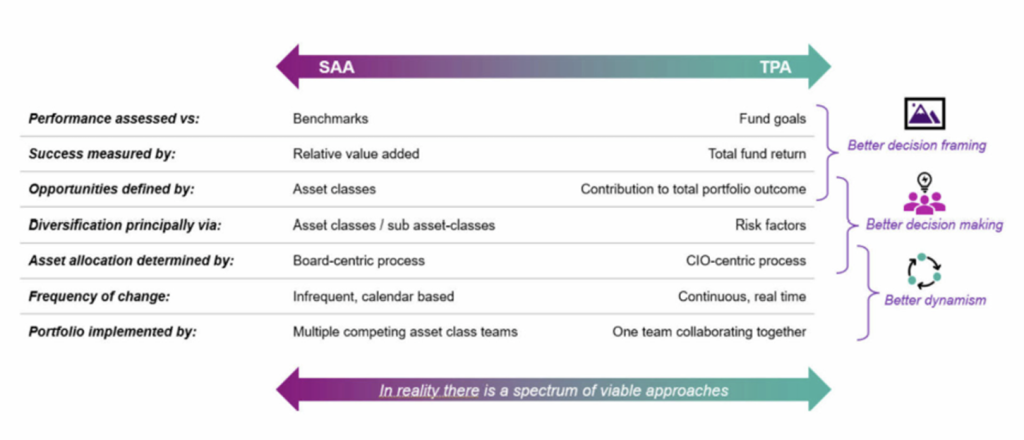
Framework Comparison of TPA to SAA – A Spectrum of Implementation Approaches
Source: CAIA Association.

TIFF’s Perspective: Useful Reminder of Best Practices, Not Revolutionary

TIFF’s view is that total portfolio thinking is fundamentally sound, but not new. Managing risk and capital at the portfolio level is simply good investment practice. In fact, experienced, top-tier investment teams have long considered cross-asset interactions, liquidity constraints, and marginal risk contributions when building portfolios, even if they did not label the process “TPA.”

TPA is a good reminder of portfolio construction best practices, regardless of title. When examining the real-world practices and implementation of TPA, TIFF found the best elements of TPA are already incorporated into our approach.
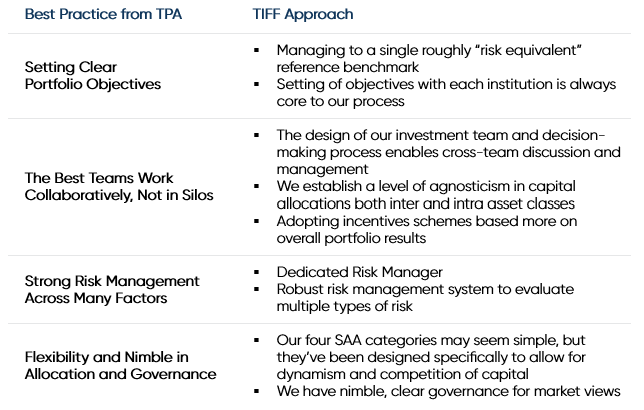
Best Practices from TPA

Limitations of TPA

In theory, TPA aims to be more dynamic and risk-aware than traditional SAA, but in practice it relies on a number of assumptions that don’t always hold up in real-world investing. These include: stable factor relationships, the ability to anticipate changes in volatility (timing the market), and the idea that illiquid positions can be managed with the same flexibility as liquid ones. Most large asset owners eventually find that the approach pushes decision-making away from true investment judgment and toward highly modeled, factor-driven processes that can look precise but are fragile in the face of regime shifts.

We also worry that approaches built around volatility-targeting or factor-optimization can inadvertently constrain returns or lead to many small “wins” followed by occasional large drawdowns, a pattern we’ve seen before in model-heavy frameworks.

Conclusion

The hype over the Total Portfolio Approach offers an important reminder: portfolios should be managed as integrated wholes, not as disconnected parts. TIFF agrees with this principle and practices it in substance. However, we remain skeptical of claims that TPA represents a fundamentally new or superior model that, on its own, delivers better performance.

In our view, TPA is best understood as common sense applied consistently, supported by strong governance, clear objectives, and experienced judgment. When used thoughtfully and pragmatically, total portfolio thinking can enhance decision-making. When treated as a cure-all or a rebranding exercise, it risks overselling what ultimately remains the same timeless challenge—building resilient portfolios that can meet long-term objectives across a wide range of market environments.

Past performance is no guarantee of future results and the opinions presented cannot be viewed as an indicator of future performance. There is no guarantee that any particular asset allocation or mix of strategies will meet your investment objectives.

The materials are being provided for informational purposes only and constitute neither an offer to sell nor a solicitation of an offer to buy securities. These materials also do not constitute investment, legal or tax advice. Opinions expressed herein are those of TIFF and are not a recommendation to buy or sell any securities.

These materials may contain forward-looking statements relating to future events. In some cases, you can identify forward-looking statements by terminology such as “may,” “will,” “should,” “expect,” “plan,” “intend,” “anticipate,” “believe,” “estimate,” “predict,” “potential,” or “continue,” the negative of such terms or other comparable terminology. Although TIFF believes the expectations reflected in the forward-looking statements are reasonable, future results cannot be guaranteed.

Footnotes

  1. https://www.calpers.ca.gov/investments as of January 13, 2026.
How I Invest Podcast – How Sophisticated LPs Evaluate Independent Sponsor Deals

Tom Duffy, Director, Private Market Client Solutions, at TIFF Investment Management, joined the How I Invest Podcast with David Weisburd to discuss TIFF’s strategy of investing alongside independent sponsors over the past decade and share key insights on how this market has evolved over time.

Key takeaways from the conversation:

  • The PE lower middle market remains an attractive and under-capitalized market segment. Given typical deal sizes and the ability to add value through improved strategy and operations, most independent sponsors invest mainly in this segment, yet it represents only a fraction of overall U.S. deal volume.
  • The independent sponsor market blends manager selection with deal selection. In our view, having a purpose-built team with a clear view of what defines an exceptional sponsor is essential for long-term market success.
  • TIFF has experience investing alongside independent sponsors and observing how certain sponsors evolve from deal-by-deal investing to institutional fund structures.

Listen on Apple -> 

Watch on YouTube -> 

Disclaimer: Tom Duffy, CFA, CFP, is a Director, Private Markets at TIFF Investment Management. All views expressed by him on this podcast are solely his opinions and do not reflect the opinions of TIFF. You should not treat any opinions expressed by Tom as a specific endorsement to make a particular investment. References to any securities are for informational purposes only and do not constitute an investment recommendation or offer to provide investment advisory services. Any past performance discussed is not indicative of future results. Please keep in mind that investment in a fund entails a high degree of risk, including the risk of loss. Please note that the ads featured in this podcast are not endorsed by TIFF, and TIFF is not a sponsor of these ads.

How I Invest is hosted by David Weisburd, a Venture Capitalist who has raised over $2B+ in institutional capital and is passionate about connecting Limited Partners (Endowments, Pension Funds, and Family Offices) with General Partners. The podcast, by their definition, interviews the world’s leading institutional investors. 

Past performance is no guarantee of future results and the opinions presented cannot be viewed as an indicator of future performance. There is no guarantee that any particular asset allocation or mix of strategies will meet your investment objectives.

The materials are being provided for informational purposes only and constitute neither an offer to sell nor a solicitation of an offer to buy securities. These materials also do not constitute investment, legal or tax advice. Opinions expressed herein are those of TIFF and are not a recommendation to buy or sell any securities. 

These materials may contain forward-looking statements relating to future events. In some cases, you can identify forward-looking statements by terminology such as “may,” “will,” “should,” “expect,” “plan,” “intend,” “anticipate,” “believe,” “estimate,” “predict,” “potential,” or “continue,” the negative of such terms or other comparable terminology. Although TIFF believes the expectations reflected in the forward-looking statements are reasonable, future results cannot be guaranteed. 

TIFF Investment Management Promotes Four Managing Directors to its Leadership Ranks

Expanded leadership team strengthens TIFF’s ability to deliver deeper expertise, continuity, and strategic insight to their mission-driven clients.

Radnor, PA –January 20, 2026 – TIFF Investment Management, an independent, employee-owned investment firm specializing in OCIO and private markets solutions for mission-driven organizations and sophisticated investors, proudly announces four employees have been named Managing Directors: Brad Calder, Ellen Lieberman, Rick Morgan, and Stephen Williams.

The expanded leadership team brings enhanced capacity to partner closely with investors, anticipate evolving needs, and provide more tailored guidance. Ultimately, these promotions reinforce TIFF’s long-term commitment to thoughtful stewardship and exceptional client service.

Brad Calder (Radnor) joined TIFF in 2015 and leads research and investment strategy across public equity, real estate, arbitrage, and crypto within the marketable portfolio. Prior to TIFF, Brad was a generalist investor at The Wallace Foundation and Lepercq de Neuflize & Co., after early career roles in education and consulting.

Ellen Lieberman (New York) joined TIFF in 2021 and plays a key leadership role in business development, leading relationship management and engagement with current and prospective clients. Prior to joining TIFF, Ellen was with Clearbrook, following leadership roles at Cowen and Convergex.

Rick Morgan, CFA (Boston) joined TIFF in 2019 and focuses on sourcing, diligence, and ongoing portfolio construction across primary, direct, and secondary private market investments. Before TIFF, Rick was on the investment team at New Mountain Capital, a multi-strategy investment firm.

Stephen Williams, CFA (Los Angeles) joined TIFF in 2015 and invests across private equity, venture capital, and secondary investments. Before TIFF, Stephen was with Cogent Partners focused on the secondary market.

“We recognize the significant contributions these individuals have made to TIFF and their continued leadership in advancing our mission-driven culture,” said Kane Brenan, CEO, TIFF Investment Management. “Alongside our existing Managing Directors, they will be instrumental in guiding the firm’s long-term success.”

“Managing Directors are critical to the effectiveness of TIFF’s investment platform, ensuring disciplined research, portfolio construction, and seamless integration with client objectives”, said Jay Willoughby, CIO, TIFF Investment Management. “Ellen, Stephen, Richard, and Brad each contribute specialized expertise that strengthens the connection between our investment process and its implementation across client portfolios.”

About TIFF Investment Management

TIFF Investment Management is an independent, employee-owned investment firm specializing in OCIO services and alternative investment strategies, including private equity, venture capital, and hedge funds. Founded in 1991, with approximately $10B1 in assets under management, TIFF draws on decades of experience to serve nonprofits, family offices, RIAs, and other sophisticated investors. As a certified B CorporationTM2, TIFF embeds accountability, transparency, and sustainability into its operations and investment process. TIFF combines nonprofit expertise with institutional-quality access, partnering with long-term investors to deliver sustainable growth and enduring results that can advance their objectives over time. Learn more at www.tiff.org.

Past performance is no guarantee of future results and the opinions presented cannot be viewed as an indicator of future performance. There is no guarantee that any particular asset allocation or mix of strategies will meet your investment objectives.

The materials are being provided for informational purposes only and constitute neither an offer to sell nor a solicitation of an offer to buy securities. These materials also do not constitute investment, legal or tax advice. Opinions expressed herein are those of TIFF and are not a recommendation to buy or sell any securities.

These materials may contain forward-looking statements relating to future events. In some cases, you can identify forward-looking statements by terminology such as “may,” “will,” “should,” “expect,” “plan,” “intend,” “anticipate,” “believe,” “estimate,” “predict,” “potential,” or “continue,” the negative of such terms or other comparable terminology. Although TIFF believes the expectations reflected in the forward-looking statements are reasonable, future results cannot be guaranteed.

Footnotes

  1. TIFF assets under management (AUM) is as of 9/30/25 and includes discretionary and non-discretionary client assets for which TIFF affiliates provide investment management or advisory services. The private markets portion of TIFF AUM is calculated based upon fund net asset value plus unfunded commitments. Calculation of TIFF AUM differs from the calculation of regulatory assets under management in TIFF’s Form ADV filings with the SEC and may differ from the AUM calculation methodologies used by other investment managers.

  2. B Lab is the independent third party that certifies companies as B Corporations when they meet rigorous standards of social and environmental performance, accountability, and transparency. B Lab certified TIFF Advisory Services, LLC as a B Corporation on September 12, 2025. To remain certified, B Corporations must update and verify their information every three years.