Executive Summary
- Universities and colleges with endowments above $1B that have announced FY26 results returned 19.3% on average, beating the 17.6% return of a 70% MSCI ACWI / 30% Bloomberg Agg benchmark and marking a third straight year of double-digit gains.
- Returns were unusually far apart, and the best results were the highest since FY21.
- Venture capital, and SpaceX in particular, drove the top results: The University of North Carolina (UNC) and Washington University in St. Louis (WashU) each returned about 37% and credited roughly half of their gains to SpaceX (plus Cerebras for WashU).
- Strong public equity markets, a broader AI trade, hedge funds, and commodities added to returns against meager fixed income returns.
- SpaceX rewarded patient investors, some of whom waited 17 years, but it has left some portfolios with large, volatile positions they cannot yet sell or rebalance.
Overview
In addition to leaf peeping season, the fall is when the biggest university endowments (those with over $1B) share their annual investment results. From these early reports, we can understand what drove performance in FY26 portfolios, ahead of the full NACUBO-Commonfund Study of Endowments, which comes out in February 2027.
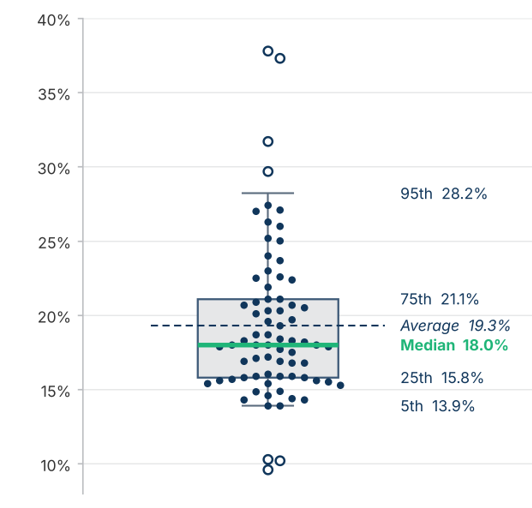
The average return of $1B+ university and college endowments that publicly announce was 19.3% vs. 17.6% for the 70% MSCI ACWI / 30% Bloomberg Agg. This represents the third consecutive year of double-digit gains, following a 10.9% and 11.2% average 1-year performance for all institutions in FY25 and FY24, respectively, per the NACUBO-Commonfund Study of Endowments. The 3-year average return stands at 13.7%1, a marked change from FY22’s -8.0%. A smaller number of sub-$1B universities and colleges also publicly announced, with an average return of 14.7%.
FY26 Endowment Returns Overview
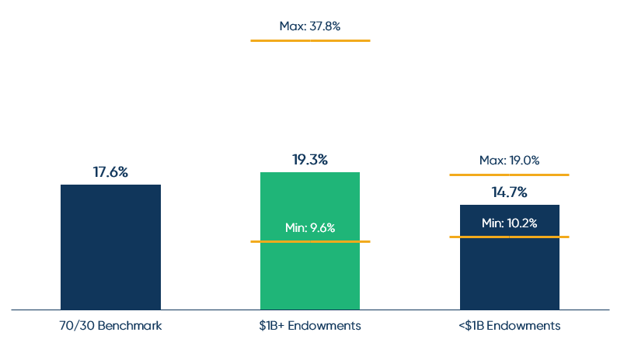
What is remarkable about this year’s returns is the wide dispersion and the highs of the best performers. Typically, we see a tighter range among institutions; this phenomenon will be discussed later and its primary driver (hint, it rhymes with SmaceX). We have not seen highs like this since FY21, when NACUBO 1-year was 30.6% for all institutions. However, we would note there is a strong clustering of returns.
FY26 Endowment Return Dispersion
What Is Driving the Returns?
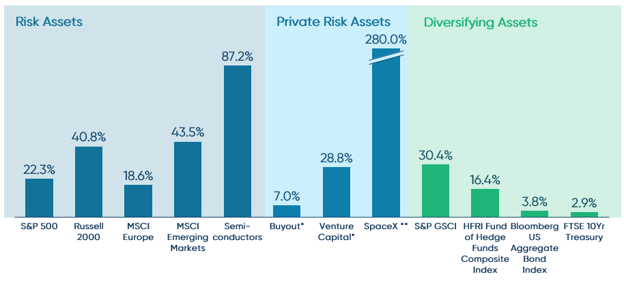
- Equity-oriented portfolios performed well as equity markets broadly returned double-digit returns, offsetting a meager year for fixed income. In equity markets, there was broad-based market strengthening, allowing many strategies to perform well. There were few bad choices in public equities, only relatively better choices, including emerging markets, biotech, and tech.
- Venture, in particular SpaceX, exposure led to top performance. Venture capital, in particular SpaceX, was a key performance driver in FY26. Most of the eye-popping performance numbers 37%+ were at least partially attributed to SpaceX exposure, which has been estimated to have returned 280%.2 Venture capital broadly had a strong year with industry numbers estimating 28.8%.
- AI theme continued to drive equity markets. Similar to last year, portfolios with exposure to AI-related themes outperformed, though this year the trade expanded to the entire AI value chain, such as semiconductors.
- Hedge funds provided uncorrelated returns to bonds. Hedge funds continued their strong outperformance over bonds. The diversification of strategies performed well in a highly dispersed, volatile equity market and active capital markets.
- Commodities delivered in a volatile market. Commodities increased on the back of an oil supply shock due to the conflict in the Middle East paired with increased demand from AI and data centers. This included both energy and metals.
FY26 Asset Class Returns
How Did Individual Endowments Do?
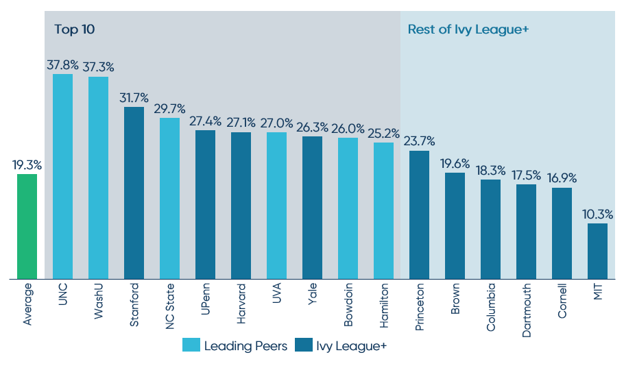
The top 10 performers include a wide array of universities, from public and private institutions to those with mid-sized and large endowments. UNC took the top spot with WashU a very close second. Each reported eye-popping returns of 37%+. The Ivy League and other renowned private endowments returned above the total group average (21.9% vs. 19.3%), while private universities outpaced public universities (20.9% vs. 18.2%).
FY26 $1B+ Individual Institutions Publicly Announced Endowment Returns
The SpaceX Factor
SpaceX had unprecedented impact in FY26. In modern history, we have not had a singular company have such an influence on endowment performance and markets. With its $75B initial public offering (IPO) on June 11, SpaceX became the largest IPO in history, roughly 3x the prior record of Saudi Aramco ($25.6B) in 2019.
Both top performers, UNC and WashU, noted SpaceX was responsible for a meaningful portion of their performance. UNC reported about half of its 37.8% growth came from SpaceX alone.3 In other words, without that one investment, UNC would have returned approximately 19%, or the average for the $1B+ cohort. Similarly, WashU stated that SpaceX and Cerebras accounted for about half of its 37.3% growth.4
Three points stood out to us, in addition to the original point on the unusual nature of SpaceX’s level of impact:
- SpaceX represents the long-term vision for certain illiquid investments: SpaceX represented almost two decades of waiting and required a long-term view on capital. Both UNC and the University of Colorado invested in 2009, with original investments of $2M5 and $150K6. Stefan Strein, President of UNC Management Company, summarized it best: “We have the ability to lock up capital for a very long time, giving us the opportunity to harvest off illiquid investments. SpaceX is a great example of that. We made that initial investment with a venture capital fund in 2009, and 17 years later, we are now harvesting an enormous gain on that investment.”7
- Investors obtained exposure through both venture capital funds and through direct private purchases: As expected, venture capital funds were important facilitators of investments in SpaceX. Founders Fund was the largest venture capital owner, with its 5%+ combined ownership requiring public disclosure via an SEC 13G filing. Interestingly, direct, private SpaceX purchases pre-IPO were also a source of exposure. Certain investors were presumed to have bought shares pre-IPO, including the University of California (9.8M shares) and Harvard University (12.9M shares) as reported in their June 30, 2026 13Fs.
- Unintended consequences – illiquid concentration: SpaceX’s success means it may have grown into outsized positions in certain portfolios. Although SpaceX is now publicly traded, these shares are not immediately liquid, either due to IPO lock-ups or ownership via venture capital funds. The result is an unusual problem: an illiquid, concentrated position in a volatile single stock. With no way to rebalance, certain portfolios will be at the mercy of markets and SpaceX stock price. The stock fell 16% from its first trade to October 30 and is down 36% from its June peak. As Scott Wilson, Chief Investment Officer of Washington University Investment Management Company, put it: “It’s a high-class problem, but it is just a problem. We want a diversified portfolio, and having more than 10% of our assets in one stock is not something we want long-term.”8
The materials are being provided for informational purposes only and constitute neither an offer to sell nor a solicitation of an offer to buy securities. These materials also do not constitute an offer or advertisement of TIFF’s investment advisory services or investment, legal or tax advice. Opinions expressed herein are those of TIFF and are not a recommendation to buy or sell any securities.
These materials may contain forward-looking statements relating to future events. In some cases, you can identify forward-looking statements by terminology such as “may,” “will,” “should,” “expect,” “plan,” “intend,” “anticipate,” “believe,” “estimate,” “predict,” “potential,” or “continue,” the negative of such terms or other comparable terminology. Although TIFF believes the expectations reflected in the forward-looking statements are reasonable, future results cannot be guaranteed.
Footnotes
Calculated using the $1B+ FY26 average of 19.3%, and the FY25 and FY24 NACUBO all institutions 1 year average. NACUBO-Commonfund Study of Endowments.
As estimated by Markov Processes; Before the Disclosure: Identifying SpaceX Exposure in Elite Endowments | Markov Processes International.
SpaceX Stake Adds $2 Billion to Washington University Endowment Returns – Bloomberg.
University of Colorado Foundation Investment Update June 30, 2026.
Inside WashU’s SpaceX investment and its impact – Student Life.